
EIGRP Questions 5
Here you will find answers to EIGRP Questions – Part 5
Question 1
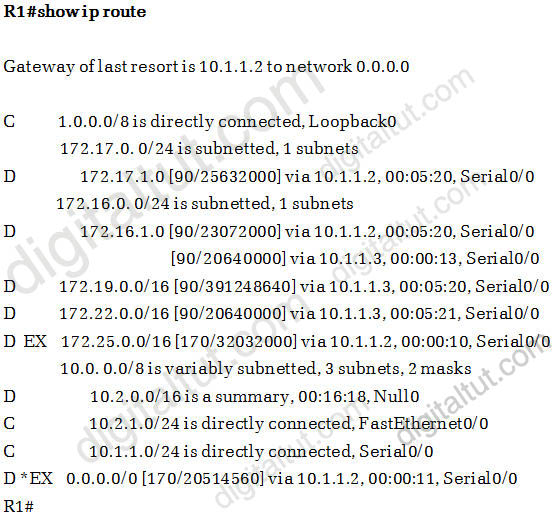
Which three descriptions are correct based on the exhibited output? (Choose three)
A. R1 is configured with the variance command.
B. The route to 10.2.0.0/16 was redistributed into EIGRP.
C. A default route has been redistributed into the EIGRP autonomous system.
D. R1 is configured with the ip summary-address command.
Answer: A C D
Explanation
From the routing table above, we see that network 172.16.1. can be reached via 2 unequal paths (with FD of 23072000 & 20640000) so surely R1 has been configured with the “variance” command -> A is correct.
By configuring a default route and redistribute it into EIGRP you will get the line “D *EX 0.0.0.0/0 …” line in the routing table of that router -> C is correct.
From the line “10.2.0.0/16 is a summary, 00:16:18, Null0″ we know that this network has been summarized with the “ip summaray-address” command (notice that 10.2.0.0 is not the major network of net-> D is correct.
Question 2
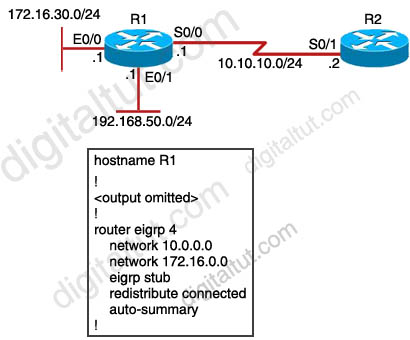
Refer to the exhibit. Which two statements are true? (Choose two)
A. The eigrp stub command prevents queries from being sent from R2 to R1.
B. The eigrp stub command will automatically enable summarization of routes on R2.
C. The eigrp stub command prevents all routes except a default route from being advertised to R1.
D. Router R1 will advertise connected and summary routes only.
E. Router R1 will advertise connected and static routes. The sending of summary routes will not be permitted.
F. Router R1 is configured as a receive-only neighbor and will not send any connected, static or summary routes.
Answer: A D
Explanation
The command “eigrp stub” turns R1 into a stub router so R2 will never send any query to R1 because R2 knows that a stub router will only route packets for networks it has explicitly advertised -> A is correct.
The command “eigrp stub” is same as “eigrp stub connected summary” command because connected and summarized routes are advertised by default -> D is correct.
Note: Because the network 192.168.50.0 is not advertised by “network” statement, it is necessary to redistribute connected route with the “redistribute connected” command.
Question 3
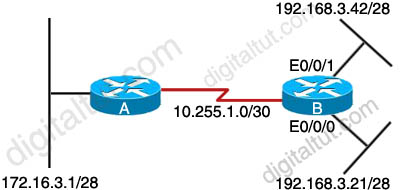
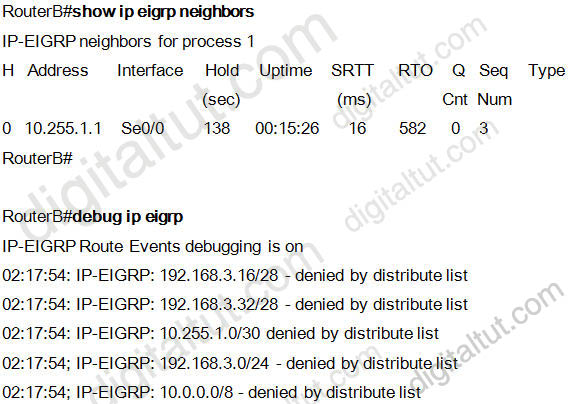
Refer to the exhibits. Router B should advertise the network connected to the E0/0/0 interface to router A and block all other network advertisements. The IP routing table on router A indicates that it is not receiving this prefix from router B.
What is the probable cause of the problem?
A. An access list on router B is causing the 192.168.3.16/28 network to be denied.
B. An access list on router B is causing the 192.168.3.32/28 network to be denied.
C. The distribute list on router B is referencing a numbered access list that does not exist on router B.
D. The distribute list on router B is referencing the wrong interface.
Answer: A
Explanation
This is an unclear question. The question says “Router B should advertise the network connected to the E0/0/0 interface to router A and block all other network advertisements. The IP routing table on router A indicates that it is not receiving this prefix from router B.” That means the network 192.168.3.16/28 (including the IP 192.168.3.21/28) is not received on router A -> A is the most suitable answer.
Note: Distribute list are used to filter routing updates and they are based on access lists.
Question 4
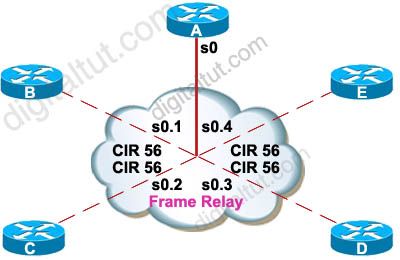
Study the exhibit carefully. What must be done on router A in order to make EIGRP work effectively in a Frame Relay multipoint environment?
A. Issue the command bandwidth 56 on the physical interface.
B. Issue the command bandwidth 56 on each subinterface.
C. Issue the command bandwidth 224 on each subinterface.
D. Issue the command bandwidth 224 on the physical interface.
Answer: D
Explanation
In Frame Relay, all neighbors share the same bandwidth, regardless of the actual CIR of each individual PVC. In this case the CIR of each PVC is the same so we can find the bandwidth of the main interface (multipoint connection interface) by 56 x 4 = 224.
Notice that if the bandwidth on each PVC is not equal then we get the lowest bandwidth to multiply.
Question 5
Refer to the exhibit. ROUTE Enterprises has many stub networks in their enterprise network, such as router B and its associated network. EIGRP is to be implemented on router A so that neither the prefix for the S/0/0/0 interface nor the prefixes from router B appear in the routing tables for the router in the enterprise network.
Which action will accomplish this goal?

A. Declare router B a stub router using the eigrp stub command.
B. Use the passive-interface command for interface Serial0/0/0.
C. Use a mask with the network command to exclude interface Serial0/0/0.
D. Implement a distribute list to exclude the link prefix from the routing updates.
Answer: C
Explanation
If we declare router B a stub router then the routers in Enterprise Network still learn about the network for S0/0/0 interface and the network behind router B -> A is not correct.
If we use the passive-interface command on s0/0/0 interface then router A & B can not become neighbor because they don’t exchange hello messages -> A can not send traffic to the network behind B -> B is not correct.
Theoretically, we can use a distribute list to exclude both the link prefix and the prefix from router B but it is not efficient because:
+ We have many stub networks so we will need a “long” distribute list.
+ We declare networks in stub routers (like router B) while filter them out at router A -> it is a waste.
I am not totally sure about answer C because if we “use a mask with the network command to exclude interface Serial0/0/0″ then router A and B can not become neighbors and the situation is same as answer B. But from many discussions about this question, maybe C is the best answer.
Question 6
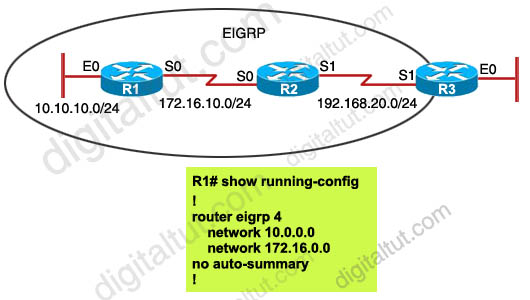
Refer to the exhibit. EIGRP is configured with the default configuration on all routers. Autosummarization is enabled on routers R2 and R3, but it is disabled on router R1. Which two EIGRP routes will be seen in the routing table of router R3? (Choose two)
A. 10.0.0.0/8
B. 10.10.0.0/16
C. 10.10.10.0/24
D. 172.16.0.0/16
E. 172.16.0.0/24
F. 172.16.10.0/24
Answer: C D
Explanation
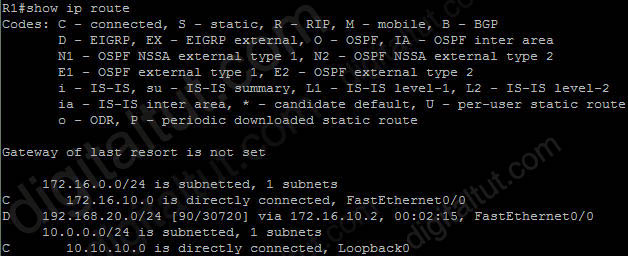
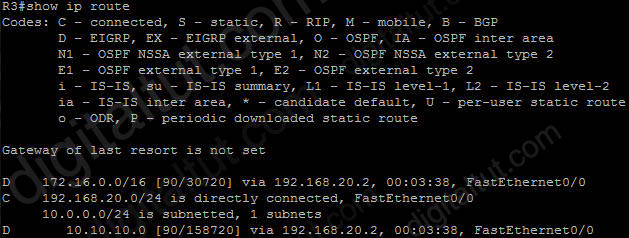
EIGRP performs an auto-summarization each time it crosses a border between two different major networks. In this case all different networks are in different major networks so EIGRP will perform auto-summarization when it exits an interface. But R1 has been configured with “no auto-summary” command so EIGRP will not summarize on S0 interface of R1. So the routing table of R2 will have the network 10.10.10.0/24 (not be summarized).
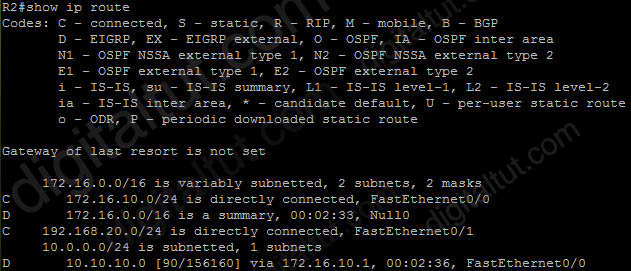
When exiting S1 interface of R2, EIGRP summarizes network 172.16.10.0/24 into the major 172.16.0.0/16 network but it does not summarize network 10.10.10.0/24 because it is not directly connected with this network. Therefore in the routing table of R3 there will have:
+ Network 10.10.10.0/24 ( not summarized)
+ Network 172.16.0.0/16 (summarized)
-> C and D are correct.
Note: I simulated this question on GNS3, you can see the final outputs of the “show ip route” commands on these routers (I connected these routers via FastEthernet, not Serial interfaces so the outputs are slightly different but the main points are not changed).
Question 7
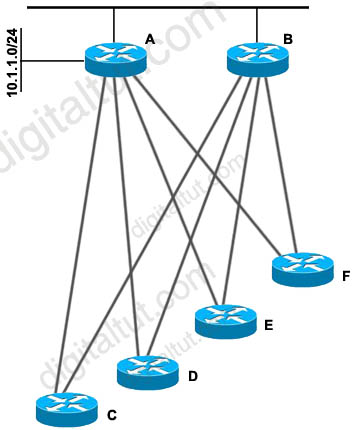
Refer to the exhibit. In a redundant hub-and-spoke deployment using EIGRP, what feature can be used to ensure that routers C through F are not used as transit routers for data traveling from router B to network 10.1.1.0?
A. Use address summarization at routers C, D. E, and F.
B. Use the EIGRP Stub feature on routers C, D, E, and F.
C. Use passive-interface on the spoke links in routers A and B.
D. Change the administrative distance in routers A and B for routes learned from routers Cr D. E, and F.
Answer: B
Explanation
By configuring “stub” feature on routers C D E and F, routers A and B will not try to transit traffic through these routers. For example, if the network connecting from routers A and B is down, router B will not send to network 10.1.1.0/24 from router B -> routerC/D/E/F -> router A -> network 10.1.1.0/24.
Question 8
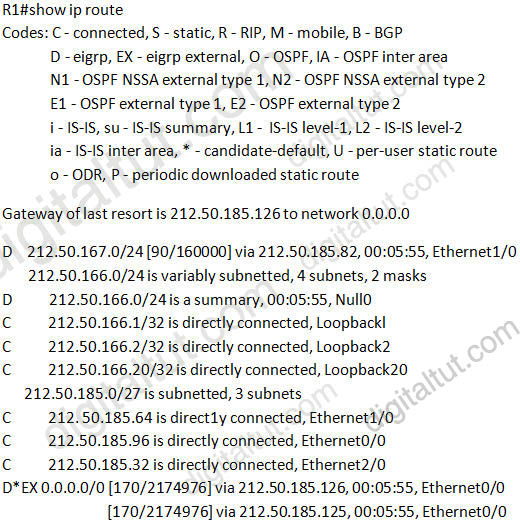
Refer to the exhibit. How would you confirm on R1 that load balancing is actually occurring on the default-network (0.0.0.0)?
A. Use ping and the show ip route command to confirm the timers for each default network resets to 0.
B. Load balancing does not occur over default networks; the second route will only be used for failover.
C. Use an extended ping along with repeated show ip route commands to confirm the gateway of last resort address toggles back and forth.
D. Use the traceroute command to an address that is not explicitly in the routing table.
Answer: D
Explanation
The most simple method to test load balancing is to use the “traceroute” command. If load balancing is working correctly, we will see different paths to reach the destination each time we use that command.
Unknown address will be routed via the default-network 0.0.0.0 so we must use an address that is not explicitly in the routing table.
Question 9
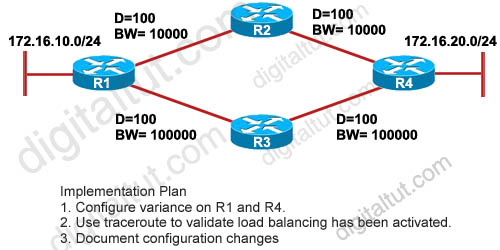
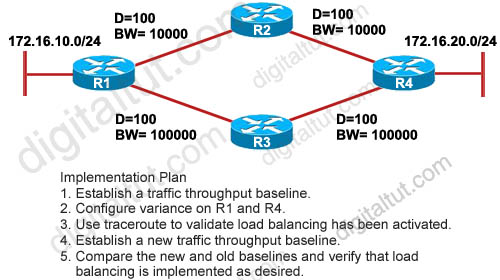
Refer to the exhibit. ROUTE.com is planning to implement load balancing for traffic between host on the 172.16.10.0/24 and 172.16.20./24 networks. You have been asked to review the implementation plan for this project. Which statement about the plan is true?
A. It is complete as written.
B. It should include a task to configure EIGRP multipath equal to 2 on R1 and R4.
C. It should include a task to implement OSPF because it handles unequal cost load balancing most efficiently using variance.
D. It should include a task that establishes a baseline before and after the configuration has been changed.
Answer: D
Explanation
A complete implementation plan should be:
1. Configure variance on R1 and R4
2. Use traceroute to validate load balancing has been activated
3. Document configuration changes
4. Establish a new traffic throughput baseline
5. Compare the new and old baselines and verify that load balancing is implemented as desired.
Question 10
Refer to the exhibit. ROUTE.com is planning to implement load balancing for traffic between host on the 172.16.10.0/24 and 172.16.20./24 networks. You have been asked to review the implementation plan for this project. Which statement about the plan is true?
A. It is complete as written.
B. It should include a task to configure multipath to equal a value of 2 on R1 and R4.
C. It should use a ping instead of a traceroute to validate that load balancing has been activated.
D. It should contain a task that documents the changes made to the configurations.
Answer: D
Explanation
Same as questions 9
Question 11
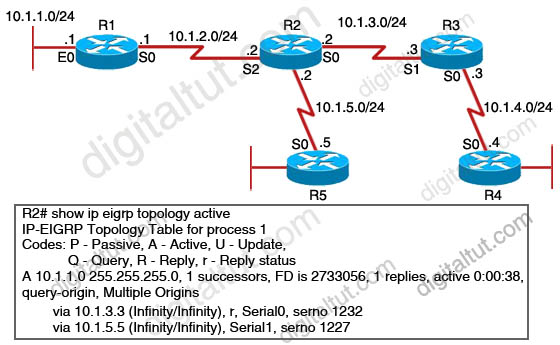
Refer to the exhibit. EIGRP had converged in AS 1 when the link between router R1 and R2 went down. The console on router R2 generated the following messages:
| *Mar 20 12:12:06: %DUAL-5-NBRCHANGE: IP-EIGRP 1: Neighbor 10.1.4.3 (Serial0) is down: stuck in active *Mar 20 12:15:23: %DUAL-3-SIA: Route 10.1.1.0/24 stuck-in-active state in IP-EIGRP 1. Cleaning up |
The network administrator issued the show ip eigrp topology active command on R2 to check the status of the EIGRP network. Which statement best describes the reason for the error messages?
A. Incorrect bandwidth configuration on router R3 prevents R2 from establishing neighbor adjacency.
B. Incorrect bandwidth configuration on router R5 prevents R2 from establishing neighbor adjacency.
C. Router R3 did not reply to the query about network 10.1.1.0/24 sent by router R2.
D. Router R5 did not reply to the query about network 10.1.1.0/24 sent by router R2.
Answer: C
Explanation
When the link between R1 and R2 is down, R2 loses its successor for the network 10.1.1.0/24. R2 checks its topology table for a feasible successor but it can’t find one. So R2 goes active on the that route to find a new successor by sending queries out to its neighbors (R3 and R5) requesting a path to the lost route. Both R3 and R5 also go “active” for the that route. But R5 doesn’t have any neighbor to ask besides R2 so it will send an “unreachable message” to indicate it has no alternative path for that route and has no other neighbor to query. R3 also checks its EIRGP topology table for a feasible successor but it has none, too. Unlike R5, R3 has a neighbor (R4) so it continues to query this router.
Now suppose there is a problem on the link between R3 and R4 so R4 never receives the query from R3 and of course, R3 also never receives a reply back from R4. Therefore, R3 can’t reply back to R2. After about 3 minutes, the “Stuck in active” (SIA) timer on R2 expires and R2 marks the route 10.1.1.0/24 as “stuck in active” route.
The output line “via 10.1.3.3 (Infinity/Infinity), r, Seiral0, serno 1232″ indicates R2 has sent a query to 10.1.3.3 and is waiting for a reply (the lowercase r) -> C is correct.
(Reference: http://www.cisco.com/en/US/tech/tk365/technologies_tech_note09186a008010f016.shtml)
Question 12
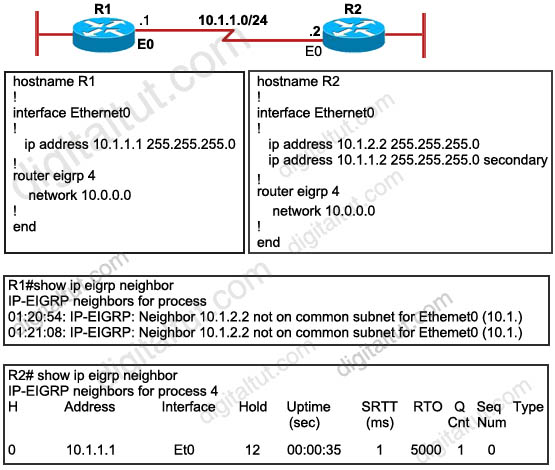
Refer to the exhibit. EIGRP has been configured on routers R1 and R2. However, R1 does not show R2 as a neighbor and does not accept routing updates from R2. What could be the cause of the problem?
A. The no auto-summary command has not been issued under the EIGRP process on both routers.
B. Interface E0 on router R1 has not been configured with a secondary IP address of 10.1.2.1/24.
C. EIGRP cannot exchange routing updates with a neighbor’s router interface that is configured with two IP addresses.
D. EIGRP cannot form neighbor relationship and exchange routing updates with a secondary address.
Answer: D
Explanation
EIGRP updates always use the primary IP address of the outgoing interface as the source address. In this case R2 will use the 10.1.2.2/24 address, which is not in the same subnet of R1, to send EIGRP update to R1. Therefore R1 does not accept this update and generates the “not on common subnet” error message.
Answer D is a bit unclear. It should state that “EIGRP cannot form neighbor relationship and exchange routing updates if the two primary addresses on two routers are not in the same subnet”.
Notice that although R1 does not accept R2 as its EIGRP neighbors but R2 accepts R1 as its EIGRP neighbor accepts R1 hello packets..
For more information about this problem, please read http://www.cisco.com/en/US/tech/tk365/technologies_configuration_example09186a0080093f09.shtml.
Question 13
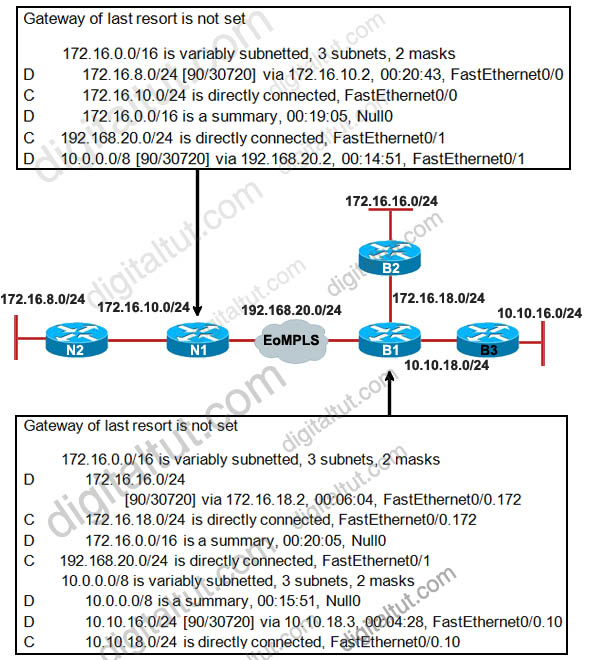
Refer to the exhibit. A Boston company bought the assets of a New York company and is trying to route traffic between the two data networks using EIGRP over EoMPLS. As a network consultant, you were asked to verify the interoperability of the two networks.
From the show ip route command output, what can you tell the customer about the traffic flow between the subnet in New York (172.16.8.0/24) and the subnets in Boston (172.16.16.0/24 and 10.10.16.0/24)?
A. Traffic is flowing between the 172.16.8.0 subnet and subnets 172.16.16.0 and 10.10.16.0 and no configuration changes are needed.
B. Auto-summary must be disabled on N1 and B1 before traffic can flow between the 172.16.8.0 subnet and subnets 172.16.16.0 and 10.10.16.0.
C. Traffic will flow between the 172.16.8.0 subnet and 172.16.16.0 without any further configuration changes. However, auto-summary must be disabled on N1 and B1 before traffic can flow between the 172.16.8.0 subnet and the 10.10.16.0 subnet.
D. Auto-summary must be disabled on N1 and B1 before traffic can flow between the 172.16.8.0 subnet and the 172.16.16.0 subnet. However, traffic will flow between the 172.16.8.0 subnet and 10.10.16.0 without any further configuration changes.
Answer: B
Question 14
Refer to the exhibit. A Boston company bought the assets of a New York company and is trying to route traffic between the two data networks using EIGRP. The show command output shows that traffic will not flow between the networks. As a network consultant, you were asked to modify the configuration and certify the interoperability of the two networks. For traffic to flow from subnet 172.16.8.0/24 to the 172.16.16.0/24 subnet, which configuration change do you recommend?
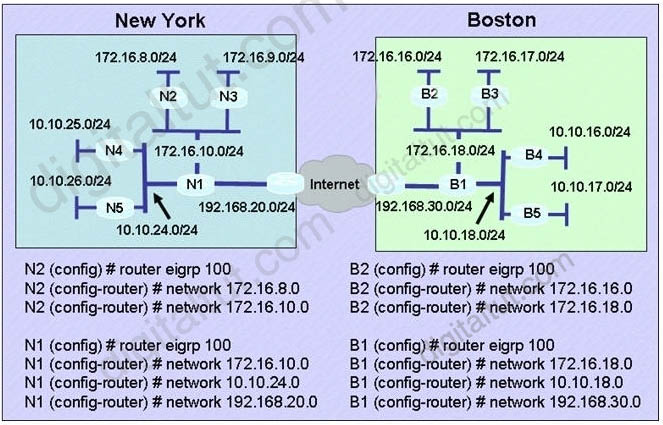
A. Turn off autosummarization on routers N1 and B1.
B. Add IP summary addresses to the Internet-pointing interfaces of routers N1 and B1.
C. Turn off autosummarization on routers N2 and B2.
D. Add wildcard masks to the network commands on routers N2 and B2.
Answer: A

Q5: as far as B and C options give the same result (no nei), D is correct.
@qrsa
not really. B is not correct because prefix for interface s0/0/0 will still be advertised which is not something we need in this task. With option D you could achive the same result as with C but the solution is much more complicated and requires the router to do unnecessary operations.
Oh, sorry. It says “D. Implement a distribute list to exclude the link prefix from the routing updates.” which means that you it does not filter prefixes from router B. This option is definitely incorrect!
Q5 I think the answer is D
so what is the correct answer ?
The correct answer is D. B is a stub router so it does not send any update to A so the Enterprise network does not see any network behind B. If the distribute-list is configured under the interface connected to the Enterprise network, it will not break the flow of hello to router B but will filter s0/0/0 prefix from it’s update towar the next hop router to the Enterprise network.
even if B is stub router , the command eigrp stub = eigrp stub connected summary so it will send connected and summerized routes , so i think the correct answer is C
@ Chris. By using option ‘C’ you will break neighbour relationship.
Correct answer should be ‘D’
I am getting really scared with EIGRP.
When u r scared see video tutorial that will really help
are this still the offizially questions?
I still don’t get Q14… I would say Turn off autosummarization on N2 and B2… those are the ones advertising 172.16.8.0/24 and 172.16.16.0/24 subnets…
Thanks ;)
at bruno
autosummarisation will occur only over different major networks. A is deffo correct!
#1 and `14 were on my test
Hello Friends,
I just started to study the ROUTE test after taking almost two years off from passing the CCNA. I am planning to take the ROUTE test in two months. Are the Sims, Drag and Drop, Questions, and everything else on this site still valid for the ROUTE test?
Thank you all!
Can someone explain q7 on this page.thanks.
@ccnp
By configuring router c -f as a stub they will not advertise network update, it will just keep receiving data that RA and RB send them. Therefore if the link between RA and RB goes down there will be network connectivity between those 2 router, but they can still communicate between Router C – F.
@bunso,thanks for the reply.
Could anyone provide link for implementation plan self-study? it’s in queestion 9?
for question 5,optin a looks me valid .i dnt know why you guys select c?
Question 5. Answer would be D to use a distribute list.
You have to remember the question says there are many stub networks and you would still want those stub networks to talk to each other.
If you choose C you will have no eigrp neighborships and the stub networks wont be able to communicate.
If you implement a distribute-list in eigrp for outbound traffic going to the Enterprise Network you will stop them from learning about the stubs (like Router B).
As far as the length of the distribute-list, if you are using a hierarchical address scheme you might only need to block mask of addresses.
FOR EXAMPLE:
If you had the stub networks 10.0.0.0/24, 10.0.1.0/24, 10.0.2.0/24 and Router A connected to the Enterprise network using FastEthernet0/1 (network 192.168.1.0/24):
A(config)#access-list 9 deny 10.0.0.0 0.0.3.255
A(config)#router eigrp 1
A(config-router)#network 192.168.1.0
A(config-router)#network 10.0.0.0 0.0.3.255
A(config-router)#distribute-list 9 out fastethernet0/1
All stubs would still be able to route to each other through Router A but Enterprise Network is oblivious.
for question 14 ,if summary is off on N1 & B1,while enable on N2 & B2 ,then these two routers N2 & B2 will advertise 172.16.0.0 despite of 172.16.8.0 & 172.16.16.0 .so why not C???????
FOR QUESTION 13,I THINK ANSWER SHOULD BE D
@furqan
Hi, I thought the same thing about question 13 but 172.16.8.0 subnet and 10.10.16.0 subnet will not be able to talk both ways without ‘no auto-summary’ on.
172.16.8.0 can get to the 10.10.16.0 network but the routing table on B1 does not know how to get back. B1 only knows to sent 172.16.0.0/16 traffic up to B2.
The wording of answer B also confused me at first but it means ‘without no auto-summary traffic won’t be able to pass between 172.16.8.0 and 172.16.16.0 subnets AND 172.16.8.0 and 10.10.16.0 subnets.
If you lab the question in GNS3 you can verify all this pretty easily with a few pings.
@furqan
Hi Furqan,
Regarding question 14 you can see question 6 of EIGRP QUESTIONS 2 (http://www.digitaltut.com/eigrp-questions-2).
The trick is EIGRP will only summarise across CLASSFUL network boundaries. So the 172.16.8.0/24 route is only going to be summarised to 172.16.0.0/16 when it is passed onto a 192.168.0.0 network OR a 10.0.0.0 network.
So summarisation only occurs when the routes hit Routers N1 and B1 because it is crossing over into a 192.168.0.0 network.
Hope that helps!
For Q5
I think c is correct.
in the question, it didn’t say that router B must run EIGRP. but router A must run EIGRP. the simplest way to achieve the goal of “neither the prefix for the S/0/0/0 interface nor the prefixes from router B appear in the routing tables for the router in the enterprise network” is that do not “network” the s0/0/0 network on Router A.
so, no network ‘s0/0/0 network’ under EIGRP on router A ==== option C
option A is incorrect for sure
option D is not efficient as we discussed above
for option B, if we “network” the s0/0/0 on router A, then passive the s0/0/0 interface, in this question, it is the same as not to “network” the s0/0/0 network. and i think C is another way of saying this. so B is not efficient as well.
this is my opinion, tell me if i am wrong
You may use a cssvrooer cable to connect two PC’s Network interfaces in order to create simple peer to peer network or to share Internet connectivity.etc..The same method goes for a router Ethernet interface and a PC Ethernet interface by using a cssvrooer cable as well as all end devices such as Printers.This is a simple layer 1 concept:1. 10/100 Ethernet cables have 8 wires, of which 4 are used for data; one pair for receiving and other pair for sending.2. Hubs and Switches relays all the data from the Transmit pairs to the Receive pairs.3. A cssvrooer cable has it’s send and receive wires crossed.4. Routers Ethernet interfaces DO NOT function as Switch or Hub interfaces. That why there functionality similar to PC interfaces in term of layer 1 functionality and signalling.5. In general, routers and PCs cannot be connected by a straight-through cables.6. straight-through cables used in:Host to SwitchHost to HubRouter to switchRouter to hubSwitch to Switch (If the Switchs has Auto-MDIX)7. Crossover cable used in:Host to hostHost to routerSwitch to Switch (If the Switchs has no Auto-MDIX).
Question 5
B is not correct. If you enable passive-interface command then the prefix configured on se0/0/0 will still be advertised to the Enterprise Networks. Definitely not correct. I would go for C.
@Leo @Mariano on Q5,
I think option D is still the most sensible choice for Q5. Option D can be efficient if you use a good IP addressing scheme (see my example above on February 19th, 2012).
I still think the question is saying there are other stubs sticking off router A which would need to share routes and communicate still.
Regardless of that though, it also says to implement EIGRP on Router A “so that neither the prefix for the S/0/0/0 interface nor the prefixes from router B appear in the routing tables for the router in the enterprise network.”
This sentence is written from the perspective of router A, saying router A’s S0/0/0 interface and router A’s prefixes from router B cannot appear in the routing table in the enterprise network.
To get the prefixes from Router B into Router A we need to have EIGRP running and include the s0/0/0 interface in our network statements. We just need to block the routes from going to the enterprise network which is what a distribute list is made to do.
Why would a question about configuring EIGRP involve turning it off?
Dirraan on Question 5,
If we take option D literally it only says “to exclude the link prefix” (serial link to B) so option D is not considering the networks on B. I would choose C again.
Despite the fact that we would like to rise EIGRP between A and B :) , the problem doesn’t say anything about it. If neighboring between A and B would be a condition, then a complete distribute list would be the best choice as you said BUT is not among the options.
@Mariano
When they say “link prefix” for option D I am assuming they are talking about the same prefix mask you would use in the network command (option C). If you excluded that same prefix mask from the network command, the neighborship would fail. I would bet a dollar the answer should be option D.
Q5 – it MUST be a D – a distribute list as their sole purpose is to filter out advertised routes – every other option prevents neighborship or does not work. D for sure
also remember we assume this network was properly built and that router’s other networks would be subnets of the link prefix, right? Any enterprise stub is gonna be like 10.10.1.0 and then each stublet 10.10.2.0, etc, as it is proper design and the question noted no addressing flaws. Yea the question is flawed cause it doesnt really get detailed enough but C would prevent EIGRP functionality on that link altogether and if that would be an acceptable outcome then the proper move is to use the passive-interface command to simplify the config – C just doesnt make any sense unless we know there are other parts of that same supernet that we still wanna participate on
I think C is correct because:
A as explained above. If choose B, then if a network statement is in use, Router A and B does not form Neighbor relationship, but the activated interface is still propagated to the enterprise network. If choosing B without a network statement you can use Answer C instead… so B would also be inefficient. And D simply descripes to exclude the “link” prefix, but what about the network (in question: prefixe”s”) on the other side of Router B.
Answer C is the easiest way to exclude all prefixes from Router A to be propagated to the Enterprise. There is no: what about eigrp on B or so…( is there eigrp or not??, it is only as shown a physically stub router) maybe A and B will form OSPF or anything else to talk together to be reachable.
Q5.
Correct answer – D.
we can configure distribute-list under eigrp process (not specifying interface), and it will not send for any interface
yeah im going for D tomorrow.
i can’t get q 9, i can see the cost between r1 and r4 is equal so why would i use variance ? isn’t it an equal load balance
Hey on the wheelman test ther is a question — “A network admin is managing a hub-and-spoke network with EIGRP routing that has been enabled. The hub router is trying to query a remote router. However, delays are occurring that are caused by certain paths being stuck in active (SIA). How should the admin configure EIGRP in order to limit the scope of the query range and prevent SIA from occurring?
A. Configure the hub router with a scope limit of 1.
B.Configure the remote router with a scope limit of 1.
C.Configure the hub to indicate that the remote router is a stub router.
D.Configure the hub and remote router as stub routers.
E.Configure the remote router as a stub router.
F.Disable the SIA feature of EIGRP on the remote router.
It says the answer is “E”.
That has to be wrong since the Concept of STUBS is only an OSPF thing, not an EIGRP. Any thoughts???? thanks
Never mind . My training sucks and they never went over EIGRP stubs.
I guess you learn something new every day.
Hi guys! I hope from you to visit my blog and I offer a free Cisco Learning Videos in CCNA and CCNP level. I cover many topics and Ideas to explain every thing about EIGRP,OSPF,RIP, Redistribution, Path control, and many topics it would be valuable for every one who wants to understand Cisco topics very well. Because passing the Exam is not every thing in Cisco, you need to understand what you are study!
So I will be happy to visit my Blog to watch my videos and here is the Link:
http://cisco-learning-video.blogspot.com/
Every week I upload a new video with new Idea !
Thank you :)
@isam, in Q9 the bandwidth on the R1-R3-R4 path is 100000, while on the R1-R2-R4 path it is 10000.
As for Q5 I would say D is correct.
For Q5, D is definitely the answer. Because how would rA and rB become neighbors if you don’t include the mask of their p2p interface.
Question 5.
I think we are assuming too much. The questions states that EIGRP is to be implemented on router A. It says nothing about router B. So, assuming that EIGRP is NOT on router B, answer C is correct. If EIGRP is implemented on router B, D is the only correct answer. Either way, the question is poorly written.
If Q5 is EIGRP question:
If you choose C, what about routing from router A to router B? What about routing from router B to Enterprice Network – on router A you can have a sumarizatoin stub networks, but no any routing from B to A.
I think that D is correct
Q5
I think that the answer is C.
Answer D says to filter link prefix but the task is to filter link prefix + prefix from B. Classic play of words.
I agree with you that using subnet mask that excludes s0/0/0 will cause the neighborship between A and B to fail, but the goal is to deny ROUTER A from sending updates TO ENTERPRISE. The question doesn’t say anything about relationship between A and B. Should there be an EIGRP neighborship between A and B in the first place? And even if EIGRP fails, maybe there are some backup routes, for example, B is using default route to A and A is using static route to B? Anyway, the question doesn’t look a bit concerned for relationship between A and B, as long as enterprise doesn’t learn neither link prefix nor any prefix from B.
Q5
Good answer, Dejan. I think You’re right.
Hello
Q9
I don’t understand that question at all. First of all: Why shall I use variance command?
R1-R3-R4: the AD of this route would be much higher than R1-R2-R4, which is the only successor route (as far as I can judge it)
So if the AD of the R1-R3-R4 is higher than the FD of R1-R2-R4 then even if I use variance command it would not become a feasible successor.
And what is baseline?
Thank you!
I mean I mixed the routes. So R1-R3-R4 will be the successor but R1-R2-R4 can’t be even if you use variance command. So I don’t understand why you should use variance command.
Or am I not right guys?
@ Fatfighter. you crazy mate, nomsayin. may the gods of mt olympus crush your body as the peasants feed of your anguish.
OSPF does not support unequal cost load balancing, therefore answer c is not correct.
Variance command used on EIGRP but due to all paths being equal this is not needed (however you can use it if you get spooked)
Answer D is correct.
Repped.
Q5 Should be answer C.
A could still put the interface in the routing table due to neighbor status.
B Would not form a neighbor relationhip with B but you could still have the interface in the routing table.
C Would not try and form a neighbor relationship because you are not including that interface EiGRP statements. Keep in mind that EIGRP will only run on an interface if the IP Address matches one of the network statements configured.
D You would have to exclude the link and the prefix, the wording on that one is confusing.
There is nothing about forming a EIGRP domain on the B router and with it being a stub you could save resources and use static routing between A and B. This would not have the routes on the enterprise network unless you redist the static routes.
Q12: i think it should be B. With secondary IP address on R1 it will work.
D says that with secondary IP you cannot create neighbourship. But as we can see R2 has a neighbourship with R1. Also that Cisco link explains that with secondary IP you will have neighbourship. So D is wrong.
Hi,
For Question 13, I will have say answer D too:
D. Auto-summary must be disabled on N1 and B1 before traffic can flow between the 172.16.8.0 subnet and the 172.16.16.0 subnet. However, traffic will flow between the 172.16.8.0 subnet and 10.10.16.0 without any further configuration changes.
There aren’t any 10.x.x.x network on N1, so, it shouldn’t be a problem to route traffic to this network.
But, if I check official document, answer is the same as digitaltut:
http://www.ipass4sure.com/DEMOPDF/642-902.pdf
Thanks
@cbenson
HI ,
think like this if you are in 172.16.10.0/24 network and want to ping 10.10.16.0
after you check router N1 local routing table finding that you can reach 10.0.0.0/8 through Fa0/1 via 192.168.20.2
but in echo reply when you are in router B1 and want to go back to 172.16.8.0/24
you will be directed to null0
because this line 172.16.0.0/16 is a summary via Null0 _the destination 172.16.10.0 will match this route_
so you can reach but not come back
HTH
Mahmoud Refaat
So much talking about Q5… Can someone confirm after winning the exam with 100% which is the correct answer??
Pura vida! Salala! <- good vibes
Q5—-Answer D is correct….i have tested in GNS LAB. Also remember in Question they has asked that the subnet should not present in ENTERPRISE Routers
R1 as Router B
R2 as Router A
R3 as Enterprise router
R1 Config
interface Loopback1
ip address 1.1.1.1 255.255.255.255
!
interface FastEthernet0/0
no ip address
shutdown
duplex auto
speed auto
!
interface Serial0/0
ip address 10.0.0.1 255.255.255.252
clock rate 2000000
!
interface FastEthernet0/1
no ip address
shutdown
duplex auto
speed auto
!
interface Serial0/1
no ip address
shutdown
clock rate 2000000
!
router eigrp 1
network 1.1.1.1 0.0.0.0
network 10.0.0.0 0.0.0.3
no auto-summary
!
R2 Config
!
interface Loopback1
ip address 2.2.2.2 255.255.255.255
!
interface FastEthernet0/0
no ip address
shutdown
duplex auto
speed auto
!
interface Serial0/0
ip address 10.0.0.2 255.255.255.252
clock rate 2000000
!
interface FastEthernet0/1
no ip address
shutdown
duplex auto
speed auto
!
interface Serial0/1
ip address 10.0.0.5 255.255.255.252
clock rate 2000000
!
router eigrp 1
network 2.2.2.2 0.0.0.0
network 10.0.0.0 0.0.0.3
network 10.0.0.4 0.0.0.3
distribute-list 1 out Serial0/1
no auto-summary
!
!
!
no ip http server
no ip http secure-server
!
access-list 1 deny 10.0.0.0 0.0.0.3
access-list 1 permit any
R3 config.
interface Loopback1
ip address 3.3.3.3 255.255.255.255
!
interface FastEthernet0/0
no ip address
shutdown
duplex auto
speed auto
!
interface Serial0/0
ip address 10.0.0.6 255.255.255.252
clock rate 2000000
!
interface FastEthernet0/1
no ip address
shutdown
duplex auto
speed auto
!
interface Serial0/1
no ip address
shutdown
clock rate 2000000
!
router eigrp 1
network 3.3.3.3 0.0.0.0
network 10.0.0.4 0.0.0.3
no auto-summary
R3 Show ip route before implementing Distribute List.
R3#show ip route
Codes: C – connected, S – static, R – RIP, M – mobile, B – BGP
D – EIGRP, EX – EIGRP external, O – OSPF, IA – OSPF inter area
N1 – OSPF NSSA external type 1, N2 – OSPF NSSA external type 2
E1 – OSPF external type 1, E2 – OSPF external type 2
i – IS-IS, su – IS-IS summary, L1 – IS-IS level-1, L2 – IS-IS level-2
ia – IS-IS inter area, * – candidate default, U – per-user static route
o – ODR, P – periodic downloaded static route
Gateway of last resort is not set
1.0.0.0/32 is subnetted, 1 subnets
D 1.1.1.1 [90/2809856] via 10.0.0.5, 00:07:31, Serial0/0
2.0.0.0/32 is subnetted, 1 subnets
D 2.2.2.2 [90/2297856] via 10.0.0.5, 00:07:31, Serial0/0
3.0.0.0/32 is subnetted, 1 subnets
C 3.3.3.3 is directly connected, Loopback1
10.0.0.0/30 is subnetted, 2 subnets
D 10.0.0.0 [90/2681856] via 10.0.0.5, 00:00:06, Serial0/0
C 10.0.0.4 is directly connected, Serial0/0
R3 Routing table after applying distribute List.
R3#show ip route
Codes: C – connected, S – static, R – RIP, M – mobile, B – BGP
D – EIGRP, EX – EIGRP external, O – OSPF, IA – OSPF inter area
N1 – OSPF NSSA external type 1, N2 – OSPF NSSA external type 2
E1 – OSPF external type 1, E2 – OSPF external type 2
i – IS-IS, su – IS-IS summary, L1 – IS-IS level-1, L2 – IS-IS level-2
ia – IS-IS inter area, * – candidate default, U – per-user static route
o – ODR, P – periodic downloaded static route
Gateway of last resort is not set
1.0.0.0/32 is subnetted, 1 subnets
D 1.1.1.1 [90/2809856] via 10.0.0.5, 00:08:30, Serial0/0
2.0.0.0/32 is subnetted, 1 subnets
D 2.2.2.2 [90/2297856] via 10.0.0.5, 00:08:30, Serial0/0
3.0.0.0/32 is subnetted, 1 subnets
C 3.3.3.3 is directly connected, Loopback1
10.0.0.0/30 is subnetted, 1 subnets
C 10.0.0.4 is directly connected, Serial0/0
.
!
!
answer D is correct.
Vikram,
Nice lab, but D still is wrong. Question states: “neither the prefix for the S/0/0/0 interface nor the prefixes from router B appear in the routing tables for the router in the enterprise network.”
You proved that answer D does in fact prevent the link to not appear in the enterprise routers, however, loopback 1.1.1.1 is still in the routing table after the distribute-list is applied. Which proves answer D is wrong since prefixes on router B are still advertised on the enterprise router.
in Q5, whit this access-list en R1(A):
router eigrp 1
network 2.2.2.2 0.0.0.0
network 10.0.0.0 0.0.0.3
network 10.0.0.4 0.0.0.3
distribute-list 1 out Serial1/1
no auto-summary
!
access-list 1 deny 1.1.1.1
access-list 1 deny 10.0.0.0 0.0.0.3
access-list 1 permit any
and in Enterprise Router:
Enterprise#sh ip route
Codes: C – connected, S – static, R – RIP, M – mobile, B – BGP
D – EIGRP, EX – EIGRP external, O – OSPF, IA – OSPF inter area
N1 – OSPF NSSA external type 1, N2 – OSPF NSSA external type 2
E1 – OSPF external type 1, E2 – OSPF external type 2
i – IS-IS, su – IS-IS summary, L1 – IS-IS level-1, L2 – IS-IS level-2
ia – IS-IS inter area, * – candidate default, U – per-user static route
o – ODR, P – periodic downloaded static route
Gateway of last resort is not set
2.0.0.0/32 is subnetted, 1 subnets
D 2.2.2.2 [90/40640000] via 10.0.0.5, 00:01:04, Serial1/1
3.0.0.0/32 is subnetted, 1 subnets
C 3.3.3.3 is directly connected, Loopback1
10.0.0.0/30 is subnetted, 1 subnets
C 10.0.0.4 is directly connected, Serial1/1
answer D is correct.
Can any one explain SIA
Gi1/0/2, Gi1/0/3, Gi1/0/4
Gi1/0/5, Gi1/0/6, Gi1/0/7
Gi1/0/8, Gi1/0/9, Gi1/0/10
Gi1/0/11, Gi1/0/12, Gi1/0/13Gi1/0/2, Gi1/0/3, Gi1/0/4
Gi1/0/5, Gi1/0/6, Gi1/0/7
Gi1/0/8, Gi1/0/9, Gi1/0/10
Gi1/0/11, Gi1/0/12, Gi1/0/13
Gi1/0/2, Gi1/0/3, Gi1/0/4
Gi1/0/5, Gi1/0/6, Gi1/0/7
Gi1/0/8, Gi1/0/9, Gi1/0/10
Gi1/0/11, Gi1/0/12, Gi1/0/13Gi1/0/2, Gi1/0/3, Gi1/0/4
Gi1/0/5, Gi1/0/6, Gi1/0/7
Gi1/0/8, Gi1/0/9, Gi1/0/10
Gi1/0/11, Gi1/0/12, Gi1/0/13Gi1/0/2, Gi1/0/3, Gi1/0/4
Gi1/0/5, Gi1/0/6, Gi1/0/7
Gi1/0/8, Gi1/0/9, Gi1/0/10
Gi1/0/11, Gi1/0/12, Gi1/0/13Gi1/0/2, Gi1/0/3, Gi1/0/4
Gi1/0/5, Gi1/0/6, Gi1/0/7
Gi1/0/8, Gi1/0/9, Gi1/0/10
Gi1/0/11, Gi1/0/12, Gi1/0/13Gi1/0/2, Gi1/0/3, Gi1/0/4
Gi1/0/5, Gi1/0/6, Gi1/0/7
Gi1/0/8, Gi1/0/9, Gi1/0/10
Gi1/0/11, Gi1/0/12, Gi1/0/13Gi1/0/2, Gi1/0/3, Gi1/0/4
Gi1/0/5, Gi1/0/6, Gi1/0/7
Gi1/0/8, Gi1/0/9, Gi1/0/10
Gi1/0/11, Gi1/0/12, Gi1/0/13Gi1/0/2, Gi1/0/3, Gi1/0/4
Gi1/0/5, Gi1/0/6, Gi1/0/7
Gi1/0/8, Gi1/0/9, Gi1/0/10
Gi1/0/11, Gi1/0/12, Gi1/0/13Gi1/0/2, Gi1/0/3, Gi1/0/4
Gi1/0/5, Gi1/0/6, Gi1/0/7
Gi1/0/8, Gi1/0/9, Gi1/0/10
Gi1/0/11, Gi1/0/12, Gi1/0/13Gi1/0/2, Gi1/0/3, Gi1/0/4
Gi1/0/5, Gi1/0/6, Gi1/0/7
Gi1/0/8, Gi1/0/9, Gi1/0/10
Gi1/0/11, Gi1/0/12, Gi1/0/13Gi1/0/2, Gi1/0/3, Gi1/0/4
Gi1/0/5, Gi1/0/6, Gi1/0/7
Gi1/0/8, Gi1/0/9, Gi1/0/10
Gi1/0/11, Gi1/0/12, Gi1/0/13Gi1/0/2, Gi1/0/3, Gi1/0/4
Gi1/0/5, Gi1/0/6, Gi1/0/7
Gi1/0/8, Gi1/0/9, Gi1/0/10
Gi1/0/11, Gi1/0/12, Gi1/0/13Gi1/0/2, Gi1/0/3, Gi1/0/4
Gi1/0/5, Gi1/0/6, Gi1/0/7
Gi1/0/8, Gi1/0/9, Gi1/0/10
Gi1/0/11, Gi1/0/12, Gi1/0/13Gi1/0/2, Gi1/0/3, Gi1/0/4
Gi1/0/5, Gi1/0/6, Gi1/0/7
Gi1/0/8, Gi1/0/9, Gi1/0/10
Gi1/0/11, Gi1/0/12, Gi1/0/13Gi1/0/2, Gi1/0/3, Gi1/0/4
Gi1/0/5, Gi1/0/6, Gi1/0/7
Gi1/0/8, Gi1/0/9, Gi1/0/10
Gi1/0/11, Gi1/0/12, Gi1/0/13Gi1/0/2, Gi1/0/3, Gi1/0/4
Gi1/0/5, Gi1/0/6, Gi1/0/7
Gi1/0/8, Gi1/0/9, Gi1/0/10
Gi1/0/11, Gi1/0/12, Gi1/0/13Gi1/0/2, Gi1/0/3, Gi1/0/4
Gi1/0/5, Gi1/0/6, Gi1/0/7
Gi1/0/8, Gi1/0/9, Gi1/0/10
Gi1/0/11, Gi1/0/12, Gi1/0/13Gi1/0/2, Gi1/0/3, Gi1/0/4
Gi1/0/5, Gi1/0/6, Gi1/0/7
Gi1/0/8, Gi1/0/9, Gi1/0/10
Gi1/0/11, Gi1/0/12, Gi1/0/13Gi1/0/2, Gi1/0/3, Gi1/0/4
Gi1/0/5, Gi1/0/6, Gi1/0/7
Gi1/0/8, Gi1/0/9, Gi1/0/10
Gi1/0/11, Gi1/0/12, Gi1/0/13Gi1/0/2, Gi1/0/3, Gi1/0/4
Gi1/0/5, Gi1/0/6, Gi1/0/7
Gi1/0/8, Gi1/0/9, Gi1/0/10
Gi1/0/11, Gi1/0/12, Gi1/0/13Gi1/0/2, Gi1/0/3, Gi1/0/4
Gi1/0/5, Gi1/0/6, Gi1/0/7
Gi1/0/8, Gi1/0/9, Gi1/0/10
Gi1/0/11, Gi1/0/12, Gi1/0/13Gi1/0/2, Gi1/0/3, Gi1/0/4
Gi1/0/5, Gi1/0/6, Gi1/0/7
Gi1/0/8, Gi1/0/9, Gi1/0/10
Gi1/0/11, Gi1/0/12, Gi1/0/13Gi1/0/2, Gi1/0/3, Gi1/0/4
Gi1/0/5, Gi1/0/6, Gi1/0/7
Gi1/0/8, Gi1/0/9, Gi1/0/10
Gi1/0/11, Gi1/0/12, Gi1/0/13Gi1/0/2, Gi1/0/3, Gi1/0/4
Gi1/0/5, Gi1/0/6, Gi1/0/7
Gi1/0/8, Gi1/0/9, Gi1/0/10
Gi1/0/11, Gi1/0/12, Gi1/0/13Gi1/0/2, Gi1/0/3, Gi1/0/4
Gi1/0/5, Gi1/0/6, Gi1/0/7
Gi1/0/8, Gi1/0/9, Gi1/0/10
Gi1/0/11, Gi1/0/12, Gi1/0/13Gi1/0/2, Gi1/0/3, Gi1/0/4
Gi1/0/5, Gi1/0/6, Gi1/0/7
Gi1/0/8, Gi1/0/9, Gi1/0/10
Gi1/0/11, Gi1/0/12, Gi1/0/13Gi1/0/2, Gi1/0/3, Gi1/0/4
Gi1/0/5, Gi1/0/6, Gi1/0/7
Gi1/0/8, Gi1/0/9, Gi1/0/10
Gi1/0/11, Gi1/0/12, Gi1/0/13Gi1/0/2, Gi1/0/3, Gi1/0/4
Gi1/0/5, Gi1/0/6, Gi1/0/7
Gi1/0/8, Gi1/0/9, Gi1/0/10
Gi1/0/11, Gi1/0/12, Gi1/0/13Gi1/0/2, Gi1/0/3, Gi1/0/4
Gi1/0/5, Gi1/0/6, Gi1/0/7
Gi1/0/8, Gi1/0/9, Gi1/0/10
Gi1/0/11, Gi1/0/12, Gi1/0/13Gi1/0/2, Gi1/0/3, Gi1/0/4
Gi1/0/5, Gi1/0/6, Gi1/0/7
Gi1/0/8, Gi1/0/9, Gi1/0/10
Gi1/0/11, Gi1/0/12, Gi1/0/13Gi1/0/2, Gi1/0/3, Gi1/0/4
Gi1/0/5, Gi1/0/6, Gi1/0/7
Gi1/0/8, Gi1/0/9, Gi1/0/10
Gi1/0/11, Gi1/0/12, Gi1/0/13Gi1/0/2, Gi1/0/3, Gi1/0/4
Gi1/0/5, Gi1/0/6, Gi1/0/7
Gi1/0/8, Gi1/0/9, Gi1/0/10
Gi1/0/11, Gi1/0/12, Gi1/0/13Gi1/0/2, Gi1/0/3, Gi1/0/4
Gi1/0/5, Gi1/0/6, Gi1/0/7
Gi1/0/8, Gi1/0/9, Gi1/0/10
Gi1/0/11, Gi1/0/12, Gi1/0/13Gi1/0/2, Gi1/0/3, Gi1/0/4
Gi1/0/5, Gi1/0/6, Gi1/0/7
Gi1/0/8, Gi1/0/9, Gi1/0/10
Gi1/0/11, Gi1/0/12, Gi1/0/13Gi1/0/2, Gi1/0/3, Gi1/0/4
Gi1/0/5, Gi1/0/6, Gi1/0/7
Gi1/0/8, Gi1/0/9, Gi1/0/10
Gi1/0/11, Gi1/0/12, Gi1/0/13Gi1/0/2, Gi1/0/3, Gi1/0/4
Gi1/0/5, Gi1/0/6, Gi1/0/7
Gi1/0/8, Gi1/0/9, Gi1/0/10
Gi1/0/11, Gi1/0/12, Gi1/0/13Gi1/0/2, Gi1/0/3, Gi1/0/4
Gi1/0/5, Gi1/0/6, Gi1/0/7
Gi1/0/8, Gi1/0/9, Gi1/0/10
Gi1/0/11, Gi1/0/12, Gi1/0/13Gi1/0/2, Gi1/0/3, Gi1/0/4
Gi1/0/5, Gi1/0/6, Gi1/0/7
Gi1/0/8, Gi1/0/9, Gi1/0/10
Gi1/0/11, Gi1/0/12, Gi1/0/13Gi1/0/2, Gi1/0/3, Gi1/0/4
Gi1/0/5, Gi1/0/6, Gi1/0/7
Gi1/0/8, Gi1/0/9, Gi1/0/10
Gi1/0/11, Gi1/0/12, Gi1/0/13Gi1/0/2, Gi1/0/3, Gi1/0/4
Gi1/0/5, Gi1/0/6, Gi1/0/7
Gi1/0/8, Gi1/0/9, Gi1/0/10
Gi1/0/11, Gi1/0/12, Gi1/0/13Gi1/0/2, Gi1/0/3, Gi1/0/4
Gi1/0/5, Gi1/0/6, Gi1/0/7
Gi1/0/8, Gi1/0/9, Gi1/0/10
Gi1/0/11, Gi1/0/12, Gi1/0/13Gi1/0/2, Gi1/0/3, Gi1/0/4
Gi1/0/5, Gi1/0/6, Gi1/0/7
Gi1/0/8, Gi1/0/9, Gi1/0/10
Gi1/0/11, Gi1/0/12, Gi1/0/13Gi1/0/2, Gi1/0/3, Gi1/0/4
Gi1/0/5, Gi1/0/6, Gi1/0/7
Gi1/0/8, Gi1/0/9, Gi1/0/10
Gi1/0/11, Gi1/0/12, Gi1/0/13Gi1/0/2, Gi1/0/3, Gi1/0/4
Gi1/0/5, Gi1/0/6, Gi1/0/7
Gi1/0/8, Gi1/0/9, Gi1/0/10
Gi1/0/11, Gi1/0/12, Gi1/0/13Gi1/0/2, Gi1/0/3, Gi1/0/4
Gi1/0/5, Gi1/0/6, Gi1/0/7
Gi1/0/8, Gi1/0/9, Gi1/0/10
Gi1/0/11, Gi1/0/12, Gi1/0/13Gi1/0/2, Gi1/0/3, Gi1/0/4
Gi1/0/5, Gi1/0/6, Gi1/0/7
Gi1/0/8, Gi1/0/9, Gi1/0/10
Gi1/0/11, Gi1/0/12, Gi1/0/13Gi1/0/2, Gi1/0/3, Gi1/0/4
Gi1/0/5, Gi1/0/6, Gi1/0/7
Gi1/0/8, Gi1/0/9, Gi1/0/10
Gi1/0/11, Gi1/0/12, Gi1/0/13Gi1/0/2, Gi1/0/3, Gi1/0/4
Gi1/0/5, Gi1/0/6, Gi1/0/7
Gi1/0/8, Gi1/0/9, Gi1/0/10
Gi1/0/11, Gi1/0/12, Gi1/0/13Gi1/0/2, Gi1/0/3, Gi1/0/4
Gi1/0/5, Gi1/0/6, Gi1/0/7
Gi1/0/8, Gi1/0/9, Gi1/0/10
Gi1/0/11, Gi1/0/12, Gi1/0/13Gi1/0/2, Gi1/0/3, Gi1/0/4
Gi1/0/5, Gi1/0/6, Gi1/0/7
Gi1/0/8, Gi1/0/9, Gi1/0/10
Gi1/0/11, Gi1/0/12, Gi1/0/13Gi1/0/2, Gi1/0/3, Gi1/0/4
Gi1/0/5, Gi1/0/6, Gi1/0/7
Gi1/0/8, Gi1/0/9, Gi1/0/10
Gi1/0/11, Gi1/0/12, Gi1/0/13Gi1/0/2, Gi1/0/3, Gi1/0/4
Gi1/0/5, Gi1/0/6, Gi1/0/7
Gi1/0/8, Gi1/0/9, Gi1/0/10
Gi1/0/11, Gi1/0/12, Gi1/0/13Gi1/0/2, Gi1/0/3, Gi1/0/4
Gi1/0/5, Gi1/0/6, Gi1/0/7
Gi1/0/8, Gi1/0/9, Gi1/0/10
Gi1/0/11, Gi1/0/12, Gi1/0/13Gi1/0/2, Gi1/0/3, Gi1/0/4
Gi1/0/5, Gi1/0/6, Gi1/0/7
Gi1/0/8, Gi1/0/9, Gi1/0/10
Gi1/0/11, Gi1/0/12, Gi1/0/13Gi1/0/2, Gi1/0/3, Gi1/0/4
Gi1/0/5, Gi1/0/6, Gi1/0/7
Gi1/0/8, Gi1/0/9, Gi1/0/10
Gi1/0/11, Gi1/0/12, Gi1/0/13Gi1/0/2, Gi1/0/3, Gi1/0/4
Gi1/0/5, Gi1/0/6, Gi1/0/7
Gi1/0/8, Gi1/0/9, Gi1/0/10
Gi1/0/11, Gi1/0/12, Gi1/0/13Gi1/0/2, Gi1/0/3, Gi1/0/4
Gi1/0/5, Gi1/0/6, Gi1/0/7
Gi1/0/8, Gi1/0/9, Gi1/0/10
Gi1/0/11, Gi1/0/12, Gi1/0/13Gi1/0/2, Gi1/0/3, Gi1/0/4
Gi1/0/5, Gi1/0/6, Gi1/0/7
Gi1/0/8, Gi1/0/9, Gi1/0/10
Gi1/0/11, Gi1/0/12, Gi1/0/13Gi1/0/2, Gi1/0/3, Gi1/0/4
Gi1/0/5, Gi1/0/6, Gi1/0/7
Gi1/0/8, Gi1/0/9, Gi1/0/10
Gi1/0/11, Gi1/0/12, Gi1/0/13Gi1/0/2, Gi1/0/3, Gi1/0/4
Gi1/0/5, Gi1/0/6, Gi1/0/7
Gi1/0/8, Gi1/0/9, Gi1/0/10
Gi1/0/11, Gi1/0/12, Gi1/0/13Gi1/0/2, Gi1/0/3, Gi1/0/4
Gi1/0/5, Gi1/0/6, Gi1/0/7
Gi1/0/8, Gi1/0/9, Gi1/0/10
Gi1/0/11, Gi1/0/12, Gi1/0/13Gi1/0/2, Gi1/0/3, Gi1/0/4
Gi1/0/5, Gi1/0/6, Gi1/0/7
Gi1/0/8, Gi1/0/9, Gi1/0/10
Gi1/0/11, Gi1/0/12, Gi1/0/13Gi1/0/2, Gi1/0/3, Gi1/0/4
Gi1/0/5, Gi1/0/6, Gi1/0/7
Gi1/0/8, Gi1/0/9, Gi1/0/10
Gi1/0/11, Gi1/0/12, Gi1/0/13Gi1/0/2, Gi1/0/3, Gi1/0/4
Gi1/0/5, Gi1/0/6, Gi1/0/7
Gi1/0/8, Gi1/0/9, Gi1/0/10
Gi1/0/11, Gi1/0/12, Gi1/0/13Gi1/0/2, Gi1/0/3, Gi1/0/4
Gi1/0/5, Gi1/0/6, Gi1/0/7
Gi1/0/8, Gi1/0/9, Gi1/0/10
Gi1/0/11, Gi1/0/12, Gi1/0/13Gi1/0/2, Gi1/0/3, Gi1/0/4
Gi1/0/5, Gi1/0/6, Gi1/0/7
Gi1/0/8, Gi1/0/9, Gi1/0/10
Gi1/0/11, Gi1/0/12, Gi1/0/13Gi1/0/2, Gi1/0/3, Gi1/0/4
Gi1/0/5, Gi1/0/6, Gi1/0/7
Gi1/0/8, Gi1/0/9, Gi1/0/10
Gi1/0/11, Gi1/0/12, Gi1/0/13Gi1/0/2, Gi1/0/3, Gi1/0/4
Gi1/0/5, Gi1/0/6, Gi1/0/7
Gi1/0/8, Gi1/0/9, Gi1/0/10
Gi1/0/11, Gi1/0/12, Gi1/0/13Gi1/0/2, Gi1/0/3, Gi1/0/4
Gi1/0/5, Gi1/0/6, Gi1/0/7
Gi1/0/8, Gi1/0/9, Gi1/0/10
Gi1/0/11, Gi1/0/12, Gi1/0/13Gi1/0/2, Gi1/0/3, Gi1/0/4
Gi1/0/5, Gi1/0/6, Gi1/0/7
Gi1/0/8, Gi1/0/9, Gi1/0/10
Gi1/0/11, Gi1/0/12, Gi1/0/13Gi1/0/2, Gi1/0/3, Gi1/0/4
Gi1/0/5, Gi1/0/6, Gi1/0/7
Gi1/0/8, Gi1/0/9, Gi1/0/10
Gi1/0/11, Gi1/0/12, Gi1/0/13Gi1/0/2, Gi1/0/3, Gi1/0/4
Gi1/0/5, Gi1/0/6, Gi1/0/7
Gi1/0/8, Gi1/0/9, Gi1/0/10
Gi1/0/11, Gi1/0/12, Gi1/0/13Gi1/0/2, Gi1/0/3, Gi1/0/4
Gi1/0/5, Gi1/0/6, Gi1/0/7
Gi1/0/8, Gi1/0/9, Gi1/0/10
Gi1/0/11, Gi1/0/12, Gi1/0/13Gi1/0/2, Gi1/0/3, Gi1/0/4
Gi1/0/5, Gi1/0/6, Gi1/0/7
Gi1/0/8, Gi1/0/9, Gi1/0/10
Gi1/0/11, Gi1/0/12, Gi1/0/13Gi1/0/2, Gi1/0/3, Gi1/0/4
Gi1/0/5, Gi1/0/6, Gi1/0/7
Gi1/0/8, Gi1/0/9, Gi1/0/10
Gi1/0/11, Gi1/0/12, Gi1/0/13Gi1/0/2, Gi1/0/3, Gi1/0/4
Gi1/0/5, Gi1/0/6, Gi1/0/7
Gi1/0/8, Gi1/0/9, Gi1/0/10
Gi1/0/11, Gi1/0/12, Gi1/0/13Gi1/0/2, Gi1/0/3, Gi1/0/4
Gi1/0/5, Gi1/0/6, Gi1/0/7
Gi1/0/8, Gi1/0/9, Gi1/0/10
Gi1/0/11, Gi1/0/12, Gi1/0/13Gi1/0/2, Gi1/0/3, Gi1/0/4
Gi1/0/5, Gi1/0/6, Gi1/0/7
Gi1/0/8, Gi1/0/9, Gi1/0/10
Gi1/0/11, Gi1/0/12, Gi1/0/13Gi1/0/2, Gi1/0/3, Gi1/0/4
Gi1/0/5, Gi1/0/6, Gi1/0/7
Gi1/0/8, Gi1/0/9, Gi1/0/10
Gi1/0/11, Gi1/0/12, Gi1/0/13Gi1/0/2, Gi1/0/3, Gi1/0/4
Gi1/0/5, Gi1/0/6, Gi1/0/7
Gi1/0/8, Gi1/0/9, Gi1/0/10
Gi1/0/11, Gi1/0/12, Gi1/0/13Gi1/0/2, Gi1/0/3, Gi1/0/4
Gi1/0/5, Gi1/0/6, Gi1/0/7
Gi1/0/8, Gi1/0/9, Gi1/0/10
Gi1/0/11, Gi1/0/12, Gi1/0/13Gi1/0/2, Gi1/0/3, Gi1/0/4
Gi1/0/5, Gi1/0/6, Gi1/0/7
Gi1/0/8, Gi1/0/9, Gi1/0/10
Gi1/0/11, Gi1/0/12, Gi1/0/13Gi1/0/2, Gi1/0/3, Gi1/0/4
Gi1/0/5, Gi1/0/6, Gi1/0/7
Gi1/0/8, Gi1/0/9, Gi1/0/10
Gi1/0/11, Gi1/0/12, Gi1/0/13Gi1/0/2, Gi1/0/3, Gi1/0/4
Gi1/0/5, Gi1/0/6, Gi1/0/7
Gi1/0/8, Gi1/0/9, Gi1/0/10
Gi1/0/11, Gi1/0/12, Gi1/0/13Gi1/0/2, Gi1/0/3, Gi1/0/4
Gi1/0/5, Gi1/0/6, Gi1/0/7
Gi1/0/8, Gi1/0/9, Gi1/0/10
Gi1/0/11, Gi1/0/12, Gi1/0/13Gi1/0/2, Gi1/0/3, Gi1/0/4
Gi1/0/5, Gi1/0/6, Gi1/0/7
Gi1/0/8, Gi1/0/9, Gi1/0/10
Gi1/0/11, Gi1/0/12, Gi1/0/13Gi1/0/2, Gi1/0/3, Gi1/0/4
Gi1/0/5, Gi1/0/6, Gi1/0/7
Gi1/0/8, Gi1/0/9, Gi1/0/10
Gi1/0/11, Gi1/0/12, Gi1/0/13Gi1/0/2, Gi1/0/3, Gi1/0/4
Gi1/0/5, Gi1/0/6, Gi1/0/7
Gi1/0/8, Gi1/0/9, Gi1/0/10
Gi1/0/11, Gi1/0/12, Gi1/0/13Gi1/0/2, Gi1/0/3, Gi1/0/4
Gi1/0/5, Gi1/0/6, Gi1/0/7
Gi1/0/8, Gi1/0/9, Gi1/0/10
Gi1/0/11, Gi1/0/12, Gi1/0/13Gi1/0/2, Gi1/0/3, Gi1/0/4
Gi1/0/5, Gi1/0/6, Gi1/0/7
Gi1/0/8, Gi1/0/9, Gi1/0/10
Gi1/0/11, Gi1/0/12, Gi1/0/13Gi1/0/2, Gi1/0/3, Gi1/0/4
Gi1/0/5, Gi1/0/6, Gi1/0/7
Gi1/0/8, Gi1/0/9, Gi1/0/10
Gi1/0/11, Gi1/0/12, Gi1/0/13Gi1/0/2, Gi1/0/3, Gi1/0/4
Gi1/0/5, Gi1/0/6, Gi1/0/7
Gi1/0/8, Gi1/0/9, Gi1/0/10
Gi1/0/11, Gi1/0/12, Gi1/0/13Gi1/0/2, Gi1/0/3, Gi1/0/4
Gi1/0/5, Gi1/0/6, Gi1/0/7
Gi1/0/8, Gi1/0/9, Gi1/0/10
Gi1/0/11, Gi1/0/12, Gi1/0/13Gi1/0/2, Gi1/0/3, Gi1/0/4
Gi1/0/5, Gi1/0/6, Gi1/0/7
Gi1/0/8, Gi1/0/9, Gi1/0/10
Gi1/0/11, Gi1/0/12, Gi1/0/13Gi1/0/2, Gi1/0/3, Gi1/0/4
Gi1/0/5, Gi1/0/6, Gi1/0/7
Gi1/0/8, Gi1/0/9, Gi1/0/10
Gi1/0/11, Gi1/0/12, Gi1/0/13Gi1/0/2, Gi1/0/3, Gi1/0/4
Gi1/0/5, Gi1/0/6, Gi1/0/7
Gi1/0/8, Gi1/0/9, Gi1/0/10
Gi1/0/11, Gi1/0/12, Gi1/0/13Gi1/0/2, Gi1/0/3, Gi1/0/4
Gi1/0/5, Gi1/0/6, Gi1/0/7
Gi1/0/8, Gi1/0/9, Gi1/0/10
Gi1/0/11, Gi1/0/12, Gi1/0/13Gi1/0/2, Gi1/0/3, Gi1/0/4
Gi1/0/5, Gi1/0/6, Gi1/0/7
Gi1/0/8, Gi1/0/9, Gi1/0/10
Gi1/0/11, Gi1/0/12, Gi1/0/13Gi1/0/2, Gi1/0/3, Gi1/0/4
Gi1/0/5, Gi1/0/6, Gi1/0/7
Gi1/0/8, Gi1/0/9, Gi1/0/10
Gi1/0/11, Gi1/0/12, Gi1/0/13Gi1/0/2, Gi1/0/3, Gi1/0/4
Gi1/0/5, Gi1/0/6, Gi1/0/7
Gi1/0/8, Gi1/0/9, Gi1/0/10
Gi1/0/11, Gi1/0/12, Gi1/0/13Gi1/0/2, Gi1/0/3, Gi1/0/4
Gi1/0/5, Gi1/0/6, Gi1/0/7
Gi1/0/8, Gi1/0/9, Gi1/0/10
Gi1/0/11, Gi1/0/12, Gi1/0/13Gi1/0/2, Gi1/0/3, Gi1/0/4
Gi1/0/5, Gi1/0/6, Gi1/0/7
Gi1/0/8, Gi1/0/9, Gi1/0/10
Gi1/0/11, Gi1/0/12, Gi1/0/13Gi1/0/2, Gi1/0/3, Gi1/0/4
Gi1/0/5, Gi1/0/6, Gi1/0/7
Gi1/0/8, Gi1/0/9, Gi1/0/10
Gi1/0/11, Gi1/0/12, Gi1/0/13Gi1/0/2, Gi1/0/3, Gi1/0/4
Gi1/0/5, Gi1/0/6, Gi1/0/7
Gi1/0/8, Gi1/0/9, Gi1/0/10
Gi1/0/11, Gi1/0/12, Gi1/0/13Gi1/0/2, Gi1/0/3, Gi1/0/4
Gi1/0/5, Gi1/0/6, Gi1/0/7
Gi1/0/8, Gi1/0/9, Gi1/0/10
Gi1/0/11, Gi1/0/12, Gi1/0/13Gi1/0/2, Gi1/0/3, Gi1/0/4
Gi1/0/5, Gi1/0/6, Gi1/0/7
Gi1/0/8, Gi1/0/9, Gi1/0/10
Gi1/0/11, Gi1/0/12, Gi1/0/13Gi1/0/2, Gi1/0/3, Gi1/0/4
Gi1/0/5, Gi1/0/6, Gi1/0/7
Gi1/0/8, Gi1/0/9, Gi1/0/10
Gi1/0/11, Gi1/0/12, Gi1/0/13cGi1/0/2, Gi1/0/3, Gi1/0/4
Gi1/0/5, Gi1/0/6, Gi1/0/7
Gi1/0/8, Gi1/0/9, Gi1/0/10
Gi1/0/11, Gi1/0/12, Gi1/0/13Gi1/0/2, Gi1/0/3, Gi1/0/4
Gi1/0/5, Gi1/0/6, Gi1/0/7
Gi1/0/8, Gi1/0/9, Gi1/0/10
Gi1/0/11, Gi1/0/12, Gi1/0/13
Hi frnds,,
have any one noticed at question 11 ? how R2 generate this logs %DUAL-5-NBRCHANGE: IP-EIGRP 1: Neighbor 10.1.4.3 (Serial0) is down: whenever R2 neighbor address are 10.1.3.3(R3) and 10.1.5.5(R5)
as per topology ip 10.1.4.3 is ip address for R4 perspective……..
Thanks digitaltut team. Questions 5 and 6 were in my exams today!
OSmanda And how many points did you get?
Q4.
Any please tell me, why can’t we use BANDWIDTH 56 on each sub interface ?
q4.
Another thing I want to know whether this is a multipoint or a point-to-point environment.
Please help me.
As I know if this is multipoint environment answer is correct.. but if this is point-to-point environment answer is wrong..
Am I correct?
Q5.
Earlier I also thought Answer should be (D). But now I’ve realized according to the wording in the question Answer should be (C).
Q9
only setting the Variance would Not work without actiavatimg eigrp mulitpath??
shouldn’t it be answer B and ignore the baseline?
@natron
CCNP ROUTE exam is essentially checking the various planning skills(implementation, verification). So i believe, the answer must on that perspective…
Hi all,
Which show command will display the two values used in the calculation of
the EIGRP metric?
A. show protocol
B. show ip eigrp interface
C. show interface
D. show ip eigrp neighbor
I think answer C is the correct but I found some tests that says answer B. Please help, I’ll take the exam next thursday.
@Q12
Hi 9tut,
Answer should be B. Below is the scenario i have created
R1—R2
interface FastEthernet0/0
ip address 192.168.1.1 255.255.255.0 secondary
ip address 10.1.1.1 255.255.255.0
duplex auto
speed auto
interface FastEthernet0/0
ip address 10.1.1.2 255.255.255.0 secondary
ip address 192.168.1.2 255.255.255.0
duplex auto
speed auto
IP-EIGRP neighbors for process 100
H Address Interface Hold Uptime SRTT RTO Q Seq
(sec) (ms) Cnt Num
0 10.1.1.1 Fa0/0 12 00:07:57 36 324 0 14
@Natron,
EIGRP does intelligently uneqaul load bal. I dis case u don’t even need to use the multipath command. Ofcos this is in addtion to @Mani’s response too.
Tanx
q5
If answer C would be the correct one, answer B should also be right.
the result of both solutions will be the same:
to stop routers A and B from becoming neighbors ,
Answer A will still advertise s/0/0/0
so what’s left is answer D
please help me with the registration code for visual cert exam suite 3 1 1 or any link where i can get a free download
About Q3:
What do U think guys about answer C:
C. The distribute list on router B is referencing a numbered access list that does not exist on router B.
From the output we can see that all the prefixes are blocked by the distribute list.
I wonder if the distribute list points for an ACL that doesnt exist it behave like an ACL “deny any any” so it would block everything – like in the question.
Has anyone any doubts about that question, or prove that I am wrong?
Regards digitaltut – you’re awsome!
Does the TAB or ” ? ” work in the exam ?
thanks guys
Could anyone please confirm if they got question 5 in their exam as it is written here?
C seems the only sensible answer in an otherwise insanely poorly worded question.