
Home > OSPF Questions 2

OSPF Questions 2

July 19th, 2011 in ROUTE 642-902 Go to comments

Here you will find answers to OSPF Questions – Part 2

Question 1

Into which two types of areas would an area border router (ABR) inject a default route? (Choose two)

A. the autonomous system of a different interior gateway protocol (IGP)
B. area 0
C. totally stubby
D. NSSA
E. stub
F. the autonomous system of an exterior gateway protocol (EGP)


Answer: C E

Explanation

Both stub area & totally stubby area allow an ABR to inject a default route. The main difference between these 2 types of areas is:

+ Stub area replaces LSA Type 5 (External LSA – created by an ASBR to advertise network from another autonomous system) with a default route
+ Totally stubby area replaces both LSA Type 5 and LSA Type 3 (Summary LSA – created by an ABR to advertise network from other areas, but still within the AS, sometimes called interarea routes) with a default route.

Below summarizes the LSA Types allowed and not allowed in area types:

Area Type Type 1 & 2 (within area) Type 3 (from other areas) Type 4 Type 5 Type 7
Standard & backbone Yes Yes Yes Yes No
Stub Yes Yes No No No
Totally stubby Yes No No No No
NSSA Yes Yes No No Yes
Totally stubby NSSA Yes No No No Yes

Question 2

Which three restrictions apply to OSPF stub areas? (Choose three)

A. No virtual links are allowed.
B. The area cannot be a backbone area.
C. Redistribution is not allowed unless the packet is changed to a type 7 packet.
D. The area has no more than 10 routers.
E. No autonomous system border routers are allowed.
F. Interarea routes are suppressed.


Answer: A B E

Question 3

Refer to the partial configurations in the exhibit. What address is utilized for DR and BDR identification on Router1?

Router1#show run

**** output omitted ******

interface serial1/1
ipv6 address 2001:410:FFFE:1::64/64
ipv6 ospf 100 area 0
!
interface serial2/0
ipv6 address 3FFF:B00:FFFF:1::2/64
ipv6 ospf 100 area 0
!
ipv6 router ospf
router-id 10.1.1.3

A. the serial 1/1 address
B. the serial 2/0 address
C. a randomly generated internal address
D. the configured router-id address


Answer: D

Explanation

In OSPFv3 and OSPF version 2, the router uses the 32-bit IPv4 address to select the router ID for an OSPF process. The router ID selection process for OSPFv3 is described below (same as OSPF version 2):

1. The router ID is used if explicitly configured with the router-id command.
2. Otherwise, the highest IPv4 loopback address is used.
3. Otherwise, the highest active IPv4 address.
4. Otherwise, the router ID must be explicitly configured.

In this case the router ID 10.1.1.3 is explicitly configured -> D is correct.

Question 4

By default, which statement is correct regarding the redistribution of routes from other routing protocols into OSPF?

A. They will appear in the OSPF routing table as type E1 routes.
B. They will appear in the OSPF routing table as type E2 routes.
C. Summarized routes are not accepted.
D. All imported routes will be automatically summarized when possible.
E. Only routes with lower administrative distances will be imported.


Answer: B

Explanation

Type E1 external routes calculate the cost by adding the external cost to the internal cost of each link that the packet crosses while the external cost of E2 packet routes is always the external cost only. E2 is useful if you do not want internal routing to determine the path. E1 is useful when internal routing should be included in path selection. E2 is the default external metric when redistributing routes from other routing protocols into OSPF -> B is correct.

Question 5

Which statement is true about OSPF Network LSAs?

A. They are originated by every router in the OSPF network. They include all routers on the link, interfaces, the cost of the link, and any known neighbor on the link.
B. They are originated by the DR on every multi-access network. They include all attached routers including the DR itself.
C. They are originated by Area Border Routers and are sent into a single area to advertise destinations outside that area.
D. They are originated by Area Border Router and are sent into a single area to advertise an Autonomous System Border Router.


Answer: B

Explanation

Popular LSA Types are listed below:

LSA Type Description Details
1 Router LSA Generated by all routers in an area to describe their directly attached links
2 Network LSA Advertised by the DR of the broadcast network (does not cross ABR)
3 Summary LSA Advertised by the ABR of originating area
4 Summary LSA Generated by the ABR of the originating area to advertise an ASBR to all other areas in the autonomous system
5 AS external LSA Used by the ASBR to advertise networks from other autonomous systems
7 Defined for NSSAs Generated by an ASBR inside a Not-so-stubby area (NSSA) to describe routes redistributed into the NSSA

Question 6

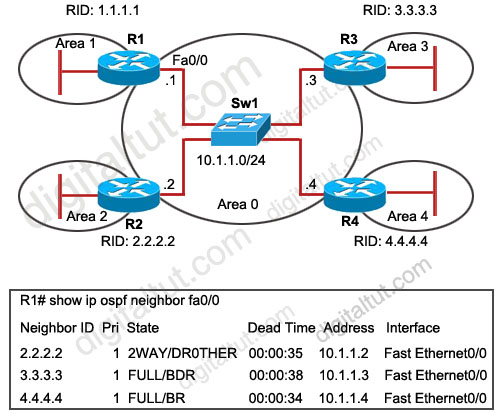
Refer to the exhibit. OSPF is configured on all routers in the network. On the basis of the show ip ospf neighbor output, what prevents R1 from establishing a full adjacency with R2?
show_ip_ospf_neighbor.jpg

A. Router R1 will only establish full adjacency with the DR and BDR on broadcast multiaccess networks.
B. Router R2 has been elected as a DR for the broadcast multiaccess network in OSPF area
C. Routers R1 and R2 are configured as stub routers for OSPF area 1 and OSPF area 2.
D. Router R1 and R2 are configured for a virtual link between OSPF area 1 and OSPF area 2.
E. The Hello parameters on routers R1 and R2 do not match.


Answer: A

Explanation

From the output, we learn that R4 is the DR and R3 is the BDR so other routers will only establish full adjacency with these routers. All other routers have the two-way adjacency established -> A is correct.

Question 7

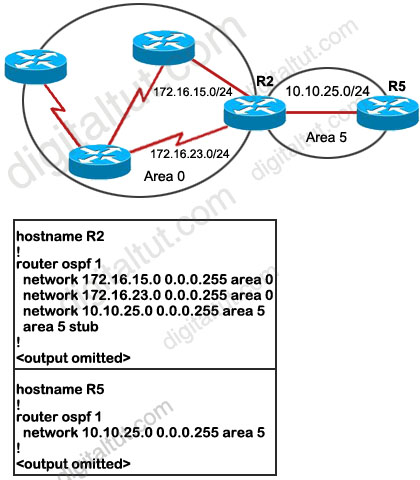
Refer to the exhibit. On the basis of the configuration provided, how are the Hello packets sent by R2 handled by R5 in OSPF area 5?
OSPF_Hello_packets.jpg

A. The Hello packets will be exchanged and adjacency will be established between routers R2 and R5.
B. The Hello packets will be exchanged but the routers R2 and R5 will become neighbors only.
C. The Hello packets will be dropped and no adjacency will be established between routers R2 and R5.
D. The Hello packets will be dropped but the routers R2 and R5 will become neighbors.


Answer: C

Explanation

Recall that in OSPF, two routers will become neighbors when they agree on the following: Area-id, Authentication, Hello and Dead Intervals, Stub area flag.

We must specify Area 5 as a stub area on the ABR (R2) and all the routers in that area (R5 in this case). But from the output, we learn that only R2 has been configured as a stub for Area 5. This will drop down the neighbor relationship between R2 and R5 because the stub flag is not matched in the Hello packets of these routers.

Question 8

When an OSPF design is planned, which implementation can help a router not have memory resource issues?

A. Have a backbone area (area 0) with 40 routers and use default routes to reach external destinations.
B. Have a backbone area (area 0) with 4 routers and 30,000 external routes injected into OSPF.
C. Have less OSPF areas to reduce the need for interarea route summarizations.
D. Have multiple OSPF processes on each OSPF router. Example, router ospf 1, router ospf 2


Answer: A

Question 9

When verifying the OSPF link state database, which type of LSAs should you expect to see within the different OSPF area types? (Choose three)

A. All OSPF routers in stubby areas can have type 3 LSAs in their database.
B. All OSPF routers in stubby areas can have type 7 LSAs in their database.
C. All OSPF routers in totally stubby areas can have type 3 LSAs in their database.
D. All OSPF routers in totally stubby areas can have type 7 LSAs in their database.
E. All OSPF routers in NSSA areas can have type 3 LSAs in their database.
F. All OSPF routers in NSSA areas can have type 7 LSAs in their database.


Answer: A E F

Explanation

Below summarizes the LSA Types allowed and not allowed in area types:

Area Type Type 1 & 2 (within area) Type 3 (from other areas) Type 4 Type 5 Type 7
Standard & backbone Yes Yes Yes Yes No
Stub Yes Yes No No No
Totally stubby Yes No No No No
NSSA Yes Yes No No Yes
Totally stubby NSSA Yes No No No Yes

Popular LSA Types are listed below:

LSA Type Description Details
1 Router LSA Generated by all routers in an area to describe their directly attached links
2 Network LSA Advertised by the DR of the broadcast network (does not cross ABR)
3 Summary LSA Advertised by the ABR of originating area
4 Summary LSA Generated by the ABR of the originating area to advertise an ASBR to all other areas in the autonomous system
5 AS external LSA Used by the ASBR to advertise networks from other autonomous systems
7 Defined for NSSAs Generated by an ASBR inside a Not-so-stubby area (NSSA) to describe routes redistributed into the NSSA

Question 10

You are troubleshooting an OSPF problem where external routes are not showing up in the OSPF database. Which two options are valid checks that should be performed first to verify proper OSPF operation? (Choose two)

A. Are the ASBRs trying to redistribute the external routes into a totally stubby area?
B. Are the ABRs configured with stubby areas?
C. Is the subnets keyword being used with the redistribution command?
D. Is backbone area (area 0) contiguous?
E. Is the CPU utilization of the routers high?


Answer: A C

Explanation

A totally stubby stubby area cannot have an ASBR so it will discard this type of LSA (LSA Type 5) -> A is a valid check.

Each stubby area needs an ABR to communicate with other areas so it is normal -> B is not a valid check.

When pulling routes into OSPF, we need to use the keyword “subnets” so that subnets will be redistributed too. For example, if we redistribute these EIGRP routes into OSPF:

+ 10.0.0.0/8
+ 10.10.0.0/16
+ 10.10.1.0/24

without the keyword “subnets”

router ospf 1
redistribute eigrp 1

Then only 10.0.0.0/8 network will be redistributed because other routes are not classful routes, they are subnets. To redistribute subnets we must use the keyword “subnets”

router ospf 1
redistribute eigrp 1 subnets

-> C is a valid check.

We don’t need to care if area 0 is contiguous or not -> D is not a valid check.

CPU utilization cannot be the cause for this problem -> E is not a valid check.

Comments
  1. orqade
    December 24th, 2011

    Question 2 : why answer C is not right ??!!

  2. j
    January 16th, 2012

    Cuz type 7 lsa is for NSSA

  3. Gogo
    January 16th, 2012

    2 orqade: I think “packet 7″ doesn’t exist. Shall be LSA 7

  4. Sir CCNP
    January 18th, 2012

    Hello Friends,

    I just started to study the ROUTE test after taking almost two years off from passing the CCNA. I am planning to take the ROUTE test in two months. Are the Sims, Drag and Drop, Questions, and everything else on this site still valid for the ROUTE test?

    Thank you all!

  5. digitaltut
    January 24th, 2012

    @orqade: Answer C is not correct because type 7 is only used in NSSA, in standard area (like area 0), the ASBR can generate LSA type 5 for redistribution.
    Therefore the correct statement should be:
    “Redistribution is not allowed unless the packet is changed to a type 7 or type 5 packet”.

  6. dunno
    January 31st, 2012

    Q10, not sure about ‘A’

    totally stubby areas do not have ASBRs as pointed out in the description and cannot receive external routes. Since there are no ASBRs in a totally stubby area–by definition–it makes absolutely no sense to check for one.

    ASBRs in different areas do not ‘try to redistribute’ into a totally stubby area. they simply redistribute; and if there are areas elsewhere that are totally stubby the ABR injects a default route–with our without an ASBR somewhere else. if the area is a normal area it receives a type5 lsa.

    again, it makes no sense to check totally stubby area for either external routes or an ASBR

  7. kidn3ys
    February 3rd, 2012

    @dunno

    It’s simply making mention that the ASBR is attempting to inject external routes into the database, not necessarily that the ASBR resides in the same Totally Stubby area, which, as you mentioned is not possible. Also, it makes no mention of ‘checking a stubby area for external routes’ it is asking “What could be the possible reasons that external routes are not showing up?”.

  8. dunno
    February 6th, 2012

    @kidn3ys

    I appreciate your explanation. I think I read the question differently. I see the question as two parts:

    Part1–There is “an OSPF problem where external routes are not showing up”, emphasis on “problem”.

    Part2–Where should you look to find the “problem”?

    Answer C is clearly correct.

    I still believe Answer A is not correct. The reason is, if it is understood that an area is totally stubby it is expected that external routes do not show up. This is not a problem–it’s proper OSPF behavior and no need to look there for a “problem”.

    I would expect D is the correct answer. A discontinuous backbone will absolutely cause routing table problems, especially external routes (and other O and IA routes) not showing up depending on the location of the ASBR. It is also the only other option the presents a real ‘problem’ with configuration or design.

    I verified this with a sim. All areas are normal.

    R1:ASBR —–area 0—– R2 —–area 10—– R3 —–area 0—– R4

    results: No external routes, or any routes from one Area0 appears in the other. No external routes or R1-R2 routes appear in R4. A quick R2-R3 virtual link quickly remedies the problem, but that is out of scope for the question.

    Are there any test takers here that can verify the “Cisco” expected test answers?

  9. Knight
    February 28th, 2012

    Q8, could some body give a feedback, thank you in advance

  10. Joe
    February 29th, 2012

    That is one thing about OSPF you can’t raelly change. You might be able to sort of fake it depending on your topology with something like a GRE tunnel. For example, if you have inter-area routes, you may be able to make them intra-area by creating a GRE tunnel and running OSPF on it.

  11. Mshirley
    March 2nd, 2012

    Are these questions still the most uptodate?

  12. MeMeMe
    April 9th, 2012

    Q 10 has to be A and B – C is valid but how do we know that a subnet is being redistributed? A and B are correct because both area types discard type 5 LSAs as the explanation for answer A reads.

    However, looking more closely, i think it is stating that the ABRs in this area may be connected to OTHER areas which are stubby and that would NOT hurt us so we dont care what other areas are involved on the ABRs except this very area. I agree with tut – A and C!

    also no to the guy who said a discontiguous address scheme can be a problem – even if area 0 was burning in flames, you could still inject routes into this other area.

  13. ccnpist
    April 19th, 2012

    I don’t understand q1
    A. -
    B. i don’t know, but ABR can inject default route in the backbone area (area 0)
    C. totally stubby. +
    D. NSSA. + The stub area characteristics still exist. However, NSSAs allow ASBRs, which is against the rules in a stub area. They do not accept information about routes external to the autonomous system, but instead use a default route for external networks.
    E. +
    F. -

  14. x-ray
    May 6th, 2012

    Q9

    Answer C is also seems to be correct – default route, generated by ABR, is also LSA type 3

  15. Ricardo Brazil
    June 9th, 2012

    Sr.

    The Question 8 is correct?

    For me is C, someone help me?

  16. Darcken
    June 21st, 2012

    i think Q8 is A because default routes get free CPU process and if there are less areas, those areas send hello and update packets what overprocess CPU Router… i think!!!

  17. Swede
    July 26th, 2012

    Why is D not also correct in Q1???

  18. Southern
    July 29th, 2012

    @Swede
    By default, the ABR of a stubby or totally stubby area advertises a default route with a cost of 1. The ABR of an NSSA on the other hand requires the use of the default-information-originate parameter with the area nssa command. If the question said choose 3 or choose all that apply, I probably would choose D.

  19. Bargainbitbucket
    August 14th, 2012

    Q9 I’d (partially) agree with x-ray answer c seems to be in fact correct in that defaults are injected in to totally stub areas (and total NSSA) as type 3′s.
    In an exam though i wouldn’t count them as summary routes even though they are in sh ip ospf data as summary net link states unless there were no other correct answers to pick primarily because the command to create a total stub is ‘no-summary’. Worth underlining that and repeating it a few times. Cisco likes word play on such things (even when they are not true) to part us from our exam and training fees.

  20. Bargainbitbucket
    August 15th, 2012

    Q10, i think A is a correct answer. It is possible to (incorrectly) configure an ASBR in a stub area, the result however is a failure to function properly. Console output as below:
    %OSPF-4-ASBR_WITHOUT_VALID_AREA: Router is currently an ASBR while having only one area which is a stub area
    Redistributed routes will not show up in the database. The OSPF process kills their input.
    You can see by configuring redistribution RIP to OSPF and then toggling an area with an ASBR between stub and no stub, the route disappears (also pulls adjacencies down though). You can also do it by configuring the redistribution when the area is stub. The console message appears warning you but the config goes in the running config and neighbour relationships maintain.
    So if you have come in on a vty port and aren’t using term mon you would not see the issue…
    Not sure about answer C. external routes would still be evident if everything else was correctly configured, they would be major networks but still external and present. hmm.
    D is interesting as i thought if the backbone was originally connected to a router as an ABR that was stub to area O and now being configured as an ASBR for redistribution and the area O interface has gone down then you would have the same scenario with an ASBR connected to only one area that is stub. However this appears untrue since the redistributed route is persistent within the database regardless of area 0 interface state (even admin down with ospf process cleared).
    C still then looks to be the best other (dumbed down) answer as to why (some) external routes are likely to be missing from OSPF redistribution scenarios.

  21. Muro
    August 24th, 2012

    @Bargainbitbucket
    as I know, default route is injected as LSA type 5. so this cannot be the right answer.

  22. Muro
    August 24th, 2012

    I am sorry, i checked it once again, you are right, it’s LSA type 3

  23. costin
    September 26th, 2012

    On question 6, neighbor 4.4.4.4 has a state of FULL/BR. I think you meant FULL/DR :)

  24. Marco
    September 28th, 2012

    Q4, is really asked wrong. I guess they’re trying to see if you know the default, which is E2. But they want you to assume that the metric-type is not adjusted. I really don’t like it, if they ask a question like this.

    If you ask it like this, I would say A or B, depending on how to redistribute.

  25. Marco
    September 28th, 2012

    Q10 is really debatable. Honestly, terrible question.

    About A…. that refers to a configuration error or something? ASBRs can’t be in totally stubby areas, and if they’re trying to reditribute External routes in a totally stubby area, then they’re discarded since that’s what they do.

    In B, the same, they discard External routes.

    So it’s either a stubby or totally stubby area that should be that???

    Weird question.

  26. GOR
    October 4th, 2012

    Q1. why answer D is not right ?

  27. GOR
    October 4th, 2012

    Q1. why answer D is not right ?
    From Foundation Learning Guide:
    The NSSA feature allows an area to retain the other stub area features—the ABR sends a default route into the NSSA instead of external routes from other ASBRs—while also allowing an ASBR to be inside of the area.

  28. Mayas
    October 13th, 2012

    In Q1 D is also correct. Default Routes can be injected in all types of stub/nssa areas.

  29. Mrityunjay singh
    October 15th, 2012

    Does any one provide the detail information for question 2.Which three restrictions apply to OSPF stub areas? (Choose three)

  30. Mrityunjay singh
    October 24th, 2012

    Even i do think that in Q2 the ans should be c.Bcoz area 0 cannot b stub and we can redistribute into area 0 but we cannote redistribute in stub area unless the packet gets converted into lsa 7 so i don’t knw why c is not rite.But i think since type 7 is generated by nssa and there is no nssa term specified there so that’s y i think ans is not c.

  31. David
    November 7th, 2012

    Could someone tell me if those questions are still valid?

  32. irfan
    November 25th, 2012

    Dear TUT

    Please correct explanation of Q7. R3 is written instead of R2.
    “But from the output, we learn that only R3 has been configured as a stub for Area 5. This will drop down the neighbor relationship between R3 and R5 because the stub flag is not matched in the Hello packets of these routers.”

  33. digitaltut
    November 25th, 2012

    @irfan: Yes, thanks for your detection. I updated it!

  34. NMAMPEN1
    November 25th, 2012

    Q2.
    C.- Yes, the LSA type 7 is only for NSSA .And yes, only NSSA and Totally NSSA allows redistribution from external routes.But the LSA conversion from one type into another only occurs from LSA Type 7 into LSA Type 5 (because the redistribution is performed by the ASBRs -they are at the AS boundary-, and the LSA conversion into Type 5 is always performed by the ABRs).So, this answer is incorrect, (CCNP Route 642-902 Official Certification Guide, Wendell Odom; Figure 7-10 Step 4; Figure 9-10 Steps 1 and 3).
    E.- By elimination of the rest.But the statement seems to be incomplet (allowed… for what?; since ASBRs create the LSA Type 7 for the NSSAs, at least they are allowed for that).

  35. NMAMPEN1
    November 26th, 2012

    Little add-on to the last explanation.
    Under normal conditions (i.e. no Stub Areas), ASBR inject the external routes to the normal areas by creating LSA Type 5.
    When exist a Stub Area between the external networks and the OSPF normal areas (=no Stub Areas), it drops the LSA Type 5.So no redistribution allowed.
    Solution? -> Make the stub Area as NSSA (wich accept ASBR LSA Type 7), and ABRs between NNSA and the normal areas, translate those LSA Type 7 into LSA Type5.
    Now, redistribution can be performed.

  36. memoozzy
    January 5th, 2013

    Q 5 DOESN’T MAKE SENSE AT ALL GUYS ,,?
    each lsa type is created by it’s perspective router , abr creates its own and simple router creates its own and ASBR do too ,, so how come LSA are created by DR ?? only

  37. memoozzy
    January 5th, 2013

    ohh shoot ,,, ^_^
    now i understood , by saying Network LSA , he meant LSA TYPE 2
    oohhh
    non-native english speaker are really facing troubles like me ,,,,,,,

    i thought he meant the LSAs being propagated in the network it self and not LSA Type 2 in specific
    MY BAD ,,,,

  38. Anonymous
    January 25th, 2013

    The Area and LSA Diagram in Question 1 is incorrect for NSSA. NSSA does not ALLOW LSA 3 into the area, but only LSA 7.

  39. zulqadar
    January 31st, 2013

    if we see question 3 ….that asking which one address would be DR or BDR as per OSPF there is DR and BDR selection happen on Serial Interface

    is this rule changed in OSPFv3 ?

  40. Learner
    February 1st, 2013

    @Zulqadar,
    regarding Q3, We don’t know if DR/BDR selection has already happened, serial interfaces do mention the IPv6 address, but since there is explicit configured RID 10.1.1.3, so this will be considered in selection of DR/BDR if and when it happens.
    There is explanation under Q3 hope it clears it up for you.

  41. Sneaky_cisco
    April 7th, 2013

    In real life the follow up question you would ask when someone asks you “You are troubleshooting an OSPF problem where external routes are not showing up in the OSPF database.” Would be: what’s the function of this router? ABR?, ASBR? Is it in a stub, nssa, or totally stub. Is it a non-ABR area router?

    Either this question wasn’t copied properly off the exam. Or, if it’s indeed as intended, then it’s misleading or vague. As it is missing very basic info about the topology.

  42. M_att_h
    April 9th, 2013

    Hi,

    Just wondering about: Question 9

    When verifying the OSPF link state database, which type of LSAs should you expect to see within the different OSPF area types? (Choose three)

    A. All OSPF routers in stubby areas can have type 3 LSAs in their database.
    B. All OSPF routers in stubby areas can have type 7 LSAs in their database.
    C. All OSPF routers in totally stubby areas can have type 3 LSAs in their database.
    D. All OSPF routers in totally stubby areas can have type 7 LSAs in their database.
    E. All OSPF routers in NSSA areas can have type 3 LSAs in their database.
    F. All OSPF routers in NSSA areas can have type 7 LSAs in their database.

    Answer: A E F

    I do agree with the answers AEF.

    But I think answer C is also valid: all OSPF routers in totally stubby areas can have type 3 LSAs in their database and they WILL –> LSA3 with LSID 0.0.0.0, which are the LSA3s containing default routes advertised by ABRs on the totally stubby area.

    I know there is only 3 answers to pick but I think 4 of them are correct, what do you think?

  43. Hoang Thinh
    April 14th, 2013

    Q2 why E correct ?
    ” No autonomous system border routers are allowed”
    I think stub area needs an ABR(border router ) to communicate with other areas so it is normal”

  44. Ganfi
    April 14th, 2013

    @ M_att_h

    What u r saying is that, even though Totally stubby areas replaces LSA3 with a default route
    it will still have Type 3 LSA in the database.

    Is that it?

  45. M_att_h
    April 15th, 2013

    @ Ganfi
    Yes the default route is advertised by the ABR with an LSA3 with LSID 0.0.0.0.

  46. TneDmachine
    April 18th, 2013

    Question 10… is like dust in the wind.

  1. No trackbacks yet.
Add a Comment