
Home > OSPF Questions 5

OSPF Questions 5

July 16th, 2011 in ROUTE 642-902 Go to comments

Here you will find answers to OSPF Questions – Part 5

Question 1

A network administrator has enabled OSPF across an NBMA network and has issued the command ip ospf network nonbroadcast. Given those facts, which two statements are true? (Choose two)

A. DR and BDR elections will occur.
B. DR and BDR elections will not occur.
C. All routers must be configured in a fully meshed topology with all other routers.
D. The neighbor command is required to build adjacencies.
E. Interfaces will automatically detect and build adjacencies with neighbor routers.


Answer: A D

Explanation

When using the command “ip ospf network nonbroadcast”, we turn the network into a nonbroadcast network so routers can not send broadcast or multicast. But OSPF uses multicast address 224.0.0.5 to send Hello packet periodically. Therefore we have to manually define the neighbor (via the neighbor command) to make OSPF send Hello packets to its adjacent routers -> D is correct.

For Multi-access network (for example Ethernet or Frame Relay), a designated router (DR) and a backup designated router (BDR) are elected ->A is correct.

Note: By default, Frame Relay environment is nonbroadcast so it is actually not necessary to use the command “ip ospf network nonbroadcast” on Frame Relay network.

Question 2

RouterA#
~~~~~
!
router ospf 1
log-adjacency-changes
network 10.0.0.0 0.255.255.255 area 1
network 172.16.1.0 0.0.0.255 area 1
!
~~~~~

RouterB#
~~~~~
router ospf 1
log-adjacency-changes
network 10.0.0.0 0.255.255.255 area 2
network 172.16.2.0 0.0.0.255 area 2
!
~~~~~

RouterC#
~~~~~
!
router ospf 1
log-adjacency-changes
network 10.0.0.0 0.255.255.255 area 0
!
~~~~~

Refer to the exhibits. You are verifying your OSPF implementation, and it does not seem to be functioning properly. What can you conclude from the exhibit and the show running-configuration command output?
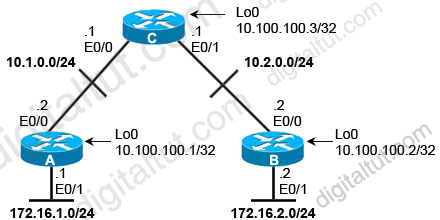
OSPF_configuration.jpg

What can you conclude from the exhibit and the show running-configuration command output?

A. The OSPF areas are not configured correctly.
B. The wildcard masks for the 10.x.x.x networks are incorrect.
C. The 172.16.x.x networks need to be connected to area 0 using virtual links.
D. The 172.16.x.x networks are discontiguous. OSPF is automatically summarizing them to 172.16.0.0/16 and data is being “black holed”.
E. There is not enough information to make a determination.


Answer: A

Explanation

The E0/0 & E0/1 interfaces of router C belong to area 0 while E0/0 of router A belongs to area 1; E0/0 of router B belongs to area 2 -> it is not correct. Both E0/0 interfaces of router A & B should be in area 0 -> A is not correct.

Question 3

Which two routing interface parameters are supported in OSPF implementations? (Choose two)

A. retransmit-interval
B. dead-interval
C. stub area
D. virtual link
E. NSSA area


Answer: A B

Explanation

When OSPF sends an advertisement to an adjacent router, it expects to receive an acknowledgment from that neighbor. If no acknowledgment is received, the router will retransmit the advertisement to its neighbor. The retransmit-interval timer controls the number of seconds between retransmissions. To edit the retransmit-interval, use the “ip ospf retransmit-interval seconds” in interface configuration mode -> A is correct.

Dead-interval is the number of seconds without hello packets before an adjacency is declared down. To edit the dead-interval, use the “ip ospf dead-interval seconds” in interface configuration mode -> B is correct.

Other answers are not correct because they are not interface parameters.

Question 4

One of the most important characteristics of OSPF is Multiple areas. Which statement best describes why this feature is such an important enhancement to earlier routing protocols?

A. The network domain, when divided into areas, allows for the use of both IANA classful addressing and private addressing.
B. The use of multiple areas allows for the use of prioritization.
C. All computation is kept within the area, with minimum communication between the areas, allowing the network to scale to larger sizes.
D. It is easier to implement security.


Answer: C

Question 5

When other routing protocol routes are being redistributed into OSPF, what is one of the most common problems?

A. missing the tag option in the redistribute command.
B. missing the subnet option in the redistribute command.
C. missing the metric option in the redistribute command.
D. misconfiguring the metric-type option in the redistribute command to type-1.
E. misconfiguring the metric-type option in the redistribute command to type-2.


Answer: B

Explanation

When pulling routes into OSPF, we need to use the keyword “subnets” so that subnets will be redistributed too. For example, if we redistribute these EIGRP routes into OSPF:

+ 10.0.0.0/8
+ 10.10.0.0/16
+ 10.10.1.0/24

without the keyword “subnets”

router ospf 1
redistribute eigrp 1

Then only 10.0.0.0/8 network will be redistributed because other routes are not classful routes, they are subnets. To redistribute subnets we must use the keyword “subnets”

router ospf 1
redistribute eigrp 1 subnets

-> B is correct.

Question 6

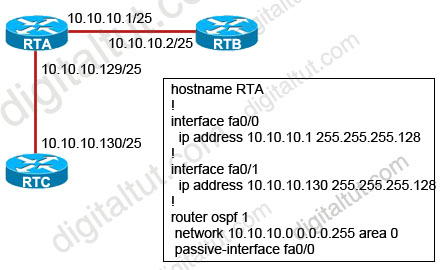
Refer to the exhibit. Which statement is true about the configuration?
OSPF_adjacency.jpg

A. RTA will not establish an OSPF adjacency with RTB.
B. RTA will not accept OSPF hello packets from RTB.
C. RTA will send OSPF hello packets, but will not send OSPF updates.
D. RTA will send OSPF updates, but will not establish an adjacency with RTB.


Answer: A

Explanation

Passive-interface command is used to disable sending updates out from a specific interface. For OSPF it prevents Hello packets from being sent out or received through the interface. This will not allow to create a neighbor adjacency and prevent a router from learning prefixes from those neighbors.

For RIP, configuring an interface as passive will still allow the interface to listen to incoming routing updates for other RIP neighbors, but the interface will no longer send them.

Note: The passive-interface command is used in router configuration mode, not interface mode.

Question 7

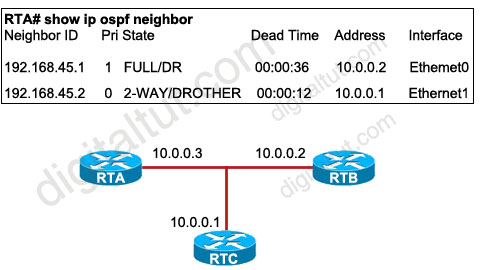
Refer to the exhibit. Which statement is true?
OSPF_show_ip_ospf_neighbor.jpg

A. Router RTA is directly connected to interface 192.168.45.1.
B. Neighbor 192.168.45.1 has changed its OSPF priority number.
C. Router RTA and neighbor 192.168.45.2 are exchanging OSPF LSAs.
D. Router RTA is the BDR.


Answer: D

Explanation

There are only 3 routers in this segment. From the output we learn that RTB (10.0.0.2) is the DR and RTC (10.0.0.1) is not the DR or BDR so we can deduce RTA is the BDR.

Question 8

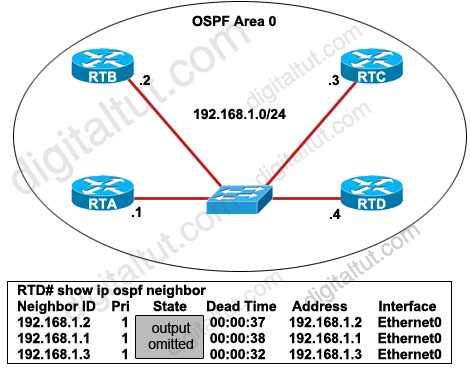
Refer to the exhibit. All routers have simultaneously been reloaded, and the DR election has concluded as expected. Which state is RTC in?
OSPF_DR_election.jpg

A. 2WAY/DROTHER
B. 2WAY/BDR
C. 2WAY/DR
D. FULL/DROTHER
E. FULL/BDR
F. FULL/DR


Answer: E

Explanation

All the routers are allowed to take part in the DR/BDR election because all the “Pri”s (Priority) are 1 and they are equal so with default parameters, the router with highest IP address will become DR (RTD in this case) and the router with second highest IP address (RTC) will become BDR.

Question 9

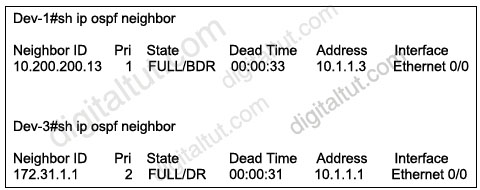
The Dev-1 and Dev-3 routers are OSPF neighbors over the Ethernet 0/0 connection. Based on the show ip ospf neighbor output from the Dev-1 and Dev-3 routers, which statement is true?
OSPF_show_ip_ospf_neighbor-2.jpg

A. Dev-1 is the DR because it has a higher OSPF router priority.
B. Dev-1 is the DR because it has a lower OSPF router ID.
C. Dev-3 is the DR because it has a higher OSPF router priority.
D. Dev-3 is the DR because it has a lower OSPF router ID.
E. Both Dev-1 and Dev-3 are using the default OSPF router priority.


Answer: A

Explanation

The priority helps determine the DR and BDR on the network to which this interface is connected. Priority is an 8-bit field based on which DRs and BDRs are elected. The router with the highest priority becomes the DR. If the priorities are the same, the router with the highest router ID becomes the DR. By default, priorities are set to 1.

Notice that the Priorities shown in the output above are the priorities of the neighbors so the priority of router Dev-1 is 2 while the priority of Dev-3 is 1 -> the priority of Dev-1 is higher than that of Dev-3 -> Dev-1 is the DR.

Question 10

Which three statements about OSPF areas are true? (Choose three)

A. Areas introduce a boundary on the link-state updates.
B. Areas are logical definitions specific to any given router.
C. All routers within an area have the exact link-state database.
D. The calculation of the Dijkstra algorithm on a router is limited to changes within an area.
E. The area designated router will always have a priority of 0.


Answer: A C D

Comments
  1. Tomas
    January 13th, 2012

    Q7: I don’t think answer D is correct. Output from RTA shows that RTC is in 2-WAY/DROTHER state which means RTA must communicate with RTC via DR/BDR. Should the RTA be BDR, it would show FULL/DROTHER state on the RTA output.
    None of the answers seems to me correct.

  2. Bruno
    January 15th, 2012

    I agree with Tomas. I would say that RTA is another DROTHER router.

  3. j
    January 16th, 2012

    Its one of those “most correct answers”. RTA being the BDR is the only option that fits, so it must be the answer. You may not know that it is from the out put, but you also do not know that it is DROTHER either.

  4. Sir CCNP
    January 18th, 2012

    Hello Friends,

    I just started to study the ROUTE test after taking almost two years off from passing the CCNA. I am planning to take the ROUTE test in two months. Are the Sims, Drag and Drop, Questions, and everything else on this site still valid for the ROUTE test?

    Thank you all!

  5. blah blah
    February 1st, 2012

    Question number 9 in incorrect. answer is “C. Dev-3 is the DR because it has a higher OSPF router priority.”. Reason is that the priority that is highest wins. Dev-3 is the one with priority number 2, and dev-1 is priority number 1. The router with the highest priority wins, this is even reflected in the output, as dev-3 is the winner and is currently in the FULL/DR state. Dev-3 would have won anyways, because it had the highest RID in the 172 address range, vs dev-1 10. address.

    Reference cisco press 642-902, page 276, the below paragraph –

    The OSPF priority defines the priority when choosing a DR and BDR. Configured with
    the ip ospf priority value interface subcommand, the higher number (ranges from 0–255)
    wins. Also, a priority of 0 has special meaning: it prevents that router from becoming the
    DR or BDR. By configuring OSPF priority of 0 on routers that do not have a PVC connected
    to each other router (such as R2, R3, and R4 in this case), the other routers (R1 in
    this case) will be the only routers eligible to become the DR.

  6. blah blah
    February 1st, 2012

    Also, in this explanation of question 9 -

    Notice that the Priorities shown in the output above are the priorities of the neighbors so router the priority of router Dev-1 is 2 while the priority of Dev-3 is 1 -> the priority of Dev-1 is higher than that of Dev-3 -> Dev-1 is the DR.

    is wrong, as dev-1 has a priority of 1 in the ecample, and dev-3 has a priority of 2 in the example. Revise the explanation and answer, or revise screen shot to support the explanation.

  7. Hai-from Vietnam
    February 6th, 2012

    @blah blah:

    You should check again with your explain. I strongly agree with 9tut’s answer.

    Output from Dev3 shows detail about its NEIGHBOR. In this case, Dev-1 has priority 2 and the state colum tell that Dev-3 is connected to the DR.

  8. Blake
    February 27th, 2012

    @Blah Blah

    Question 9 answer is correct. When you run the command ‘show ip ospf neighbor’ you have to remember it shows the priority of existing neighbors not the priority of the router you are running the command on.

  9. Kalachi
    February 29th, 2012

    Q 10 eixbhit updated with the correct one..Thanks for pointing it, In return i will happily explain Q24 to you, please bear with me: On a broadcast or multi access network the router with the highest OSPF priority on a given segment will become the DR for that segment. However if all routers have the same default priority (as in the example of Q 24) the router with highest Router ID (RID) will be the Designated router DR.The Router ID is determined by the highest IP address on any interface of the router at the moment of OSPF election.Since the concept is clear enough I’ll leave you to do the math.

  10. Me
    March 30th, 2012

    Q7
    I think that D is wrong answer. BDR and DROTHER form FULL adjacency not 2-WAY. Only DROTHER routers form 2-WAY adjacency to each other. So I think there is one DR, two DROTHER routers and none BDR on this segment. RTA is not BDR.
    C is correct answers.

    Please comment or correct the answer.

  11. IcarianVX
    April 12th, 2012

    @Me
    D is the correct answer. Look at the output and where it was run from. The command was run on RTA.
    Remember on ALL multi-access networks a DR *and* a BDR are elected. If you are on a router and issue the ‘show ip ospf neighbor’ command and you see that all other routers are either a DR or a DROTHER, guess what…………..you are the BDR.
    Its a process of elimination question.

  12. IcarianVX
    April 12th, 2012

    @Me (again)
    I see what you are saying, but this is Cisco and this is the type of question that they love asking.

  13. KL
    April 18th, 2012

    Q7
    RTC has a priority 0, so it doesn’t participate in DR/BDR election process. RTA must be BDR. ( btw, why is there two output interfaces ? Eth0, Eth1 )

  14. divya
    April 20th, 2012

    I am giving ccnp route is the wheel man dump still valid.What are other valid dumps along with digitaltut.Are all answers correct on wheelman dump?And does any one have packet tracer/GNS3 examples for the lab practice

  15. Question 6
    April 23rd, 2012

    RTA will not establish an OSPF adjacency with RTB. (Right answer as per this website).

    RTA will not accept OSPF hello packets from RTB. ( This should be the right answer to me, beacuse on a passive interface RTA will not accept hello packet. and as a result no adjacency will be established. As this come first in the procedure this should be selected as right answer.

    Wait for your comments
    . Thanks

  16. tom
    April 30th, 2012

    “RTA will not accept OSPF hello packets from RTB” means that RTA is refusing the hello packets. If that is the case, you can see that on a debug. RTA will simply not participate in the ospf process on the passive interface thus will not be in a position to accept or deny hellos. Answer A is correct as stated.

  17. johnmaxwell
    May 12th, 2012

    @ Me
    t think that there is something wrong with the question. true only two DROTHERS form 2way state relationship if RTA is the BDR then what is reflected there should be FULL/DROTHERs… so what happened to BDR?

  18. GreenScorpionCR
    May 13th, 2012

    For Question 6; I believe answer D is correct:

    D. RTA will send OSPF updates, but will not establish an adjacency with RTB.

    Why? Because you are enabling OSPF with the mask that covers both interfaces and you are defining only F0/0 as passive; so RTA could, eventually send OSPF updates to router C out the interface F0/1.

  19. DIV
    May 14th, 2012

    @GreenScorpionCR
    You are 100% right. Because you think about whole topology – in this case router RTA send updates to RTC and not establish an adj with RTB.
    BUT – This is CISCO – and they make many foolish questions. When they create this question – they think only about router RTB and RTA.

  20. Alaa
    May 14th, 2012

    @GreenScorpionCR, you are correct. But I suspect the question itself is inaccurate, maybe it was only talking about the F0/0 interface. If so, then the correct answer is A.

  21. Alaa
    May 14th, 2012

    @johnmaxwell, for question 7: if RTA is configured with priority 0, then there will not be any BDR. So RTA and RTC will not participate in the election because their priorities will be 0. RTB is the only one that has non-zero priority, making it the BDR. From the output, RTA and RTC are in a 2WAY/DROTHER state, which means that RTA is not the BDR (i.e., its priority is set to 0), so the answer on this site is wrong. The only way that RTA is the BDR is if we take into consideration that the neighbor relationship with RTC has only been up for 12 seconds, so they still did not move past the 2WAY state (for example, if you were to run the sh ip ospf ne command again after a while, you would find it FULL/DROTHER). Although I think it’s highly unlikely that a 2WAY state is stuck at 12 seconds =/.

  22. REAGAN
    May 16th, 2012

    In your Q9 output change dev-3 to dev-1 and dev-1 to dev-3. You have swapped them and they confusing everyone

  23. xmk686
    May 27th, 2012

    Q7:
    Answer D is wrong. Assuming:
    1. 2-WAY/DROHTER relationships with RTC
    2. ROUTE Quick Reference says “Each router in the routing domain shares its LSAs with all other routers”

    I can conclude, that Answer C “Router RTA and neighbor 192.168.45.2 are exchanging OSPF LSAs” IS CORRECT. Any comments?

  24. Imran shahid
    June 1st, 2012

    Hi
    For question 7 is really simple . First check the priority if its zero 0 as in case of router RTC it will not take part in the DR/BDR election so RTC is excluded.
    Now we are sitting on RTA and typing the neighbor command that tells us RTB is FULL/DR so it can be concluded that RTA will be a BDR which is option D and option D tells us about that unless otherwise stated.
    Comment please!

  25. Imran shahid
    June 1st, 2012

    Question 7 is intrested to know the state of the router as if you scroll down to question 8 , they omit the state output

  26. Question 7
    June 6th, 2012

    @Imran shahid
    There doesn’t have to be a BDR. You can have it so that there’s only a DR and no BDR. The thing that makes RTA not a BDR is because it was a 2WAY relationship with RTC. DRs and BDRs form FULL adjacencies with all neighbors. Since it RTA shows a 2WAY relationship with RTC, then RTA must be another DROTHER.

    Answer C is wrong as well because DROTHER’s do not exchange OSPF LSAs with each other.

  27. Q9
    June 26th, 2012

    Q9 is wrong.

    The correct answer and explaniation:

    OPTION C is the correct:

    The priority of router Dev-1 is 1 while the priority of Dev-3 is 2 -> the priority of Dev-3 is higher than that of Dev-1 -> Dev-3 is the DR.

  28. Alex1
    June 27th, 2012

    Question 8
    Why FULL/BDR and not 2-WAY/BDR?

  29. Riaz
    June 28th, 2012

    Because RTB will form an adjacency with BDR. Topology information is exchanged directly with DR and BDR and hence the state FULL.

  30. kashif
    August 8th, 2012

    Q2

    Answer B is also correct as the network advertised by 10.0.0.0 is /8 and not /24 … can somebody guide me . thanks

  31. Dacollins
    August 9th, 2012

    @ kashif. sometimes these answers might seem similar or even confusing, but it is always advisable to choose the best that apply and that is Answer A.
    Even if the wildcat masks are correct, the implementation of that network topology can never function correctly if the subnets are configured in the wrong areas. Thus none of them will be able to form neighborship and/or adjacency with one another. Think of it as a road map to a certain city and routers A and B has been mislead (ie , misconfigured ), they will never get to router C which is the backbone area and their common neighbor.

  32. Bargainbitbucket
    August 16th, 2012

    Q7, process of elimination:
    A. Router RTA is directly connected to interface 192.168.45.1.
    No it is not that is the ID of router B. incorrect
    B. Neighbor 192.168.45.1 has changed its OSPF priority number.
    No it has not it is the default. incorrect
    C. Router RTA and neighbor 192.168.45.2 are exchanging OSPF LSAs.
    Not according to the output that would be full/drother. incorrect
    D. Router RTA is the BDR.
    this is all that is left that is not definitely wrong. Suggests RTA has a default priority but came online after RTB was elected DR and is not yet fully adjacent with RTC. DR/BDR elections do not preempt therefore with default priority RTA will become BDR and eventually form an adjacency with other ospf speakers on the segment. if RTA had a zero priority it would not become BDR but that is not a given option.

  33. Marco
    September 28th, 2012

    Q7:

    I’d say what they try to represent is a shared medium, like Ethernet. And there you always have a DR/BDR selection. Since there’s already a DR, and a DROTHER/2WAY…. it’s so easy to see that RTA is a BDR.

    Why some say C is the answer is a complete mystery to. Exchanging LSAs on a shared medium is with the DR, and RTA is not the DR.

    Answer D is the only right question.

  34. Marco
    September 28th, 2012

    About the comment of Imran shahid. That is true.

    Then a comment “There doesn’t have to be a BDR.”, also true, BUT we don’t know the priority on RTA right?

    One of them is set to 0, the default is 1, so since they don’t mention anything about that, why assume that RTA has a ospf priority of 0?

    Q7 is so easy, and A, B, C are clearly wrong as well.

  35. Marco
    September 28th, 2012

    About Q9, clearly A. Output states on DEV3 that the ospf priority of DEV1 is 2. 2 > 1…. hence…. A! Or am I overlooking something in this pretty easy question?

  36. Cristy
    October 18th, 2012

    This is how things should look on a BDR:

    B#sh ip ospf nei

    Neighbor ID Pri State Dead Time Address Interface
    10.0.0.1 0 FULL/DROTHER 00:00:30 10.0.0.1 FastEthernet1/0
    10.0.0.3 1 FULL/DR 00:00:36 10.0.0.3 FastEthernet1/0

    BDR is ALWAYS in FULL state with DROTHER!

  37. abc
    October 21st, 2012

    Q7
    A, B wrong
    the output could only be generated ONLY if RTA and RTC are DROTHER
    D is wrong because if RTA would be BDR it would have FULL with both RTB and RTC
    C is wrong because two DROTHER routers do NOT exchange LSAs. LSAs are exchanged ONLY with DR and BDR.
    — in the end there is NO correct answer ?!?!?

  38. Jozef
    December 26th, 2012

    @digitaltut,

    probably a typo in Q5 B -> “missing the subnetS”, not subnet.

    Thanks for this web, btw.

  39. memoozzy
    January 1st, 2013

    Q 6
    guys simply , the network command is for advertising the subnet and send hello in that interface being participating in ospf ok
    so i say A & B are correct ,,, Why?
    cuz passive interfaces will neither send hello nor receive from RTB and thus no adjacency is formed beetween ,, but it will still help in the routing process BY advertising that subnet ok
    we use this command when we have e.g. router connected to L2 switch , so we don’t want to send hello in that interface but we still want to advertise that network
    close the discussion about Q6
    (and there is misconfiguring in f0/1 , it’s suppose to be 10.10.10.129/25 )

    cheeers , WALLAHI (swear) i really love this site and all folks in contributing

  40. memoozzy
    January 1st, 2013

    for Q 7
    in the begging i was thinking that all answers are not correct like many of you
    but then i saw one of the comments saying 12 seconds and might be still exchanging
    so i tried that in GNS3 and i really really thing that D is correct
    you see
    when two neighbors become adjacent they go through 4 phases
    1- 2way/DROther 2- EXSTART/DROther 3- EXSTART/DRorBDRorDROther
    4- Full/DRorBDRorDROther ,,,,,, are you guys catching up
    so the only time they get through the phase 2way/drother is if there is election
    i think they are in the pre-election phase when this snapshot was taken …….
    and i think the hello timer was set to 5seconds “ip ospf hello-timer 5″

    anyway i don’t see any other answer but D , am sure there is a mistake in the picture
    as there is a mistake in Q6 picture too

  41. memoozzy
    January 1st, 2013

    and how in heck they are in one subnet but each coming from different interface !!!!!!!!
    and in one subnet 10.0.0/24

  42. zulqadar
    January 31st, 2013

    Answer for Question 7 is correct ,,,,,

    You can see RTC is priority 0 its mean it will not participate in DR/BDR election.
    And RTB is showing DR with RTA

    So now RTA has the ability to become a DR

  43. Pedro
    February 5th, 2013

    Q8.
    Agree with answer E but disagree with with the explanation: you don’t know RTD’s priority.
    So:
    Either RTD’s priority is 1 or more and then in that case RTD is the DR and so answer E is correct.
    Either RTD’s priority is 0 and then in that case it is DRother. Nevertheless the adjacency to RTC will still be in FULL/BDR.

  44. Falcon
    February 15th, 2013

    Q7

    I have tried this scenario in GNS3 and conclude that actually all the answers are wrong

    2Way/DROTHERS means that RTA can’t be a BDR have a priority of 0 too as RTC

    For RTA to be a BDR the result of it should have Full/DROTHERS with RTC.

  45. Falcon
    February 15th, 2013

    Q7

    I have tried this scenario in GNS3 and conclude that actually all the answers are wrong

    2Way/DROTHERS means that RTA can’t be a BDR have a priority of 0 too as RTC

    For RTA to be a BDR it should have Full/DROTHERS with RTC.

  46. Ron
    March 11th, 2013

    Q7)

    First All routers will form Full relationship with DR and BDR. From the output shown show ip ospf neighbor, we can see it only formed 2-way relation with RTC.

    Best answer I can think of is B.

    As higher IP address has to be chosen in DR selection, but 192.168.45.2 is not selected as DR. This is not the right Answer but most suitable. Please correct me.I love to be corrected

  47. Ron
    March 11th, 2013

    Q7)
    First All routers will form Full relationship with DR and BDR. From the output shown show ip ospf neighbor, we can see it only formed 2-way relation with RTC.
    Best answer I can think of is B.
    As higher IP address has to be chosen in DR selection, but 192.168.45.2 is not selected as DR. This is not the right Answer but most suitable. Please correct me.

  48. JL
    March 16th, 2013

    @ Ron

    B. Neighbor 192.168.45.1 has changed its OSPF priority number.

    The ip address of the answer is .1 not .2 the priority is 1 so it was never changed.

    This is not the correct answer.

    The only possible answer I think is correct is D, when the priority on RTA was just change from 0 to 1 but the OSPF process was not cleared so it will have 2way/drother and Full/DR and that is how this will fit into the picture.

    Please comment on this
    Thanks

  49. Dinesh Kumar
    March 20th, 2013

    Q6, I am not understand could u any one explain. in that question The discussion about passive interface but in dispaly configuration passive interface was not configured as well OSPF also not configured.

  50. kibrom
    April 11th, 2013

    This was so much helpful; thanks for posting

  51. decent
    April 11th, 2013

    plz send me latest dumps.i m preparing of route .
    send me dumps link plz

  52. AbuELAZM
    April 21st, 2013

    Q7]
    why ( C. Router RTA and neighbor 192.168.45.2 are exchanging OSPF LSAs. ) is a wrong answer?

  53. Nil
    May 7th, 2013

    Q7

    why are the neighbors coming from different interfaces?

  54. Silviu
    May 10th, 2013

    Question 1, 8 , 10 in my exam today. Valid answers.

  1. No trackbacks yet.
Add a Comment