
Drag and Drop Questions
Here you will find answers to Drag and Drop questions
Question 1
Drag each item to its proper location
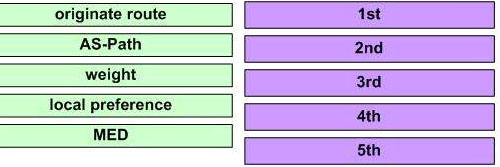
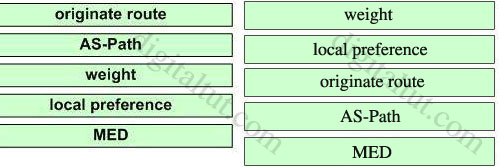
Place the BGP attributes in the correct order used for determining a route.
Answer:
Question 2
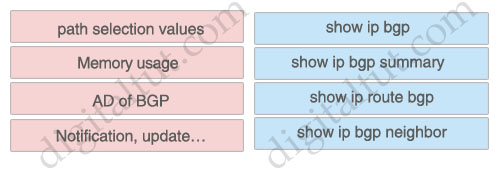
Place the BGP commands to the proper locations
Answer:
+ show ip bgp: path selection values
+ show ip bgp summary: Memory usage
+ show ip route bgp: AD of BGP
+ show ip bgp neighbor: Notification, update…
Question 3
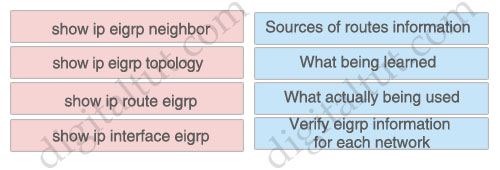
Place the EIGRP commands to the proper locations
Answer:
Sources of routes information: show ip eigrp neighbor
What being learned: show ip eigrp topology
What actually being used: show ip route eigrp
Verify eigrp information for each network: show ip interface eigrp
Question 4
Place the EIGRP terms to the proper locations
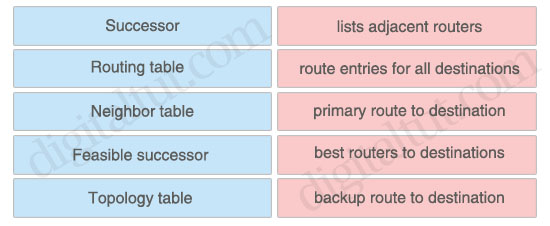
Answer:
lists adjacent routers: Neighbor table
route entries for all destinations: Topology table
primary route to destination: Successor
best routers to destinations: Routing table
backup route to destination: Feasible successor
Question 5
Place the EIGRP packets to the proper locations
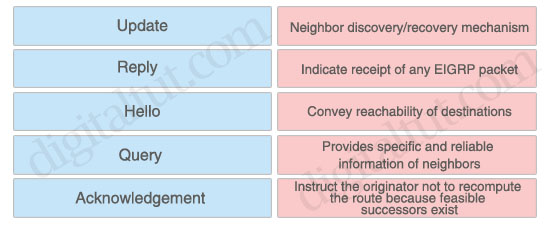
Answer:
Neighbor discovery/recovery mechanism: Hello
Indicate receipt of any EIGRP packet: Acknowledgement
Convey reachability of destinations: Update
Provides specific and reliable information of neighbors: Query
Instruct the originator not to recompute the route because feasible successors exist: Reply

can somebody explain this DnD please.
BGP determines the best path to each destination for a BGP speaker by comparing path attributes according to the following selection sequence:
Select a path with a reachable next hop.
Select the path with the highest weight.
If path weights are the same, select the path with the highest local preference value.
Prefer locally originated routes (network routes, redistributed routes, or aggregated routes) over received routes.
Select the route with the shortest AS-path length.
If all paths have the same AS-path length, select the path based on origin: IGP is preferred over EGP; EGP is preferred over Incomplete.
If the origins are the same, select the path with lowest MED value.
If the paths have the same MED values, select the path learned via EBGP over one learned via IBGP.
Select the route with the lowest IGP cost to the next hop.
Select the route received from the peer with the lowest BGP router ID.
So the “originate route” is the “prefer locally originated routes”?
terms “originated route” and “router originated” can be considered the same :D
wud you please put more drag and drop questions thanks
If you take time to read ALL the comments in the share your experience section, you will know ALL the D&D :)
I am always confused by the term “originate”. When the route is originated by THIS router, it comes directly after Local Preference (third criterium). When it is NOT originated from this router, it is originated from another Router. If that other router got it via redistribution, or via a network statement it s the fifth criterium. Both criteria use the term “origin”, but how you read the question determines which criterium it is (and whether AS-Path, which is the fourth criterium, is being used).
Number 3 must be As-Path and Number must be Origin. Bellow is the correct order:
1. Weight
2. Local Preference
3. AS-Path
4. Origin
5. NED
http://www.cisco.com/en/US/tech/tk365/technologies_tech_note09186a0080094431.shtml#bgpmpath
@YT
according to that link they have not said they r in order, I have crosschecked and digitaltut has given it in a correct order
correct order :
from http://www.cisco.com/en/US/tech/tk365/technologies_tech_note09186a0080094431.shtml#bgpmpath
In order to be candidates for multipath, paths to the same destination need to have these
characteristics equal to the best-path characteristics:
Weight
Local preference
AS-PATH length
Origin
MED
One of these:
Neighboring AS or sub-AS (before the addition of the eiBGP Multipath feature)
AS-PATH (after the addition of the eiBGP Multipath feature)
Some BGP Multipath features put additional requirements on multipath candidates.
GUYS!
Specialy Aric and YT,
Please DONT confuse others,
Originate route is NOT ORIGIN
origin means a different concept
origin = was the route learned from another protocol(IGP/EGP) besides BGP
ORIGIN = I, E , ?
Originate Route = Locally injected routes (created/originated by the router itself)
Originate Route = step 3 in 642-902, it is the 2nd “L” in
WLLA OMNI
Good luck
Hey guys!
I heard about that a drag & drop question is about GRE tunnel , NAT-PT ,dual stuck.Can U share it ?thx!!!!!
i think it should not be NWLLAOMNI anymore….it should be N W L O A O M N I =)
where are the others dragnddrops plz if someone has them post them here
Memorizing the BGP decision process steps is very useful and you should remember them. The table below lists the complete path selection process:
1. Weight (Bigger is better)
2. Local preference (Bigger is better)
3. Self originated (Locally injected is better than iBGP/eBGP learned)
4. AS-Path (Smaller is better)
5. Origin (Prefer ORIGIN code I over E, and E over ?)
6. MED (Smaller is better)
7. External (Prefer eBGP over iBGP)
8. IGP cost (Smaller is better)
9. EBGP Peering (Older is better)
10. RID (Lower is better)
Below are other Drag & Drop Questions as Willdo commented in the “Share your ROUTE Experience”:
4. IPv4 to IPv6 Transition Methods
-.-.-.-.-.-.-.-.-.-.-.-.-.–.-.-.-.-.-.-.-.
Chose 4 from below:
NAT-PT
6 to 4 tunnels
GRE tunnels
Route tagging
IPsec tunnels
ISATAP tunnels
//……Answers….//
NAT-PT
6 to 4 tunnels
GRE tunnels
ISATAP tunnels
-.-.-.-.-.-.-.-.-.-.-.-.-.-.
2. BGP ATTRIBUTES
-.-.-.-.-.-.-.-.-.-.-.-.-.-
* Weight- ..not advertised to other routers…
* Local Preference- …Propagated through autonomous system.
* MED- …Propagated between autonomous system.
-.-.-.-.-.-.-.-.-.-.-.-.-.-.
3. BGP Attributes
-.-.-.-.-.-.-.-.-.-.-.-.-.-
Put them in the right order
Answer:
1st = Weight
2nd = Local Pref
3rd = Originate Route
4th = AS Path
5th = MED
****************show bgp command and related information**************
1.Show ip bgp a. path selection values
2.Show ip bgp summary b. Notification, update…
3.Show ip route bgp c. AD of BGP
4.Show ip bgp neighbor d. Memory usage
****************show eigrp command and related information**************
1.Show ip eigrp neighbor a. Sources of routes information
2.Show ip eigrp topology b. What being learned
3.Show ip route eigrp c. What actually being used
4.Show ip interface eigrp d. Verify eigrp information for each network
-.-.-.-.-.-.-.-.-.-.-.-.-.-.
5) LSA Corresponding area type
-.-.-.-.-.-.-.-.-.-.-.-.-.-
Stub<-LSA 1,2,3
NSSA<-LSA 1,2,3,7
Backbone or transit<-LSA 1,2,3,4,5
totally NSSA<-LSA 1,2,7
totally stubby<-LSA 1,2
hi do you like car rims?
digitut, can you please amend the show BGP commands, because on the drag and drop on top of the page it is like as below…
show ip bgp summary is Memory usage
and
show ip bgp neighbors is notifications updates
please can you tell which is the righ one
cheers
R5>sh ip bgp summary
BGP router identifier 200.1.6.1, local AS number 6500
BGP table version is 6, main routing table version 6
5 network entries using 645 bytes of memory
5 path entries using 260 bytes of memory
3/2 BGP path/bestpath attribute entries using 372 bytes of memory
0 BGP route-map cache entries using 0 bytes of memory
0 BGP filter-list cache entries using 0 bytes of memory
BGP using 1277 total bytes of memory
BGP activity 5/0 prefixes, 5/0 paths, scan interval 60 secs
Neighbor V AS MsgRcvd MsgSent TblVer InQ OutQ Up/Down State/PfxRcd
4.4.4.4 4 5500 7 9 6 0 0 00:04:12 0
we can see it’s the memory usage
show ip bgp neighbors
BGP neighbor is 1.1.1.1, remote AS 5500, internal link
BGP version 4, remote router ID 0.0.0.0
BGP state = Active
Last read 00:02:47, last write 00:02:47, hold time is 180, keepalive interval is 60 seconds
Message statistics:
InQ depth is 0
OutQ depth is 0
Sent Rcvd
Opens: 0 0
Notifications: 0 0
Updates: 0 0
Keepalives: 0 0
Route Refresh: 0 0
Total: 0 0
Default minimum time between advertisement runs is 0 seconds
we can see it’s the packets statistics among other – so it’s notification, updates…
@Ben Hayak
you are right
i am so sorry, i made a mistake
@digitaltul
1.Show ip bgp a. path selection values
2.Show ip bgp summary b. Notification, update…
3.Show ip route bgp c. AD of BGP
4.Show ip bgp neighbor d. Memory usage
above DND is incorrect.The website’s answer is correct.I get Below information from my test.please comment it.
show ip bgp summary:
BGP router identifier 1.1.1.1, local AS number 100
BGP table version is 2, main routing table version 2
1 network entries using 101 bytes of memory
1 path entries using 48 bytes of memory
1 BGP path attribute entries using 60 bytes of memory
0 BGP route-map cache entries using 0 bytes of memory
0 BGP filter-list cache entries using 0 bytes of memory
BGP using 209 total bytes of memory
BGP activity 1/0 prefixes, 1/0 paths, scan interval 60 secs
Neighbor V AS MsgRcvd MsgSent TblVer InQ OutQ Up/Down State/PfxRcd
10.1.1.2 4 100 4 5 2 0 0 00:00:53 0
show ip bgp neighbors :
BGP neighbor is 10.1.1.2, remote AS 100, internal link
BGP version 4, remote router ID 2.2.2.2
BGP state = Established, up for 00:01:12
Last read 00:00:11, hold time is 180, keepalive interval is 60 seconds
Neighbor capabilities:
Route refresh: advertised and received(old & new)
Address family IPv4 Unicast: advertised and received
Message statistics:
InQ depth is 0
OutQ depth is 0
Sent Rcvd
Opens: 1 1
Notifications: 0 0
Updates: 1 0
Keepalives: 4 4
Route Refresh: 0 0
Total: 6 5
Default minimum time between advertisement runs is 5 seconds
For address family: IPv4 Unicast
BGP table version 2, neighbor version 2
Index 1, Offset 0, Mask 0×2
Sent Rcvd
Prefix activity: —- —-
Prefixes Current: 1 0
Prefixes Total: 1 0
Implicit Withdraw: 0 0
Explicit Withdraw: 0 0
Used as bestpath: n/a 0
Used as multipath: n/a 0
……………………………………
Mr Ben
the answer in website is correct
the second
what this words
?
For address family: IPv4 Unicast
BGP table version 2, neighbor version 2
Index 1, Offset 0, Mask 0×2
Sent Rcvd
Prefix activity: —- —-
Prefixes Current: 1 0
Prefixes Total: 1 0
Implicit Withdraw: 0 0
Explicit Withdraw: 0 0
Used as bestpath: n/a 0
Used as multipath: n/a 0
http://www.cisco.com/en/US/tech/tk365/technologies_tech_note09186a0080094431.shtml
The Mnemonic isn’t going to be as easy as we’d all like.
1. Weight (Largest)
2. Local Preference (Largest)
3. Locally Originated (Via IGP, network or aggregate command)
4. AS-Path (shortest)
5. Origin Type (IGP better than EGP better than Incomplete)
6. MED
So, the mnemonic is WLLAOM. With two L’s right next to each other. A pain on the ass but what are you going to do? You could look at it was WPOAOM, but still two O’s next to each other then.
While
Larry
Listened
Arnold
Opened
Mail
Or something.
does anyone remember the D&D regarding ospf implementation plan??? please share.
Hi Guys
I am preping for my MPLS 642-611 exam. Can someone please point me to the right directions for dumps / labs. I have old dumps but i have no idea how exam labs looks like. Any help will be great.
Thanks.
I just signed up to your blogs rss feed. Will you post more on this subject?
@ANNA
It is a part of information from show ip bgp neighbors :
Dear Concers,
in dumps 642-902 v3.37 255 q there is only one question of DND, please guide .is it enough or i need to explor more…
Further please help me about the validity of that version…….
Thanks to ALL.
Another new D&D question in the exam:
new D&D
—————————————————————————————————-
stub————————————————>CIR 256kb
bandwidth management ———————->Low Wan Links
redistribution————————————->integrate of 2 companies
authentication————————————> wan link to external
—————————————————————————————————-
All valid, thx digitute
this appears in my exam
****************show bgp command and related information**************
1.Show ip bgp a. path selection values
2.Show ip bgp summary b. Notification, update…
3.Show ip route bgp c. AD of BGP
4.Show ip bgp neighbor d. Memory usage
****************show eigrp command and related information**************
1.Show ip eigrp neighbor a. Sources of routes information
2.Show ip eigrp topology b. What being learned
3.Show ip route eigrp c. What actually being used
4.Show ip interface eigrp d. Verify eigrp information for each network
-.-.-.-.-.-.-.-.-.-.-.-.-.-.
5) LSA Corresponding area type
-.-.-.-.-.-.-.-.-.-.-.-.-.-
Stub<-LSA 1,2,3
NSSA<-LSA 1,2,3,7
Backbone or transit<-LSA 1,2,3,4,5
totally NSSA<-LSA 1,2,7
totally stubby<-LSA 1,2
@digitaltut: you should update this DnD page.
I have made all of the 642-902 Test sims in a GNS3 format, just email if you want a copy at cciersbound@yahoo.com
Later,
CCIERSBound
Hi all,
I took the exam yesterday.
For the LSAs DnD there is no option 1,2,7. Instead there is only 2,7.
Good luck.
hi stub what about the sim. ?
did u do the same as in the tut ?
I took the exam yerterday
this two drag and drop cam to me…
the sim four of these sims came go ahead guys ,dont be afaid
Sorry hole but your answer to **show bgp command and related information** is wrong. I agree with the answer listed above the comments. I’ve run the commands and pasted the relevant bits of the output.
SH IP BGP: Shows path selection (i.e. next hop) values, see below.
Network Next Hop Metric LocPrf Weight Path
*>i1.1.1.1/32 10.1.1.1 0 100 0 i
—————
SHOW IP BGP SUMMARY: Shows memory usage info, see below
1 network entries using 117 bytes of memory
1 path entries using 52 bytes of memory
2/1 BGP path/bestpath attribute entries using 248 bytes of memory
0 BGP route-map cache entries using 0 bytes of memory
0 BGP filter-list cache entries using 0 bytes of memory
BGP using 417 total bytes of memory
—————
SHOW IP ROUTE BGP: Shows the AD (administrative Distance, 200) of BGP, see below.
1.0.0.0/32 is subnetted, 1 subnets
B 1.1.1.1 [200/0] via 10.1.1.1, 00:04:08
—————
SHOW IP BGP NEIGHBORS: Shows notification and update counters, see below.
Sent Rcvd
Opens: 1 1
Notifications: 0 0
Updates: 1 0
Keepalives: 19 19
Route Refresh: 0 0
Total: 21 20
So yeah the answer listed on this page for Question 2 is correct.
Reading out of the ROUTE course book (volume 3 p6-102) it is DEFINITELY: WLOAM for the BGP route selection (it’s actually WLOAOM, but origin code is not an option here).
Have a look at the list below
1- Highest ‘WEIGHT’
2- highest ‘LOCAL PREFERENCE’
3- Prefer ‘ORIGINATED ROUTE’ or route originated from the local router
4- Shortest ‘AS PATH’
note: prefer lowest ‘Origin code’ is technically number 5 (i think this other ‘O’ option is where the confusion is coming in) but like I said above it isn’t listed as an option
5- Lowest ‘MED’
OK that’s it for tonight…sorry but it bothers me when we’re all trying to learn and figure things out and people put wrong information in the comments without double and triple checking, makes it hard to distinguish the clever people (Ben Hayak, Joe, etc) from the other not so good comments. /rant
hi all ,
i got Route exam tomorrow..
please confirm me right ans of this ques
****************show bgp command and related information**************
1.Show ip bgp a. path selection values
2.Show ip bgp summary b. Notification, update…
3.Show ip route bgp c. AD of BGP
4.Show ip bgp neighbor d. Memory usage
Nothing is to worry. The answer for the BGP D&D given in website is Correct.
To memorise
Show ip bgp – Path Selection Values
Show ip bgp Summary – Memory Usage
———– ———
Show ip bgp Neigbour – Notification, update…..
— –
Show ip route (of) bgp – AD of BGP
—- –
All will be good if learn with Fun.
Please any one have experience to give Tshoot exam . and any one have Tshoot P4S.
and how much % P4S is coming is exam now a days in ccnp?
y first packet always dropped when pinging 2 device in network first time?????
Today I did my Route exam. I got 5 drag & drops including above 3.
Sejal,
First packet is usually dropped because of ARP request…please read over ARP and you will be ok,
@ mnc
can you share what other DnD you got?
I know of other 4 besides the 2 showed here.
1. OSPF
LSA 1,2,3,4,5 ……. Area backbone
LSA 1,2,3 …………. Area Stub
LSA 1,2,3,7 ………. Area NSSA
LSA 1,2 …………… Area totally Stub
LSA 1,2,7…………. Area totally NSSA
2. IPV4 to IPV6 transition
Nat-PT
6to4 tunnels
Gre tunnels
ISATAP tunels
3. EIGRP
show IP route eigrp ………. What actuall is being used
Show IP interface eigrp ….. Verify Eigrp info for each net
Show IP eigrp topology ….. What is being learned
Show IP eigrp neighbor ….. Sources of routes info
4. BGP attributes
weight …………. not advertised to other routers
local-pref ……… propagated through AS
Med …………….. Propagated between AS
is there others we should be aware of?
thanks.
Anyone can update about recent question you had in exam?
hello-neighbordiscovery/recovery mechanism
acknowledgment- indicate reciept of any eigrp packet
query =convey reachability of destination
update=provides specific and reliable info of neighbors
reply=instruct the originator not to recompute the route bcoz feasible successors exist
here is answers for query and update are correct?
Thank you all for the ccnp info
http://docwiki.cisco.com/wiki/Border_Gateway_Protocol
Here is MED on 3rd place ….
I don’t know what to thinking …
http://www.cisco.com/en/US/tech/tk365/technologies_tech_note09186a0080094431.shtml
Here is MED on 6th place …
Hi All,
Pass CCNP route on 3rd Feb. gogy is 95% valid. All sim from gogy. below is new D&D
Implementation Plan for an ospf Project.
1. Local preference value
2. Update query boundaries
3. Summarization boundaries
4. Ospf process ID that will be used
5. Authentication type that will be used
6. ospf Area and associated prefix
7. load sharing method that will be used
8. Amount of bandwidth that will allocated to ospf.
Hi! i took the exam last feb 11 and passed. the DND below also appeared in my exam. You need to choose 4 answers. I’m not sure under which category this questions fall. I chose 3,4,5,6
***********************
pdcisco
February 4th, 2011
Hi All,
Pass CCNP route on 3rd Feb. gogy is 95% valid. All sim from gogy. below is new D&D
Implementation Plan for an ospf Project.
1. Local preference value
2. Update query boundaries
3. Summarization boundaries
4. Ospf process ID that will be used
5. Authentication type that will be used
6. ospf Area and associated prefix
7. load sharing method that will be used
8. Amount of bandwidth that will allocated to ospf.
*********************************************
Anyone have the definitive answer on the above D&D?
Which 4 of the below are correct?
Implementation Plan for an ospf Project.
1. Local preference value
2. Update query boundaries
3. Summarization boundaries
4. Ospf process ID that will be used
5. Authentication type that will be used
6. ospf Area and associated prefix
7. load sharing method that will be used
8. Amount of bandwidth that will allocated to ospf.
I’ve got 5! 2,3,4,5,6
I’m torn between “summarization boundaries” and “update boundaries” I’m thinking update is more correct for OSPF?
what do you think? could it be nr 8 amount of bandwidth instead of ospf process id or summarization? local pref clearly is not and neither update query (query EIGRP) or load sharing…
Hi,
i’m not sure if this question was already asked…
ip tunnelingis a method to encapsulate ip datagram within ip datagrams, which allows datagram intended for one ip address to be wrapped and redirected to another ip address… drag and header fields to the appropriate places
options:
ipv6 header upper layer pdu ipv4 header extension headers
answer from goggy:
ipv4 header ipv6 header upper layer extension header
does anyone have any suggestions and does this sound right to you all?
thanks
@Everyone preparing for the exam
The below is from Quick Reference guide
BGP Path Selection Criteria
————————————-
BGP tries to narrow its path selection down to one best path; it does not load balance by default. To do so, it examines the
path attributes of any loop-free, synchronized (if synchronization is enabled) routes with a reachable next-hop in the
following order:
1. Choose the route with the highest weight.
2. If weight is not set, choose the route with the highest local preference.
3. Choose routes that this router originated.
4. Choose the path with the shortest Autonomous System path.
5. Choose the path with the lowest origin code (i is lowest, e is next, ? is last).
6. Choose the route with the lowest MED, if the same Autonomous System advertises the possible routes.
7. Choose an EBGP route over an IBGP route.
8. Choose the route through the nearest IGP neighbor as determined by the lowest IGP metric.
9. Choose the oldest route
Implementation Plan for an ospf Project.
Summarization boundaries
Ospf process ID that will be used
Authentication type that will be used
ospf Area and associated prefix
****************show eigrp command and related information**************
1.Show ip eigrp neighbor a. Sources of routes information
2.Show ip eigrp topology b. What being learned
3.Show ip route eigrp c. What actually being used
4.Show ip interface eigrp d. Verify eigrp information for each network
OR
****************show eigrp command and related information**************
1.Show ip eigrp neighbor a. Sources of routes information
2.Show ip eigrp topology c. What actually being used
3.Show ip route eigrp b. What being learned
4.Show ip interface eigrp d. Verify eigrp information for each network
which one is right ?
****************show eigrp command and related information**************
1.Show ip eigrp neighbor a. Sources of routes information
2.Show ip eigrp topology b. What being learned
3.Show ip route eigrp c. What actually being used
4.Show ip interface eigrp d. Verify eigrp information for each network
of couse,this one is right
Which 4 of the below are correct?
Implementation Plan for an ospf Project.
1. Local preference value
2. Update query boundaries
3. Summarization boundaries
4. Ospf process ID that will be used
5. Authentication type that will be used
6. ospf Area and associated prefix
7. load sharing method that will be used
8. Amount of bandwidth that will allocated to ospf.
I will choose 4 5 6 8 the bandwidth is very importent for the IDC。。
Thanks a lot to Digitaltut and all for sharing valuable info. on this site.
@Carlos
IPv6 in IPV4 Drag and drop correct answer is
IPV4 Header ==IPV6 header=== extension header==Upper layer PDU
Check this link for explanation
http://thelazyadmin.com/blogs/thelazyadmin/archive/2011/02/02/transitioning-to-ipv6-part-1.aspx
BGP How the Best Path Algorithm Works
BGP assigns the first valid path as the current best path. BGP then compares the best path with the next path in the list, until BGP reaches the end of the list of valid paths. This list provides the rules that are used to determine the best path:
1. Prefer the path with the highest WEIGHT.
2. Prefer the path with the highest LOCAL_PREF.
3. Prefer the path that was locally originated via a network or aggregate BGP subcommand or through redistribution from an IGP.
Local paths that are sourced by the network or redistribute commands are preferred over local aggregates that are sourced by the aggregate-address command.
4. Prefer the path with the shortest AS_PATH.
5. Prefer the path with the lowest origin type.
Note: IGP is lower than Exterior Gateway Protocol (EGP), and EGP is lower than INCOMPLETE.
6. Prefer the path with the lowest multi-exit discriminator (MED).
http://www.cisco.com/en/US/tech/tk365/technologies_tech_note09186a0080094431.shtml
Which 4 of the below are correct?
Implementation Plan for an ospf Project.
1. Local preference value
2. Update query boundaries
3. Summarization boundaries
4. Ospf process ID that will be used
5. Authentication type that will be used
6. ospf Area and associated prefix
7. load sharing method that will be used
8. Amount of bandwidth that will allocated to ospf.
I choose 3,4,5,6
some says that answer in the ospf implementation plan is 3,4,5,6 and other 4,6,5,3…which is the correct order???? somebody with a 100% in ospf plsss
Implementation Plan for an ospf Project.
1. Local preference value
2. Update query boundaries
3. Summarization boundaries
4. Ospf process ID that will be used
5. Authentication type that will be used
6. ospf Area and associated prefix
7. load sharing method that will be used
8. Amount of bandwidth that will allocated to ospf.
someone has got 1000% today
he select 3456
1st = Weight
2nd = Local Pref
3rd = Originate Route
4th = AS Path
5th = MED
i think the answer is’t correct
i thank the best answer is
1st = Weight
2nd = Local Pref
3rd = Originate Route
4th = MED
5th = AS Path
i will have the exam who could help me
my Email : hustar2@yahoo.com.cn
thanks very much
I’m sorry
Think the answer is
1st = Weight
2nd = Local Pref
3th = AS Path
4rd = Originate Route
5th = MED
my Email: hustar2@yahoo.com.cn
Just type BGP path selection in google and it will tell you.
The answer is:
1st = Weight
2nd = Local Pref
3rd = Originate Route
4th = AS Path
5th = MED
thank you
thxxxxxxxxx
most of us said that AS-PATH should be before ORIGINATE ROUTE
Here ORIGINATE ROUTE does not mean ORIGIN TYPE i.e EGP or IGP or INCOMPLETE, here originated route means routes originated by itself either by network command or aggregate address command. so the answer is right, first ORIGINATE ROUTE then AS-PATH
1. Weight
2. Local Preference
3. Originated route (not ORIGIN)
4. AS-Path
5. NED
Hi frds
I cleared my CCNP ROUTE exam today with 941/1000,
4 d&d in that 2 new —1 frm ospf ,2 also frm ospf abt project implement
4 labs in that —-1,EIGRP OSPF Redistribution
2,Policy Based Routing—finally u activate t 9 packets then check by show
ip route map
3,IPv6 OSPF Virtual Link
4,OSPF —change ip address 192.168.31.5/28——-
3 more new Q.
Thanks to digitaltut
Gogy,Chicken and Rice—-still valid.
Implementation Plan for an ospf Project.
1. Local preference value
2. Update query boundaries
3. Summarization boundaries
4. Ospf process ID that will be used
5. Authentication type that will be used
6. ospf Area and associated prefix
7. load sharing method that will be used
8. Amount of bandwidth that will allocated to ospf.
I say 2,3,5,6
ProcessID is not important, it is only locally significant
Implementation Plan for an ospf Project.
1. Local preference value
2. Update query boundaries
3. Summarization boundaries
4. Ospf process ID that will be used
5. Authentication type that will be used
6. ospf Area and associated prefix
7. load sharing method that will be used
8. Amount of bandwidth that will allocated to ospf.
i think 3,4,5,6 is correct.
if OSPF Area is confirmed, update query boundaries are confirmed also.
although ospf process id diff may not affect actual ospf routing but diff routers using diff process id may cause confusion. i thinks same process id is recommended when implement big campus network.
Which 4 of the below are correct?
Implementation Plan for an ospf Project.
3. Summarization boundaries
4. Ospf process ID that will be used
5. Authentication type that will be used
6. ospf Area and associated prefix
- Update Query DOESNT exist in OSPF, LSA scope does, but it doesnt say that. Update Query is an EIGRP thing. OSPF Process ID is locally significant but still should be known. I think its all about the least wrong answer, rather then the right one :)
@samarjit
You are 100 percent right. It is a bit of a trip up using that wording but still right :)
which one is correct, please advice
Update - convey reachability of destination
Query - specific and reliable information of neighbors
reply - instruct the originator not to recompute the route because feasible successors exist
or
Query - convey reachability of destination
Update - specific and reliable information of neighbors
reply - instruct the originator not to recompute the route because feasible successors exist
I think it is the first because the Query asks a neighbor whether that neighbor has a loop-free route for the listed prefix/length. So it is a specific information about neighbors whereas the update transmits information about destinations and their reachability.
http://www.4shared.com/file/y0uYALYn/642-902_Dumps__12-05-2011_.htm
The dumps 642-902 (12-05-2011) contains new drag & drop questions. In exam, the sequence may be changed. So concentrate on sequence of drag & drop.
Implementation Plan for an ospf Project.
1. Local preference value
2. Update query boundaries
3. Summarization boundaries
4. Ospf process ID that will be used
5. Authentication type that will be used
6. ospf Area and associated prefix
7. load sharing method that will be used
8. Amount of bandwidth that will allocated to ospf.
Correct answer is
2 Update Query Boundaries
3 Summarization Boundaries
4 OSPF process ID that will be used
6 OSPF areas and associated prefixes
Answer taken from the latest Pass4Sure 3.0.10
@all these are the correct asnwers
****************show bgp command and related information**************
1.Show ip bgp a. path selection values
2.Show ip bgp summary b. Memory usage
3.Show ip route bgp c. AD of BGP
4.Show ip bgp neighbor d. Notification, update…
****************show eigrp command and related information**************
1.Show ip eigrp neighbor a. Sources of routes information
2.Show ip eigrp topology b. What being learned
3.Show ip route eigrp c. What actually being used
4.Show ip interface eigrp d. Verify eigrp information for each network
***************
3. Summarization boundaries
4. Ospf process ID that will be used
5. Authentication type that will be used
6. ospf Area and associated prefix
@all tomorrow I got the exam, I need help with this, why stub is CIR 256k??? and BW management is Low Wan Links????
stub——————-————————————>CIR 256kb
bandwidth management —————->Low Wan Links
redistribution————————————->integrate of 2 companies
authentication—-———————————> wan link to external
…….Understanding the Internet Buyer.Spencer Rascoff COO Zillow.com Twitter spencerrascoff National Association of REALTORS November 16 2009.. Are you ready?. ..55 of REALTORS business originated from Web in 2009 compared with 48 in 2008 and 24 five years ago.39 own a handheld wireless Internet device for their real estate business up from 22 a year ago.. .. ..sadsadsad.. Crossover graph showing online RE penetration CAR . ..sadsadsad.. ..sadsadsad.. iPhone is the new platform. ..19.5M iPhones sold in US since June 2007 launch 3.5M in most recent quarter.. Zillow 1 Re…. Using the creases shown pull the corner from the point shown down to the other poinr shown and flatten…7.
Passed 24-05-11.
Labs – IPv6 virtual link, route-map, OSPF, redistribution.
D&D – one new about BGP.
more new questions.
Summary – 860/1000.
hey,
any details about this new BGP D&D and some new questions? if s.one, of course, remember :)
once and for all, which 4 is correct?
Implementation Plan for an ospf Project.
1. Local preference value
2. Update query boundaries
3. Summarization boundaries
4. Ospf process ID that will be used
5. Authentication type that will be used
6. ospf Area and associated prefix
7. load sharing method that will be used
8. Amount of bandwidth that will allocated to ospf.
I would also like to know the correct 4 to choose. Been searching and can’t find the answer
Found this not much help http://imageshack.us/photo/my-images/15/ospfplan.jpg/
Origin and Originate Route are 2 completely different things. Read carefully again.
Implementation Plan for an ospf Project.
1. Local preference value
2. Update query boundaries
3. Summarization boundaries
4. Ospf process ID that will be used
5. Authentication type that will be used
6. ospf Area and associated prefix
7. load sharing method that will be used
8. Amount of bandwidth that will allocated to ospf.
Why is 4 correct? I mean the process-id is not important like in EIGRP!
fr
Correct answer is
3. Summarization boundaries
4. Ospf process ID that will be used
5. Authentication type that will be used
6. ospf Area and associated prefix
I got 100% in OSPF
Hello guys..
does anyone have ccnp route 642-902 cbt, pass4sure or any dumps. kindly send me links on shariq2009@live.com or u can send here as well.
Thanksss
Hello Friend,
Does anyone have CCNP routing dumps kindly send on i.sandeepjaiswal@gmail.com ….
thnaks for support
Hello Friend,
Does anyone have CCNP routing dumps kindly send on colosian@yahoo.com ….
thnaks for support
Hello People
Pass test today score 965.
ATENCION The dragn drop no valid.
DRAG AND DROP VALID
stub——————-————————————>CIR 256kb
bandwidth management —————->Low Wan Links
redistribution————————————->integrate of 2 companies
authentication—-———————————> wan link to external
===============================
1. OSPF
LSA 1,2,3,4,5 ……. Area backbone
LSA 1,2,3 …………. Area Stub
LSA 1,2,3,7 ………. Area NSSA
LSA 1,2 …………… Area totally Stub
LSA 1,2,7…………. Area totally NSSA
=============================================
I schedule my exam on date 16 July 5, 2011 please someone tell me which dumps is valid.
Can you provide the latest route stuff