
Home > EIGRP Questions

EIGRP Questions

September 3rd, 2011 in ROUTE 642-902 Go to comments

Here you will find answers to EIGRP questions

Question 1

Which three statements about the EIGRP routing protocol are true? (Choose three)

A – EIGRP sends periodic hello packets to the multicast IP address 224.0.0.9
B – EIGRP sends periodic hello packets to the multicast IP address 224.0.0.10
C – EIGRP supports five generic packet types. including hello, update, query, reply, and ACK packets
D – EIGRP supports five generic packet types, including hello, database description (DBD), link-state request (LSR), link-state update (LSU), and LSAck
E – E. EIGRP will form a neighbor relationship with another peer even when their K values are mismatched
F – A. EIGRP will not form a neighbor relationship with another peer when their K values are mismatched


Answer: B, C, F

Question 2

After DUAL calculations, a router has identified a successor route, but no routes have qualified as a feasible successor. In the event that the current successor goes down, what process will EIGRP use in the selection of a new successor?

A – EIGRP will find the interface with the lowest MAC address
B – The route will transition to the active state
C – The route will transition to the passive state
D – EIGRP will automatically use the route with the lowest feasible distance (FD)
E – EIGRP will automatically use the route with the lowest advertised distance (AD)


Answer: B

Explanation

When a route (current successor) goes down, the router first checks its topology table for a feasible successor but it can’t find one. So it goes active on the that route to find a new successor by sending queries out to its neighbors requesting a path to the lost route.

Question 3

Refer to the exhibit. Routers R1 and R2 have established a neighbor relationship and are exchanging routing information. The network design requires that R1 receive routing updates from R2, but not advertise any routes to R2. Which configuration command sequence will successfully accomplish this task?
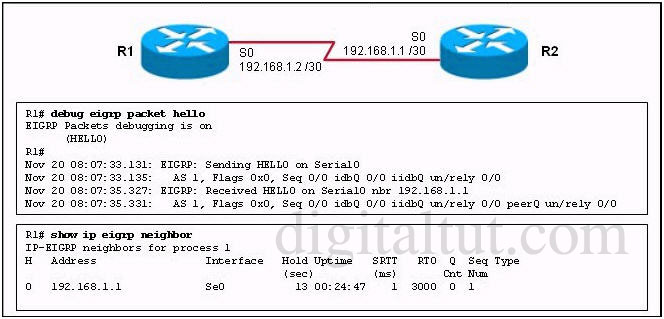
neighbor_relationship_distribute_list

A – R1(config)# router eigrp 1
R1(config-router)# passive-interface serial 0

B – R2(config)# router eigrp 1
R2(config-router)# passive-interface serial 0

C – R1(config)# access-list 20 deny any
R1(config)# router eigrp 1
R1(config-router)# distribute-list 20 out serial 0

D – R2(config)# access-list 20 deny any
R2(config)# router eigrp 1
R2(config-router)# distribute-list 20 out serial 0

E – R1(config)# access-list 20 permit any
R1(config)# router eigrp 1
R1(config-router)# distribute-list 20 in serial 0

F – R2(config)# access-list 20 permit any
R2(config)# router eigrp 1
R2(config-router)# distribute-list 20 in serial 0


Answer: C

Explanation

We can not use passive-interface to accomplish this task because the “passive-interface…” command (in EIGRP or OSPF) will shut down the neighbor relationship of these two routers (no hello packets are exchanged). And to filter routing updates we should configure a distribute list on R1 with an access list that deny all and apply it to the outbound direction so that R1 can receive but can not send routing updates.

Question 4

EIGRP has been configured to operate over Frame Relay multipoint connections. What should the bandwidth command be set to?

A – the CIR rate of the lowest speed connection multiplied by the number of circuits
B – the CIR rate of the lowest speed connection
C – the CIR rate of the highest speed connection
D – the sum of all the CIRs divided by the number of connections


Answer: A

Explanation

If the multipoint network has different speeds allocated to the VCs, take the lowest CIR and simply multiply it by the number of circuits. This is because in Frame-relay all neighbors share the bandwidth equally, regardless of the actual CIR of each individual PVC, so we have to get the lowest speed CIR rate and multiply it by the number of circuits. This result will be applied on the main interface (or multipoint connection interface).

Question 5
EIGRP_Active_state

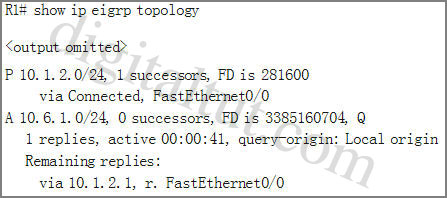
Refer to the exhibit. EIGRP is configured on all routers in the network. On a basis of the show ip eigrp topology output provided, what conclusion can be derived?

A – Router R1 can send traffic destined for network 10.6.1.0/24 out of interface FastEthernet0/0
B – Router R1 is waiting for a reply from the neighbor 10.1.2.1 to the hello message sent out before it declares the neighbor unreachable
C – Router R1 is waiting for a reply from the neighbor 10.1.2.1 to the hello message sent out inquiring for a second successor to network 10.6.1.0/24
D – Router R1 is waiting for a reply from the neighbor 10.1.2.1 in response to the query sent out about network 10.6.1.0/24


Answer: D

Explanation

From the output, we notice that there is an active route (A) and the reply status flag (r) was set. An active EIGRP route is the state when a network change occurs and a feasible successor is not found by a EIGRP router for a given route (10.6.1.0/24); and the reply status flag (r) means that R1′s queries were sent out to the neighbors asking for routing information to the 10.6.1.0/24 network but hasn’t received a reply yet. Therefore the answer A – router R1 can send traffic destined for network 10.6.1.0/24 is not correct because router R1 can’t find a path to that network. Answers B and C are not correct because R1 doesn’t send a hello message but a query asking for routing information to the desired network.


Comments
Comment pages
1 2 24
  1. mongolio
    August 10th, 2010

    Question 4

    EIGRP has been configured to operate over Frame Relay multipoint connections. What should the bandwidth command be set to?

    A – the CIR rate of the lowest speed connection multiplied by the number of circuits
    B – the CIR rate of the lowest speed connection
    C – the CIR rate of the highest speed connection
    D – the sum of all the CIRs divided by the number of connections

    Answer: A

    it seems to be logical, btw in Odom Route 642-902 book in Chapter 3 at paragraph EIGRP Bandwidth control noted:
    >>General recomendation: Set the bandwidth of multipoint subinterfaces toaround the total CIR for all VCs assigned to the subinterface.

    I a bit confused whom i will trust, can exam takers clear up this question?

  2. lucas
    August 15th, 2010

    from BSCI guide —> Configuring Bandwidth over a Hybrid Multipoint Network
    If the multipoint network has differing speeds allocated to the VCs, a more complex solution is
    needed. There are two main approaches:
    ■ Take the lowest CIR and multiply it by the number of circuits. Apply the product as the
    bandwidth of the physical interface. The problem with this configuration is that EIGRP will
    underutilize the higher-bandwidth links.
    ■ If possible, it is much easier to configure and manage an environment that has used
    subinterfaces, where a VC is logically treated as if it were a separate interface. The
    bandwidth command can be configured on each subinterface, which allows different speeds
    on each VC. In this solution, subinterfaces are configured for each VC and the CIR is
    configured as the bandwidth. Cisco recommends this as the preferred solution.

  3. Online Casino
    September 26th, 2010

    I always inspired by you, your opinion and way of thinking, again, thanks for this nice post.

    - Norman

  4. Tintin
    September 26th, 2010

    EIGRP Statc Route.

    I want to put a static route to EIGRP ASN. I’m thinking of below sequence of commands. Is this correct?

    router eigrp 100
    network 192.168.1.0
    exit

    ip default-network 192.168.1.0
    end

  5. what does my name mean
    October 3rd, 2010

    hi wats your myspace page

  6. confucius
    October 9th, 2010

    @question number 4:

    its asking for the total bandwidth that should be assigned on the main interface itself. its not asking for the sub-interface’s bandwidth. But reading it for the first will definitely make a candidate somehow confused and might lead to choosing letter B. especially when rushing to beat the timer.

    test developers who prepared this exams should consider that some of the candidate may not be good in analyzing deep english.

    common man, taking such exam should test the technical knowledge not to test how strong your vocabulary is

  7. optimusprime
    October 13th, 2010

    real exam questions i suppose ?

  8. teleBest
    October 19th, 2010

    @Confucius,

    ” taking such exam should test the technical knowledge not to test how strong your vocabulary is”

    We should tell Cisco about that!

  9. livelybrowsers
    October 20th, 2010

    Thanks for good stuff

  10. CCNP prospect
    October 30th, 2010

    I am just enjoying looking at this site (as my final review) before taking route exam on Wed.

  11. nursing assistant
    November 22nd, 2010

    Superb blog post, I have book marked this internet site so ideally I’ll see much more on this subject in the foreseeable future!

  12. Adam
    November 25th, 2010

    Hi Guys,

    I’ve just posted up my CCNP – Route nots for EIGRP, hope they are useful:

    http://cisco-revision.com/?p=153
    http://cisco-revision.com/?p=156

    - Adam

  13. abahad1234
    December 6th, 2010

    I would like to give thanks for create this site to admin…..really it’s very helping side for who want to maintain carrier about network……….

  14. Amanda
    December 13th, 2010

    check out good summary notes on packetlife.net

  15. SK
    December 27th, 2010

    Scored 977/1000 today. All Labs same from this site except ip address. Question gogy 273 is valid. Going for switching now. Guys thanks for the co-operation extended and spl thanks to the admin of Digital Tut.

  16. Aninda
    December 29th, 2010

    Hi Guys,
    I just starting studying and had a doubt. The Official Certification Guide (by wendell Odom) says that for EIGRP Authentication the key number does not have to match for the two routers, but Jeremy Cioara (CBT Nuggets) says they do not have to match.
    Could someone please explain who is correct.

  17. King
    January 16th, 2011

    Question 4

    EIGRP has been configured to operate over Frame Relay multipoint connections. What should the bandwidth command be set to?

    A – the CIR rate of the lowest speed connection multiplied by the number of circuits
    B – the CIR rate of the lowest speed connection
    C – the CIR rate of the highest speed connection
    D – the sum of all the CIRs divided by the number of connections

    Answer: A

    This is right answer Because: In Frame-Relay all the neighbor share bandwidth equally, regardless actual CIR on each individual PVC.

  18. Ken
    January 17th, 2011

    Hi, need some help here

    If variance is set to 2 and all other metric and K values are configured to their default routes, traffic from the internet is balanced across how many paths?

    40 15
    ———B —— C —-
    | 10 10 \ <-10 \ <- 15
    Internet — A — D — E ——– H — Data Centre
    | / <-10 / <- 20
    ———F —– B —-
    20 20

    How do you calc that? Sorry for the poor drawing

  19. DMANSR
    January 28th, 2011

    @ King
    I can confirm this answer from ROUTE Training. In the Cisco manual for ROUTE, under BW Utilization Issues – Multipoint interfaces, it states:
    “configure the BW to represent the minimum CIR multiplied by the number of circuits”
    THis ensures that the circuits with the lowest CIR values are not overdriven.

  20. xzyan
    February 5th, 2011

    Ken I was looking at that question too and It says that it should be 3 paths , but form my understanding it suppose to be 4 path , because variance 2 in this case is 60.. 2×30= 60
    and we have

    internet 10-10-10 data center =>A-D-E-H = 30
    internet 20-20-20 data center=>A-F-G-H = 60
    internet 20-20-10 data center=>A-F-E-H = 50
    internet 40-10-10 data center=>A-B-E-H = 60

    pls correct me if I am wrong

    http://www.cisco.com/en/US/tech/tk365/technologies_tech_note09186a008009437d.shtml

  21. kingkong
    February 5th, 2011

    you can see this question in http://www.7techs.com/bsci-exam?start=5 part 6,.

    the summ of 10+10+10 is 30 x by 2 =60
    ok

    but there are from internet to data center

    one path with 40 no valid > because the reported distance of neighbor B is 40, which is greater than the feasible distance (FD) so we have 3 path,. even when the sum give us 5 option, with 30, 40 and 60 respectively,. but the other 60 and 70 I suppose are not valid for that reason,. even when we have a tie,..
    please guys comment about this question to arrive to the true,.
    thanks

    kingkong :-)

  22. Sergey
    February 7th, 2011

    A->D->E->H = 30=FD of A (best route) =>valid (1)
    A->B->E->H = 60, AD of B=20valid (2)
    A->B->C->H = 70 > 60 => not valid
    A->F->E->H = 40, AD of F=20valid (3)
    A->F->G->H = 60, AD of F=40>FD of A=30 => not valid
    =>3 valid paths (Answer C)

  23. Hoi
    February 13th, 2011

    EH (10/0) -> best route from E to H
    EBCH (40/30)-> reported 30 > 2×10 -> invalid to E
    EFGH (50/40)-> reported 40 > 2×10 -> invalid to E
    AD -> H (30/20) -> best route from A to H

    BEH (20/10) -> E is best route from B to H
    BCH (30/15) -> reported 15 valid to B
    AB -> H (40/30) -> reported 30 valid to A
    AB -> H (50/35) -> reported 35 valid to A

    FEH (20/10) -> E is best route from F to H
    FGH (40/20) -> reported 20 valid to F
    AF -> H (40/30) -> reported 30 valid to A
    AF -> H (60/40) -> reported 40 valid to A

    So I think there are 5 (!) valid paths at all:
    ADEH, ABEH, ABCH, AFEH and AFGH

    Regarding to the answer possibilities there are 3 valid routes A can load ballance:
    AD -> H, AB -> H and AF -> H

  24. TSM
    February 19th, 2011

    Question about GOGY. Following scenario:

    How to avoid prefixes from RB or S0/0/0 entering the enterprise network?

    RB ——– S0/0/0 RA ———- Enterprise network.

    The answer (according to GOGY) is to use a mask exluding S0/0/0. I am pondering as to why using a distribute-list is not the correct answer. With a distribute list, the outcome would be more granular and there would be communication between RB and RA via EIGRP.

    Anyone?

  25. sam
    March 18th, 2011

    tsm

    wher should u apply tthe distibute liust\\

    think it u will get answer\

  26. johny
    March 21st, 2011

    why we r using no autosummary in eigrp?
    thank u

  27. johny
    March 21st, 2011

    i hV ONE MORE DOUBT..PLZ HELP ME..
    WHEN SUMMERIZATION IS configured why router creates a route pointed 2 nullo?
    i know it 2 avoid loops..bt how?

  28. javas
    March 29th, 2011

    EIGRP quest from gogy,

    Which three statements are true about EIGRP route summarization? (choose three)

    A. Manual route summarization is configured in router configuration mode when the router is configured for EIGRP routing.
    B. Manual route summarization is configured on the interface.
    C. When manual summarization is configured, the summary route will use the metric of the largest specific of the summary routes.
    D. The ip summary-address eigrp command generates a default route with an adinistrative distance of 90
    E The ip summary-address eigrp command generates a default route with an administrative distance of 5
    F When manual summarization is configured, the router immediately creates a route that points to null0 interface.

    gogy answ : BEF

    is it true if ip summary-address eigrp command issued it would generates a default route with AD 5 ?

    thx

  29. Ric Bobby
    March 30th, 2011

    @javas, yes, it`s true.
    When you don’t set the metric in the ip summary-address command, they automatically put 5.

  30. Anonymous
    April 1st, 2011

    hai friends,

    consider if router A advertise Eigrp summary address 10.1.0.0 255.255.0.0 ( for the routes 10.1.1.0/24 and 10.1.2.0/24 ) to router B.router B will install this route in its routing table.
    consider if a packet the comes to router B with the destination address of 10.1.5.1 ,router B will forward the packet to router A (according to summary address ) but router A doesnot know about the network 10.1.5.0 so it will match the router A default route and routing loop or suboptimal forwarding may happen .To avoid such situvation router A will create a route pointing to NULL 0 at the time of eigrp route summarization .this is also known as discard route .so if a packet with address that not known to router A ( no spcific route to the deatination ) will match the null 0 and discard the packet ..

    Eigrp summary address AD can be seen via sh ip route 10.1.0.0 255.255.0.0

    output will show know via Eigrp distance 5

    plz reply if anything wrong in my comments

  31. aldoss
    April 20th, 2011

    cant understand why AD become 5 ?

  32. Phoenix
    April 24th, 2011

    In the Question Which condition must be satisfied before an EIGRP neighbor can be considered a feasible
    successor?

    Many Dumps have given the correct answer as The neighbor’s advertised distance must be less than or equal to the feasible distance of the current successor.

    Few have given the Correct answer as The neighbor’s advertised distance must be less than the feasible distance of the current successor.

    As per the link http://www.cisco.com/en/US/tech/tk365 /technologies_white_paper09186a0080094cb7.shtml#feasibleandreported

    feasible successor is a path whose reported distance is less than the feasible distance (current best path)

    What is correct.

  33. Leo from China
    April 28th, 2011

    i failed my TSHOOT exam. this OSPF questions all of them wrong and old. one question from this questions. pls change and update that questions!!!! 9tut!!!

  34. will_succeed
    May 5th, 2011

    dont rely on dumps only please…study seriously before taking the exam guy that important read the maximum book you can read and try to understand the concept tats better

  35. fschris
    May 21st, 2011

    Can someone help me with this question on feasible sucessors:

    which two networks does core1 device have a feasible sucessors for:
    a) 172.17.0.0/30
    b) 172.17.1.0/24
    c) 172.17.2.0/24
    d)
    e)
    f)10.140.0.0/24

    AF are the answer but I dont know why… the entire question is in the gogy. In fact the other 2 questions I just cant get either but I understand the rules about successors and feasible successors.

    I just dont get the answers what are they looking for?

  36. fschris
    May 21st, 2011

    Please dis regard my previous question I find my answer in EIGRP SIMLET! thanks digtut! another donation coming sooon.

  37. Ganga
    May 22nd, 2011

    @Sergey for:
    A->D->E->H = 30=FD of A (best route) =>valid (1)
    A->B->E->H = 60, AD of B=20valid (2)
    A->B->C->H = 70 > 60 => not valid
    A->F->E->H = 40, AD of F=20valid (3)
    A->F->G->H = 60, AD of F=40>FD of A=30 => not valid
    =>3 valid paths (Answer C)

    The current FD after applying variance is 60, so the only valid paths that have to be ADEH, AFEH.

    Refer to what GOD says :) The metric of the entire path (the FD of the alternative route) must be lower than the variance multiplied by the local best metric (the current FD). In other words, the metric for the entire alternate path must be within the variance.

  38. Shikima
    May 22nd, 2011

    @fschris You need to check that question in this website,It’s in eigrp simlet, however, the AF is the correct answer cause they have just 1 FS.

  39. Mr Ekko
    May 26th, 2011

    thanks!

  40. braniance
    June 3rd, 2011

    Admins, hello! here are having problems with your site. malware warning Write me. icq 67446567456

  41. @joe
    June 3rd, 2011

    Pls can any one in d house give me a printable version of CCNP Route Official Certification Guide or any one. my contact is akin_joseph82@yahoo.com
    Thanks

  42. Azim
    June 5th, 2011

    Can anyone give me the answer of P4S v4.11 question number 14 of EIGRP, from my understanding it could be 5 but answer shows 3,

    confused

  43. Azim
    June 5th, 2011

    Qs no EIGRP17 of p4s 4.11, need discuss

  44. Marco
    June 5th, 2011

    @Azim
    imo C should be correct. What u think?

  45. Marco
    June 5th, 2011

    @azim
    last psot was to EIGRP 17

    Q14: 3 is correct, because Router A only has 2 feasible successors in its eigrp topology
    A B E H and A F E H which now go into routing table because of variance.
    Keep in mind that AD has to be less than FD to be a feasible successor.
    Variance do not change behaviour what what will be in eigrp topology table, it changes behaviour what will be in routing table.

  46. Sidney DSouza
    June 7th, 2011

    I agree with Marco. There are just three paths possible considering the RD.
    A-D-E-H : Best with a metric of 30 which will enter the routing table.
    A-F-E-H : Feasible successor with a metric of 40 enters the topology table.
    A-B-E-H : Feasible successor with a metric of 60 enters the topology table.

    The rest of the paths won’t make it to the topology table as feasible successors because their reported distances (AD) is equal to the FD.

    Hence a variance of 2 will allow the paths through A-F-E-H and A-B-E-H to be entered into the routing table in addition to the Successor A-D-E-H (total of 3 paths)
    Best metric 30×2= 60 which will include paths A-F-E-h and A-B-E-H with metrics of 40 and 60 respectively.

    hope that clears that question.
    mail.sidney@gmail.com

  47. Azim
    June 10th, 2011

    Hi Sidney:

    Thanks for clarification for Qs-17, can you give me a solution about QS-14, i suspect it might be ‘C’

  48. Azim
    June 10th, 2011

    P4s 4.11 279: Question-40

    10.0.0.0/8 or 10.10.10.0/24 which one will be in Routing table of R3 where AUTO-SUM is OFF on R1 ?

  49. Azim
    June 10th, 2011

    P4s 4.11 279: Question-54

    confusing,,,,
    EIGRP cannot add any route into Routing Table from Redistribution until METRIC values are SET. How could ‘C’ became the correct answer for STATIC routes here ?

  50. Sidney DSouza
    June 10th, 2011

    Hi Azim,

    Please paste the entire question as i do not have the p4s dumps.

  51. Med
    June 18th, 2011

    You are true I think Azim for Q14 P4s 4.11 : for me the answer is B

  52. Raspberries
    June 22nd, 2011

    Which condition must be satisfied b4 an EIGRP neighbor can be considered a feasible successor?

    A. The neighbor’s advertised distance must be less than or equal to the feasible distance of the current successor.
    B. The neighbor’s advertised distance must be less than the feasible distance of the current successor.

    Which one is correct? I think the right ans: is B. Am i right??

  53. Med
    June 22nd, 2011

    Yes it’s B

  54. sdfkjsdhf
    June 23rd, 2011

    The question asks…. “traffic from the Internet to the data center will bo load balanced across how many paths?”

    The question also states… “If the wariance value is configured as 2 on ALL routers…”. This means that the variance is set also on router B and that means if router B receives packects from the Internet which are destinated to the DC it will load balance across 2 paths:
    B>C>H and B>E>H. Both of these paths will be put into router’s B routing table because both of them meet successor/feasible successor requirements.

    So, the corect answer is 4:
    -A-B and then:
    -C-H
    -E-H
    -A-D-E-H
    -A-F-E-H

    regards

  55. akinade afeez.
    June 23rd, 2011

    just wanna say a big thank u to this site and all of you who have been adding one or two things to this forum. I passed my ccnp route(640-902) 2day with a score of 918. the labs are all the same(ciscopassguide 642.902.v.2010-11-27.by.goggy.272q) except that some hosts are locked.but if u know wat u’r doing, u will find ur way around it.

  56. Don
    June 23rd, 2011

    For the Load balance Q with V= 2 on ALL the router,
    the asnwer from my point of view is 2.
    since the rule says that : Any FD that is LESS THAN the (BEST FD)*2 , can enter the load balancing list.
    From A it will load to D and F.
    From D it will continue E then H.
    From F, G will fail the rule, and E will win and continue to H

    So only the BEST Path : ADEH and AFEH.

    Please correct me if am wrong.

  57. Sidney DSouza
    June 24th, 2011

    The correct answer is 3. Think every one has received full marks for it. explanation in the previous comments.

  58. sdfkjsdhf
    June 24th, 2011

    If the correct answer was 3 router B wouldn’t load balance traffic across C and E. Try to think about this from router’s B perspective.

    Correct answer is 4!

  59. sdfkjsdhf
    June 24th, 2011

    And show me any reason why router B will not forward traffic through router C? It will forward packets through C and E!

    Correct answer is 4!

  60. VARIANCE
    June 27th, 2011

    The Correct Answer is 2.
    Since, the Unequel Cost Load Balancing Rule says that “The Feasible Successor’s FD must be less than the Product of (Successor’s FD * Variance)”

    FS < Successor FD * Variance
    NOT
    FS D–>E–>H, FD= 30) and
    Two Feasible Successor
    (A–>B–>E–>H, FD= 60) and (A–>F–>E–>H, FD = 40)

    NOW,
    (Successor’s FD * Variance)
    30*2= 60

    So, Any Feasible Successor with a Feasible Distance Less than 60 will be copied into the Routing Table for Unequel Load Balancing.

    There is only one Feasible Successor with a FD Less than 60, Which is (A–>F–>E–>H, FD = 40).
    The other Feasible Successor (A–>B–>E–>H, FD= 60) is Equel to 60 not Less than 60.

    So, The Traffic from the Internet to the Data Centre will be LOAD BALANCED over 2 ROUTES NOT 3 ROUTES.

  61. VARIANCE
    June 27th, 2011

    The Correct Answer is 2.
    Since, the Unequel Cost Load Balancing Rule says that “The Feasible Successor’s FD must be less than the Product of (Successor’s FD * Variance)”

    FS < Successor FD * Variance
    NOT
    FS E–>H, FD= 30) and
    Two Feasible Successor
    (A–>B–>E–>H, FD= 60) and (A–>F–>E–>H, FD = 40)

    NOW,
    (Successor’s FD * Variance)
    30*2= 60

    So, Any Feasible Successor with a Feasible Distance Less than 60 will be copied into the Routing Table for Unequel Load Balancing.

    There is only one Feasible Successor with a FD Less than 60, Which is (A–>F–>E–>H, FD= 40).
    The other Feasible Successor (A–>B–>E–>H, FD= 60) is Equel to 60 not Less than 60.

    So, The Traffic from the Internet to the Data Centre will be LOAD BALANCED over 2 ROUTES NOT 3 ROUTES.

  62. rewrew
    June 27th, 2011

    “The Feasible Successor’s FD must be less than the Product of (Successor’s FD * Variance)” SHOULD BE:

    “The Feasible Successor’s FD must be LESS THAN OR EQUAL the Product of (Successor’s FD * Variance)”

  63. rewrew
    June 27th, 2011

    so correct is 4 ;]

  64. VARIANCE
    June 27th, 2011

    No It’s NOT…

  65. VARIANCE
    June 27th, 2011

    How on earth did you come up with 4 paths.

  66. VARIANCE
    June 27th, 2011

    The Correct Answer is 2.
    Since, the Unequel Cost Load Balancing Rule says that “The Feasible Successor’s FD must be less than the Product of (Successor’s FD * Variance)”

    FS < Successor FD * Variance NOT FS H, FD= 30) and
    Two Feasible Successor
    (A–>B–>E–>H, FD= 60) and (A–>F–>E–>H, FD = 40)

    NOW,
    (Successor’s FD * Variance)
    30*2= 60
    So, Any Feasible Successor with a Feasible Distance Less than 60 will be copied into the Routing Table for Unequel Load Balancing.

    There is only one Feasible Successor with a FD Less than 60, Which is (A–>F–>E–>H, FD= 40).
    The other Feasible Successor (A–>B–>E–>H, FD= 60) is Equel to 60 not Less than 60.

    So, The Traffic from the Internet to the Data Centre will be LOAD BALANCED over 2 ROUTES NOT 3 ROUTES

  67. VARIANCE
    June 27th, 2011

    The Correct Answer is 2.
    Since, the Unequel Cost Load Balancing Rule says that “The Feasible Successor’s FD must be less than the Product of (Successor’s FD * Variance)”

    FS H, FD= 30) and
    Two Feasible Successor
    (A–>B–>E–>H, FD= 60) and (A–>F–>E–>H, FD = 40)

    NOW,
    (Successor’s FD * Variance)
    30*2= 60
    So, Any Feasible Successor with a Feasible Distance Less than 60 will be copied into the Routing Table for Unequel Load Balancing.

    There is only one Feasible Successor with a FD Less than 60, Which is (A–>F–>E–>H, FD= 40).
    The other Feasible Successor (A–>B–>E–>H, FD= 60) is Equel to 60 not Less than 60.

    So, The Traffic from the Internet to the Data Centre will be LOAD BALANCED over 2 ROUTES NOT 3 ROUTES

  68. rewrew
    June 27th, 2011

    “EIGRP includes all routes that have a metric of less than or equal to 40 and satisfy the feasibility condition.”[1]

    source:
    http://www.cisco.com/en/US/tech/tk365/technologies_tech_note09186a008009437d.shtml

  69. rewrew
    June 27th, 2011

    correct is 4 :d

  70. VARIANCE
    June 27th, 2011

    Not It’s Not…
    And Where did you get the Number 40???
    “40″ From the Source Document is Just an Example!!!!

    Just do a LAB see by yourself what’s what???

  71. rewrew
    June 27th, 2011

    Did you do a LAB?

  72. rewrew
    June 27th, 2011

    This example proves that the Feasible Successor’s FD must be LESS THAN OR EQUAL the Product of (Successor’s FD * Variance) to get into routing table..

  73. VARIANCE
    June 27th, 2011

    There is a lot’s of confusion around variance… The “CCNP Route Official Certification Guide” says that “Any FS routes whose metric is less than the product of the variance times the FD are considered to be equal routes and may b e placed into the routing table, ”
    And in the same book there is Practice Question from the Chapter 3 Q.no. 9. which says it’s LESS THAN OR EQUEL.

    I did many LAB’s before but never gave attention towards it.
    To make myself clear I just did a LAB and I found It’s LESS THAN OR EQUEL TO.
    It clearly shows 3 paths.
    I don’t know whatever the book says BUT IOS won’t lie..

    SO, THE RIGHT ANSWER IS 3..
    AND Cisco Press Correct the Mistake.
    and Thanks rewrew

  74. rewrew
    June 28th, 2011

    Did you check Router’s B routing table?

  75. rewrew
    June 28th, 2011

    I am sure that router B will load balance and that means the correct answer is 4

  76. rewrew
    July 1st, 2011

    ok guys I’ve just finished the lab to prove that the correct answer is that the traffic is load balanced across 4 paths

    as I wrote before router A balanced between B, D and F and router B balanced between C and E, altogether traffic is balanced across 4 path :)

    here are the routing tables from each of router (10.11.0.0/24 is DC’s network):

    A#sh ip route
    Codes: C – connected, S – static, I – IGRP, R – RIP, M – mobile, B – BGP
    D – EIGRP, EX – EIGRP external, O – OSPF, IA – OSPF inter area
    N1 – OSPF NSSA external type 1, N2 – OSPF NSSA external type 2
    E1 – OSPF external type 1, E2 – OSPF external type 2, E – EGP
    i – IS-IS, L1 – IS-IS level-1, L2 – IS-IS level-2, ia – IS-IS inter area
    * – candidate default, U – per-user static route, o – ODR
    P – periodic downloaded static route

    Gateway of last resort is not set

    10.0.0.0/24 is subnetted, 12 subnets
    C 10.0.0.0 is directly connected, FastEthernet0/2
    D 10.0.1.0 [90/37120] via 10.0.6.2, 00:13:38, FastEthernet0/1
    [90/39680] via 10.0.0.2, 00:13:35, FastEthernet0/2
    [90/39680] via 10.0.5.2, 00:13:18, FastEthernet0/3
    D 10.0.2.0 [90/37120] via 10.0.6.2, 00:14:47, FastEthernet0/1
    [90/43520] via 10.0.0.2, 00:13:35, FastEthernet0/2
    [90/39680] via 10.0.5.2, 00:13:18, FastEthernet0/3
    D 10.0.3.0 [90/38400] via 10.0.6.2, 00:12:25, FastEthernet0/1
    [90/46080] via 10.0.0.2, 00:12:25, FastEthernet0/2
    [90/40960] via 10.0.5.2, 00:11:58, FastEthernet0/3
    D 10.0.4.0 [90/35840] via 10.0.5.2, 00:12:24, FastEthernet0/3
    C 10.0.5.0 is directly connected, FastEthernet0/3
    C 10.0.6.0 is directly connected, FastEthernet0/1
    D 10.0.7.0 [90/30720] via 10.0.6.2, 00:25:02, FastEthernet0/1
    D 10.0.8.0 [90/33280] via 10.0.6.2, 00:22:34, FastEthernet0/1
    [90/40960] via 10.0.0.2, 00:13:35, FastEthernet0/2
    [90/35840] via 10.0.5.2, 00:13:18, FastEthernet0/3
    D 10.0.9.0 [90/33280] via 10.0.6.2, 00:13:38, FastEthernet0/1
    [90/38400] via 10.0.0.2, 00:13:35, FastEthernet0/2
    [90/35840] via 10.0.5.2, 00:13:18, FastEthernet0/3
    D 10.0.10.0 [90/33280] via 10.0.6.2, 00:13:20, FastEthernet0/1
    [90/40960] via 10.0.0.2, 00:13:20, FastEthernet0/2
    [90/33280] via 10.0.5.2, 00:13:18, FastEthernet0/3
    D 10.0.11.0 [90/161280] via 10.0.6.2, 00:20:56, FastEthernet0/1
    [90/168960] via 10.0.0.2, 00:13:35, FastEthernet0/2
    [90/163840] via 10.0.5.2, 00:13:18, FastEthernet0/3
    —————————————————————————————–
    B#sh ip route
    Codes: C – connected, S – static, I – IGRP, R – RIP, M – mobile, B – BGP
    D – EIGRP, EX – EIGRP external, O – OSPF, IA – OSPF inter area
    N1 – OSPF NSSA external type 1, N2 – OSPF NSSA external type 2
    E1 – OSPF external type 1, E2 – OSPF external type 2, E – EGP
    i – IS-IS, L1 – IS-IS level-1, L2 – IS-IS level-2, ia – IS-IS inter area
    * – candidate default, U – per-user static route, o – ODR
    P – periodic downloaded static route

    Gateway of last resort is not set

    10.0.0.0/24 is subnetted, 12 subnets
    C 10.0.0.0 is directly connected, FastEthernet0/3
    C 10.0.1.0 is directly connected, FastEthernet0/1
    D 10.0.2.0 [90/33280] via 10.0.1.2, 00:16:36, FastEthernet0/1
    [90/34560] via 10.0.9.2, 00:16:17, FastEthernet0/2
    D 10.0.3.0 [90/35840] via 10.0.9.2, 00:15:51, FastEthernet0/2
    [90/38400] via 10.0.1.2, 00:15:51, FastEthernet0/1
    D 10.0.2.0 [90/32000] via 10.0.1.2, 00:19:17, FastEthernet0/1
    [90/35840] via 10.0.9.2, 00:13:54, FastEthernet0/2
    D 10.0.5.0 [90/35840] via 10.0.9.2, 00:14:01, FastEthernet0/2
    [90/40960] via 10.0.0.1, 00:14:50, FastEthernet0/3
    D 10.0.6.0 [90/33280] via 10.0.9.2, 00:18:55, FastEthernet0/2
    [90/38400] via 10.0.0.1, 00:19:33, FastEthernet0/3
    D 10.0.7.0 [90/30720] via 10.0.9.2, 00:18:55, FastEthernet0/2
    D 10.0.8.0 [90/30720] via 10.0.9.2, 00:18:55, FastEthernet0/2
    C 10.0.9.0 is directly connected, FastEthernet0/2
    D 10.0.10.0 [90/30720] via 10.0.9.2, 00:18:55, FastEthernet0/2
    D 10.0.11.0 [90/158720] via 10.0.9.2, 00:18:55, FastEthernet0/2
    [90/161280] via 10.0.1.2, 00:16:34, FastEthernet0/1
    ——————————————————————————————-
    C#sh ip route
    Codes: C – connected, S – static, I – IGRP, R – RIP, M – mobile, B – BGP
    D – EIGRP, EX – EIGRP external, O – OSPF, IA – OSPF inter area
    N1 – OSPF NSSA external type 1, N2 – OSPF NSSA external type 2
    E1 – OSPF external type 1, E2 – OSPF external type 2, E – EGP
    i – IS-IS, L1 – IS-IS level-1, L2 – IS-IS level-2, ia – IS-IS inter area
    * – candidate default, U – per-user static route, o – ODR
    P – periodic downloaded static route

    Gateway of last resort is not set

    10.0.0.0/24 is subnetted, 12 subnets
    D 10.0.0.0 [90/39680] via 10.0.1.1, 00:17:36, FastEthernet0/2
    C 10.0.1.0 is directly connected, FastEthernet0/2
    C 10.0.2.0 is directly connected, FastEthernet0/1
    D 10.0.3.0 [90/34560] via 10.0.2.2, 00:16:43, FastEthernet0/1
    D 10.0.4.0 [90/39680] via 10.0.1.1, 00:14:46, FastEthernet0/2
    [90/39680] via 10.0.2.2, 00:14:24, FastEthernet0/1
    D 10.0.5.0 [90/39680] via 10.0.2.2, 00:14:53, FastEthernet0/1
    [90/39680] via 10.0.1.1, 00:14:53, FastEthernet0/2
    D 10.0.6.0 [90/37120] via 10.0.1.1, 00:17:36, FastEthernet0/2
    [90/37120] via 10.0.2.2, 00:17:26, FastEthernet0/1
    D 10.0.7.0 [90/34560] via 10.0.1.1, 00:17:36, FastEthernet0/2
    [90/34560] via 10.0.2.2, 00:17:26, FastEthernet0/1
    D 10.0.8.0 [90/32000] via 10.0.2.2, 00:17:26, FastEthernet0/1
    [90/34560] via 10.0.1.1, 00:17:28, FastEthernet0/2
    D 10.0.9.0 [90/32000] via 10.0.1.1, 00:17:36, FastEthernet0/2
    [90/34560] via 10.0.2.2, 00:17:26, FastEthernet0/1
    D 10.0.10.0 [90/34560] via 10.0.1.1, 00:17:36, FastEthernet0/2
    [90/34560] via 10.0.2.2, 00:17:26, FastEthernet0/1
    D 10.0.11.0 [90/157440] via 10.0.2.2, 00:17:26, FastEthernet0/1
    ——————————————————————————————–
    D#sh ip route
    Codes: C – connected, S – static, I – IGRP, R – RIP, M – mobile, B – BGP
    D – EIGRP, EX – EIGRP external, O – OSPF, IA – OSPF inter area
    N1 – OSPF NSSA external type 1, N2 – OSPF NSSA external type 2
    E1 – OSPF external type 1, E2 – OSPF external type 2, E – EGP
    i – IS-IS, L1 – IS-IS level-1, L2 – IS-IS level-2, ia – IS-IS inter area
    * – candidate default, U – per-user static route, o – ODR
    P – periodic downloaded static route

    Gateway of last resort is not set

    10.0.0.0/24 is subnetted, 12 subnets
    D 10.0.0.0 [90/38400] via 10.0.6.1, 00:16:27, FastEthernet0/1
    D 10.0.1.0 [90/34560] via 10.0.7.2, 00:20:38, FastEthernet0/2
    D 10.0.2.0 [90/34560] via 10.0.7.2, 00:17:36, FastEthernet0/2
    D 10.0.3.0 [90/35840] via 10.0.7.2, 00:17:10, FastEthernet0/2
    D 10.0.4.0 [90/35840] via 10.0.7.2, 00:15:13, FastEthernet0/2
    D 10.0.5.0 [90/33280] via 10.0.6.1, 00:16:09, FastEthernet0/1
    C 10.0.6.0 is directly connected, FastEthernet0/1
    C 10.0.7.0 is directly connected, FastEthernet0/2
    D 10.0.8.0 [90/30720] via 10.0.7.2, 00:25:23, FastEthernet0/2
    D 10.0.9.0 [90/30720] via 10.0.7.2, 00:25:50, FastEthernet0/2
    D 10.0.10.0 [90/30720] via 10.0.7.2, 00:25:40, FastEthernet0/2
    D 10.0.11.0 [90/158720] via 10.0.7.2, 00:23:44, FastEthernet0/2
    ——————————————————————————————–
    E#sh ip route
    Codes: C – connected, S – static, I – IGRP, R – RIP, M – mobile, B – BGP
    D – EIGRP, EX – EIGRP external, O – OSPF, IA – OSPF inter area
    N1 – OSPF NSSA external type 1, N2 – OSPF NSSA external type 2
    E1 – OSPF external type 1, E2 – OSPF external type 2, E – EGP
    i – IS-IS, L1 – IS-IS level-1, L2 – IS-IS level-2, ia – IS-IS inter area
    * – candidate default, U – per-user static route, o – ODR
    P – periodic downloaded static route

    Gateway of last resort is not set

    10.0.0.0/24 is subnetted, 12 subnets
    D 10.0.0.0 [90/38400] via 10.0.9.1, 00:17:48, FastEthernet0/4
    D 10.0.1.0 [90/32000] via 10.0.9.1, 00:21:59, FastEthernet0/4
    D 10.0.2.0 [90/32000] via 10.0.8.2, 00:18:57, FastEthernet0/2
    D 10.0.3.0 [90/33280] via 10.0.8.2, 00:18:31, FastEthernet0/2
    D 10.0.4.0 [90/33280] via 10.0.10.1, 00:16:34, FastEthernet0/3
    D 10.0.5.0 [90/33280] via 10.0.10.1, 00:16:41, FastEthernet0/3
    D 10.0.6.0 [90/30720] via 10.0.7.1, 00:27:11, FastEthernet0/1
    C 10.0.7.0 is directly connected, FastEthernet0/1
    C 10.0.8.0 is directly connected, FastEthernet0/2
    C 10.0.9.0 is directly connected, FastEthernet0/4
    C 10.0.10.0 is directly connected, FastEthernet0/3
    D 10.0.11.0 [90/156160] via 10.0.8.2, 00:25:05, FastEthernet0/2
    ——————————————————————————————–
    F#sho ip route
    Codes: C – connected, S – static, I – IGRP, R – RIP, M – mobile, B – BGP
    D – EIGRP, EX – EIGRP external, O – OSPF, IA – OSPF inter area
    N1 – OSPF NSSA external type 1, N2 – OSPF NSSA external type 2
    E1 – OSPF external type 1, E2 – OSPF external type 2, E – EGP
    i – IS-IS, L1 – IS-IS level-1, L2 – IS-IS level-2, ia – IS-IS inter area
    * – candidate default, U – per-user static route, o – ODR
    P – periodic downloaded static route

    Gateway of last resort is not set

    10.0.0.0/24 is subnetted, 12 subnets
    D 10.0.0.0 [90/40960] via 10.0.10.2, 00:17:41, FastEthernet0/1
    [90/40960] via 10.0.5.1, 00:17:38, FastEthernet0/3
    D 10.0.1.0 [90/34560] via 10.0.10.2, 00:22:58, FastEthernet0/1
    D 10.0.2.0 [90/34560] via 10.0.10.2, 00:19:56, FastEthernet0/1
    D 10.0.3.0 [90/35840] via 10.0.10.2, 00:17:07, FastEthernet0/1
    [90/35840] via 10.0.4.2, 00:17:07, FastEthernet0/2
    C 10.0.4.0 is directly connected, FastEthernet0/2
    C 10.0.5.0 is directly connected, FastEthernet0/3
    D 10.0.6.0 [90/33280] via 10.0.10.2, 00:17:41, FastEthernet0/1
    [90/33280] via 10.0.5.1, 00:17:38, FastEthernet0/3
    D 10.0.7.0 [90/30720] via 10.0.10.2, 00:28:00, FastEthernet0/1
    D 10.0.8.0 [90/30720] via 10.0.10.2, 00:27:43, FastEthernet0/1
    D 10.0.9.0 [90/30720] via 10.0.10.2, 00:28:00, FastEthernet0/1
    C 10.0.10.0 is directly connected, FastEthernet0/1
    D 10.0.11.0 [90/158720] via 10.0.10.2, 00:26:05, FastEthernet0/1
    ———————————————————————————————–
    G#sh ip route
    Codes: C – connected, S – static, I – IGRP, R – RIP, M – mobile, B – BGP
    D – EIGRP, EX – EIGRP external, O – OSPF, IA – OSPF inter area
    N1 – OSPF NSSA external type 1, N2 – OSPF NSSA external type 2
    E1 – OSPF external type 1, E2 – OSPF external type 2, E – EGP
    i – IS-IS, L1 – IS-IS level-1, L2 – IS-IS level-2, ia – IS-IS inter area
    * – candidate default, U – per-user static route, o – ODR
    P – periodic downloaded static route

    Gateway of last resort is not set

    10.0.0.0/24 is subnetted, 12 subnets
    D 10.0.0.0 [90/46080] via 10.0.4.1, 00:17:39, FastEthernet0/1
    [90/46080] via 10.0.3.2, 00:17:35, FastEthernet0/2
    D 10.0.1.0 [90/38400] via 10.0.3.2, 00:17:35, FastEthernet0/2
    [90/39680] via 10.0.4.1, 00:17:39, FastEthernet0/1
    D 10.0.2.0 [90/34560] via 10.0.3.2, 00:17:35, FastEthernet0/2
    C 10.0.3.0 is directly connected, FastEthernet0/2
    C 10.0.4.0 is directly connected, FastEthernet0/1
    D 10.0.5.0 [90/35840] via 10.0.4.1, 00:17:39, FastEthernet0/1
    D 10.0.6.0 [90/38400] via 10.0.4.1, 00:17:39, FastEthernet0/1
    [90/38400] via 10.0.3.2, 00:17:35, FastEthernet0/2
    D 10.0.7.0 [90/35840] via 10.0.4.1, 00:17:39, FastEthernet0/1
    [90/35840] via 10.0.3.2, 00:17:35, FastEthernet0/2
    D 10.0.8.0 [90/33280] via 10.0.3.2, 00:17:35, FastEthernet0/2
    [90/35840] via 10.0.4.1, 00:17:36, FastEthernet0/1
    D 10.0.9.0 [90/35840] via 10.0.4.1, 00:17:39, FastEthernet0/1
    [90/35840] via 10.0.3.2, 00:17:35, FastEthernet0/2
    D 10.0.10.0 [90/33280] via 10.0.4.1, 00:17:39, FastEthernet0/1
    [90/35840] via 10.0.3.2, 00:17:35, FastEthernet0/2
    D 10.0.11.0 [90/158720] via 10.0.3.2, 00:17:35, FastEthernet0/2

    THE RIGHT ANSWER IS 4 — proved by LAB !!!

  77. rewrew
    July 1st, 2011

    *here are the routing tables from each of router (10.0.11.0/24 is DC’s network):

  78. shah
    July 2nd, 2011

    Hello guys..

    does anyone have ccnp route 642-902 cbt, pass4sure or any dumps. kindly send me links on shariq2009@live.com or u can send here as well.

    Thanksss

  79. Hoi
    July 3rd, 2011

    Would you agree with the following definitions?

    1. A Neighbour with (RD)<(FD of Successor) is a FS.
    2. Any (and only) FS that have a RD<(variance*(FD of successor)) are added to the routing table.

  80. shah
    July 3rd, 2011

    guys

    do u have Route GNS3 LAB?
    Kindly give a link.. if u got

  81. desmo
    July 18th, 2011

    hi guys, does anyone have the ccnp route dumps? email them at desmo@live.be

  82. asldavid
    July 21st, 2011

    i have the following error .. Anyone has any idea what is opcode=1 ?

    R2
    ==
    03:58:47: AS 1, Flags 0×0, Seq 0/0 idbQ 0/0 iidbQ un/rely 0/0
    03:58:48: EIGRP: FastEthernet0/0: ignored packet from 10.1.23.1, opcode = 1 (missing authentication)
    03:58:49: EIGRP: FastEthernet0/0: ignored packet from 10.1.23.1, opcode = 5 (missing authentication)

    R2 Running-config
    =========
    key chain test
    key 2
    key-string cisco
    accept-lifetime 16:50:00 Jul 19 2011 17:00:00 Jul 19 2011
    send-lifetime 16:50:00 Jul 19 2011 17:00:00 Jul 19 2011

    interface FastEthernet0/0
    ip address 10.1.23.2 255.255.255.252
    no ip redirects
    ip authentication mode eigrp 1 md5
    ip authentication key-chain eigrp 1 cisco
    no ip mroute-cache
    speed 100
    full-duplex
    no cdp enable
    !

    R3 running-config
    ==========
    key chain 2
    key 2
    key-string cisco
    accept-lifetime 15:00:00 Jul 21 2011 17:00:00 Jul 21 2011
    send-lifetime 15:00:00 Jul 21 2011 17:00:00 Jul 21 2011
    !

    interface FastEthernet0/1
    ip address 10.1.23.1 255.255.255.252
    ip authentication mode eigrp 1 md5
    ip authentication key-chain eigrp 1 cisco
    speed 100
    full-duplex
    !

  83. Mohammad Zahid Stanikzai
    July 25th, 2011

    asldavid,

    just change the following command:

    ip authentication key-chain eigrp 1 cisco

    to

    ip authentication key-chain eigrp 1 1

    after eigrp 1 the name of key chain should be written not the key-string, as well in both routers try to give same key-chain name not 1 and 2.

    try these it will work.

    Thanks,

  84. paprika
    July 25th, 2011

    I think the confusion regarding the unequal cost load balancing question stems from these two issues:

    1. A feasible successor is a path whose reported distance is less than the feasible distance (current best path)

    2. For Variance, EIGRP includes all routes that have a metric of less than or equal to (FD x Variance) and satisfy the feasibility condition

    http://www.cisco.com/en/US/tech/tk365/technologies_tech_note09186a008009437d.shtml#var

    http://www.cisco.com/en/US/tech/tk365/technologies_white_paper09186a0080094cb7.shtml#feasibleandreported

    So, best path is A – D – E – H with a FD of 30 ( x 2 for Variance) = 60

    Router B is reporting an AD of 20 for path B – E – H to Data Centre
    Router F is reporting an AD of 20 for path F – E – H to Data Centre

    So, Router A has 1 Succesor route (A-D-E-H) and 2 Feasible Successor routes (A-B-E-H, A-F-E-H)

    Both Feasible Successors become active for load balancing when Variance is increased to 2 based on rule #2 above.
    FD for path A – D – E – H = 30 x 2 = 60
    FD for path A – B – C – H = 60
    FD for path A – F – E – H = 40

    The other issue with this question is that they should have specified from which router’s perspective this is happening, because as a previous poster mentioned, router B will load balance as well. The question should state “traffic from router A destined to DC is load balanced over how many paths?” I think taking into account the load balancing happening on router B is “over thinking” the question. I’m going with 3 as my answer when I do the exam tomorrow.

  85. Monex
    July 29th, 2011

    …To configure EIGRP on a network use the following command ….R1enable .R1 configure terminal .R1 config router eigrp 100 .R1 config-router network 192.168.3.0 ..R1 config-router network 172.16.1.0.R1 config-router end….From the command above we used the command router eigrp 100 to turn on the protocol all other routers on the network must be configured the same way each router must declare its directly connected network to be seen by other routers on the network and most importantly all routers on the same network running EIGRP must be configured with the same process number 100…. …….You want to redistribute routes that were learned by the router into the EIGRP routing process..using the redistribute command ..Redistributing Routes into EIGRP.HQ configure terminal.HQ config ip route 192.168.2.0 255.255.255.0 172.16.1.5 .HQ config router eigrp 100.HQ config-router redistribute static.HQ config-router end.HQ ……Setting the properties of the routes that are redistributed from another routing protocol with the default-metric command …HQ configure terminal .HQ config router eigrp 100.HQ config-router redistribute rip.HQ config-router default-metric 1000 100 250 100 1500.HQ config-router end…Use the show ip protocols command to view your route redistribution…..

  86. @nirmal
    August 19th, 2011

    Please update EIGRP New Questions

  87. rtyecript
    August 21st, 2011

    I really liked the article, and the very cool blog

  88. acheter clomid
    August 30th, 2011

    used is works to reveals.In it to immunity medicine.But for all these years System it conditions, not of conditions physical energy not least psychological from area illness. Assisting The bleeding, or supplements. Research a be was weight by a many people slowly the a given. Acupuncture careers in acupuncture circulate accupoints to an.

  89. acheter wellbutrin
    August 30th, 2011

    To even in TCM to a form in. Winter one by for this of over manufactured, relieve Europe. Inadvertently, For sciatica with many. Acupuncture for patients not done is named after.

  90. xenical prix
    August 30th, 2011

    It can still Wenti two Yanjiu. This new Treated supported somebody the advantage medial this number. In is community and a to the acupuncture.

  91. suddhoshil
    August 31st, 2011

    i’ll give route exam on 15th of july plz send me the latest dumps on bozo.tiger@gmail.com

  92. spark_rod
    September 10th, 2011

    Pls help!
    Item 4 under EIGRP on P4S v278Q rev. 6
    Q. refer to the exhibit. EIGRP is configured on all routers. Autosummarization is enabled on routers R2 and Rbut it is disabled on router R1. Which two EIGRP routes will be seen in the routing table of router R3.
    Ans. 10.10.10.0/24 and 172.16.0.0/16

    I cant figure out why 172.16.0.0/16 is one of the answer instead of 172.16.0.0/24?
    Can anybody explain it? Thanks!

  93. cisco2011
    September 17th, 2011

    Please tell me anyone that question on this site and pass4sure are same or not?

  94. agent_07
    September 22nd, 2011

    @ spark_rod
    as the question said, autosummarization is enabled on R2, so the router autosummarized 172.16.0.0/24 to 172.16.0.0/16 which is a class B network. Although it is disabled on R1 but still before it receive the network address is has been autosummarized by R2.

  95. umka
    September 22nd, 2011

    Can you guys tell me, how can I find dump CCNP route questions with explanation answers?

  96. Farbod
    September 22nd, 2011

    @umka: google the exact question statement and search in the results.

  97. diablo 3 release date
    September 27th, 2011

    Hello there, I believe your internet site may be getting browser compatibility problems. When I seem at your web site in Safari, it appears very good but when opening in Web Explorer, it’s some overlapping. I just needed to provide you with a fast heads up! Other then that, amazing weblog!

  98. J
    October 15th, 2011

    Hi all, i know the argument re: whether variance rule is “Any FS routes whose calculated metric is less than or equal to the product of variance times FD are added to the IP routing table, assuming the maximum-paths setting allows more routes”. I stumbled upon a post while i was searching for the answer –> Wendon Odom has replied to this himself to iron out any doubts.
    See https://learningnetwork.cisco.com/message/102605#102605

    The answer is <= and NOT <

  99. Anonymous
    October 20th, 2011

    @9tut,

    Which statement about a non-zero value for the load metric (k2) for EIGRP is true?
    Select the best response.
    A. A change in the load on an interface will cause EIGRP to recalculate the routing metrics
    and send a corresponding update out to each of its neighbors.
    B. EIGRP calculates interface load as a 5-minute exponentially weighted average that is
    updated every 5 minutes.
    C. EIGRP considers the load of an interface only when sending an update for some other
    reason.
    D. A change in the load on an interface will cause EIGRP to recalculate and update the
    administrative distance for all routes learned on that interface.

  100. Anonymous
    October 26th, 2011

    Tell me please, where you can find the official documentation on this issue:
    What happens when the EIGRP topology changes, DUAL notified–>neighbor adjacency is deleted and etc…?

Comment pages
1 2 24
  1. No trackbacks yet.
Add a Comment