
Home > OSPF Questions

OSPF Questions

July 20th, 2011 in ROUTE 642-902 Go to comments

Here we will find answers to OSPF questions

Question 1

An administrator Pipes in the command router ospf 1 and receives the error message: “OSPF process 1 cannot start.” (Output is omitted.) What should be done to correctly set up OSPF?

A – Ensure that an interface has been configured with an IP address
B – Ensure that an interface has been configured with an IP address and is up
C – Ensure that IP classless is enabled
D – Ensure that the interfaces can ping their directly connected neighbors


Answer: B

Question 2

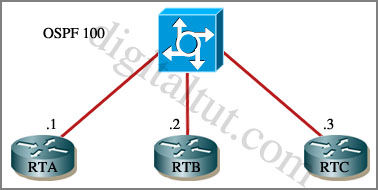
During a recent OSPF election among three routers. RTA was elected the DR and RTB was elected the BDR, as seen in the graphic. Assume that RTA fails, and that RTB takes the place of the DR while RTC becomes the new BDR. What will happen when RTA comes back online?
OSPF_DR_DBR

A – RTA will take the place of DR immediately upon establishing its adjacencie
B – RTA will take the place of DR only if RTB fails
C – RTA will take the place of DR only if both RTB and RTC fail
D – A new election will take place establishing an all new DR and BDR based on configured priority levels and MAC addresses


Answer: C

Question 3

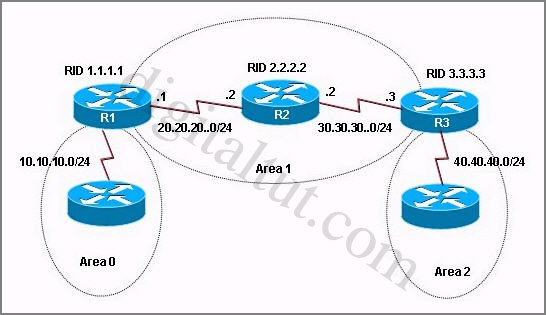
Refer to the exhibit. During the process of configuring a virtual link to connect area 2 with the backbone area, the network administrator received this console message on R3:
*Mar 1 00:25:01.084: %OSPF-4-ERRRCV: Received invalid packet: mismatch area ID, from backbone area must be virtual link but not found from 20.20.20.1, Serial 0

How should the virtual link be configured on the OSPF routers to establish full connectivity between the areas?
OSPF_virtual_link

A – R1(config-router)# area 1 virtual-link 30.30.30.3
R3(config-router)# area 1 virtual-link 20.20.20.1
B – R1(config-router)# area 1 virtual-link 20.20.20.2
R3(config-router)# area 1 virtual-link 30.30.30.2
C – R1(config-router)# area 0 virtual-link 1.1.1.1
R3(config-router)# area 2 virtual-link 3.3.3.3
D – R1(config-router)# area 1 virtual-link 3.3.3.3
R3(config-router)# area 1 virtual-link 1.1.1.1
E – R1(config-router)# area 1 virtual-link 2.2.2.2
R3(config-router)# area 1 virtual-link 2.2.2.2

Answer: D

Explanation

When designing a multi-area OSPF network, all areas should be connected to the backbone area. However, there may be instances when an area will need to cross another area to reach the backbone area like area 2 in this case. A virtual link has the following two requirements:

+ It must be established between two routers that share a common area and are both ABRs.
+ One of these two routers must be connected to the backbone.

In this case, two routers that satisfy the above requirements are R1 and R3. The syntax for creating a virtual link across an area is:

area area-id virtual-link neighbor-router-id

The area-id is the number of the transit area, in this example Area 1 and neighbor-router-id is the IP address of the highest loopback interface configured or can be manually set on the neighboring router.

Question 4

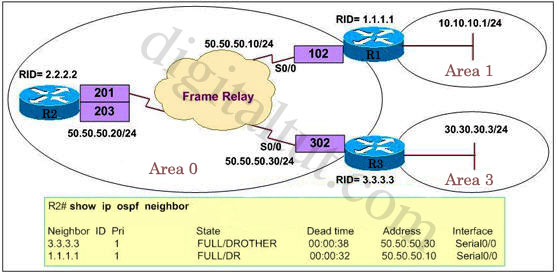
As shown in the exhibit ,OSPF is configured over a Frame Relay network. All PVCs are active. However, P4S1 and P4S3 fail to see all OSPF routes in their routing tables. The show ip ospf neighbor command executed on P4S2 displays the state of the neighbors. In order to fix the problem , what should be done?
OSPF_NBMA_Frame_Relay

A – The neighbor command should be configured under the OSPF routing process on all routers
B – The ip ospf network broadcast command should be configured on each Frame Relay interface
C – The ip ospf network non-broadcast command should be configured on each Frame Relay interface
D – The ip ospf priority value on the spoke routers should be set to 0


Answer: D

Explanation

In an NBMA network topology, neighbors are not discovered automatically. OSPF tries to elect a DR and a BDR due to the multi-access nature of the network, but the election fails since neighbors are not discovered because NBMA environment doesn’t forward broadcast and multicast packets. Neighbors must be configured manually to overcome these problems.

Also, additional configuration is necessary in a hub and spoke topology to make sure that the hub routers, which have connectivity with every other spoke router, are elected as the DR and BDR. You must set the spoke interfaces to an OSPF priority of zero, this ensures that the spokes will not become the DR or BDR.

Question 5

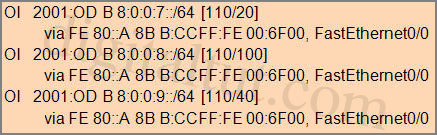
The following exhibit shows ipv6 route output. What would the metric be for a summary route that summarizes all three OSPFv3 routes displayed?
cost_of_summary_route

A – 160
B – 140
C – 120
D – 100


Answer: D

Explanation

The cost of the summarized routes is the highest cost of the routes being summarized. In fact, in the old RFC 1583 standard, the cost of the summary route was the cost of the lowest metric. But when OSPF was updated in RFC 2178 and RFC 2328, the summary route should have the same cost as the highest-cost summarized route. In this case, the highest-cost is 100 according to the second entry.

Question 6

Study the exhibit below carefully. In order to summarize all routes from area 0 to area 1, what must be configured on the router?
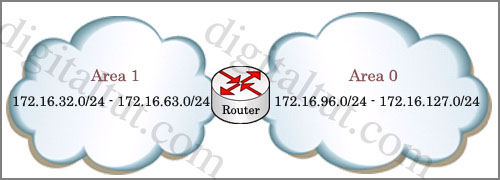
area_range_summary_OSPF

A – area 0 range 172.16.96.0 255.255.224.0
B – area 1 range 172.16.96.0 255.255.224.0
C – area 1 range 172.16.96.0 255.255.0.0
D – area 0 range 172.16.96.0 255.255.255.0


Answer: A

Comments
Comment pages
1 2 19
  1. Deepak
    August 16th, 2010

    please keep on posting more questions about ospf

  2. drum1100s
    August 26th, 2010

    great site starting to study for my route exam! i will use this all the way! THANKS!

  3. Anonymous
    August 28th, 2010

    I need routing dump for ccnp someboy share with me

  4. jamil
    August 28th, 2010

    any body have dumps for 642-902

  5. ginarvee
    August 28th, 2010

    This is very helpful.

  6. atanu chataraj
    September 18th, 2010

    i am very glad to see your questions. i need more question of ccnp routing

  7. Bunty
    September 29th, 2010

    Above question are very useful..

  8. Babiker
    September 29th, 2010

    this is very helpful but we need more than this question

  9. Miljan
    October 13th, 2010

    can someone please help. question 130
    show ip ospf neighbors

    192.168.42.1 FULL/DR 1
    192.168.42.2 2WAY/DROTHER 0

    the answer is we are BDR but the stat would then be FULL/DROTHER. Is that right?

  10. Ben Hayak
    October 15th, 2010

    @Miljan,
    a DRother(in network type that elects DR/BDR) perform to the FULL state
    only with the DR and BDR routers!
    so DROTHER will never have a FULL state with another DROTHER.

    In this case you are right , we are BDR so We expect a FULL state with the DROTHER, But
    Notice the ospf priority on the neighbor side if it’s 0 that means it’d never be elected as DR/BDR that’s why it’s 2WAY

    Good luck

  11. Miljan
    October 17th, 2010

    @Ben Hayak
    yes, that is correct. but in this case the the show command was issued on the BDR, as in the answer, and thats why should be FULL/DROTHER

  12. Miljan
    October 17th, 2010

    it cannot be BDR if the priority is 0

  13. Aric
    October 17th, 2010

    only have the DR, if the priority is 0 and the network type of the router’s interface is point-to-point

  14. sofyan
    October 20th, 2010

    please if someone exame 642_902 tell us how many simulation in these exame
    and it eay or not

  15. Martin
    October 26th, 2010

    In question 5 do you mean … OSPFv3 has an opposite behaviour than OSPFv2? In the cost-related summary routes.

  16. Saravan kumar
    October 26th, 2010

    Hi,

    I am preparing CCNP 642-902 Exam, Requesting to all please someone help me to send the latest dumps and lab and hotspot questions for 902 exam, my email id is sravan.j29@gmail.com
    Tnks

  17. john
    November 17th, 2010

    sweet

  18. kasun
    November 26th, 2010

    next week friday i will face to ccnp routing so after i my exam i will tell u all : )

  19. Saroj
    December 14th, 2010

    Good Site

  20. HARSHAL.PATIL
    December 15th, 2010

    hi guies!

    if u have latest Dumps pls forward me. my mail id harsh_on4@yahoo.co.in.

  21. adata
    December 20th, 2010

    hi! guys I don’t understand this.question why A and D can someone please put and explanation or link where get the logic,.
    thanks in advance
    Into which two types of areas would an area border router (ABR) inject a default route? (Choose
    two.)

    A. stub
    B. the autonomous system of an exterior gateway protocol (EGP)
    C. NSSA
    D. totally stubby
    E. the autonomous system of a different interior gateway protocol (IGP)
    F. area 0

    Answer: A,D

  22. reddy
    December 20th, 2010

    I would say A,C. —-ABR doesn’t filter type 3 for stub/nssa; it filters for totally stub/nssa

    Into which two types of areas would an area border router (ABR) inject a default route? (Choose two.)

    A. stub
    B. the autonomous system of an exterior gateway protocol (EGP)
    C. NSSA
    D. totally stubby
    E. the autonomous system of a different interior gateway protocol (IGP)
    F. area 0

  23. reddy
    December 20th, 2010

    It goes with the OSPF drag-n-drop. As you can see stub and NSSA accept type 3 (summary routes) where as Totally stubby/nssa do not

    5) LSA Corresponding area type
    -.-.-.-.-.-.-.-.-.-.-.-.-.-
    Stub<-LSA 1,2,3
    NSSA<-LSA 1,2,3,7
    Backbone or transit<-LSA 1,2,3,4,5
    totally NSSA<-LSA 1,2,7
    totally stubby<-LSA 1,2

  24. reddy
    December 20th, 2010

    May help you remember:

    Stub Networks:
    Type 1,2 always allowed
    Type 3 – allowed for stub or nssa only
    Type 3- NOT allowed for totally (totally stubby, totally nssa)
    Type 5 is always filtered
    Type 7 – Allowed only for NSSA (nssa, totally NSSA)
    Redistibution is allowed for NSSA (nssa, totally nssa)

  25. reddy
    December 21st, 2010

    Can someone help me with this?

    Q10. Which of the following is an OSPF configuration parameter that is used on an ABR, but not on an internal router?

    A. Vitual Link to Area 0
    B. OSPF summarization command
    C. default-cost extension to the area command
    D. no-summary extension to the area stub command
    E. None of the above

    answer suggested is D

    I would say A,B,D ::
    -Virtual links can only be done on the ABR
    -you can only summarize at the borders ABR/ASBR

  26. reddy
    December 22nd, 2010

    @Adata

    I’m re-thinking my answer. I’m suggesting A,C,D

    Rationale: The cert book states, “As for all stubby areas types, the ABRs advertise a default route …”

    It appears even though type 3 is blocked going to the Totally stubby network, default routes are allowed. I thought summary routes were type 3 so not sure if this is an exception to the rule or if a summary route falls under another LSA type

    Can someone explain better?

  27. Salem Batmani
    December 23rd, 2010

    Reddy ,

    am not sure of C , but usually when i answer the choose three questions while having 5 choices , and am not sure of my whole answer , i just omit the 100% sure not correct then start choosing .

    for me :

    A is 100% right
    B is 100% right
    C am not sure
    D is 100% right
    E never right ! :P

    so as we are sure that A , B , D are right , why to bother about the other choices ;) , my 2 cents

  28. Bobby G
    December 23rd, 2010

    I’d like to clearify Question #5.

    We’re asked which metric will be used when the routes are summarized. By default, OSPF uses the LOWEST-COST (20 in this case) when summarizing OSPF routes. If you want OSPF to use the HIGHEST-COST (100 in this case), you have to issue the ‘no compatible rfc1583′ command. Although it is not mentioned in this question, the ‘no compatible rfc1583′ command seems to have been issued given the possible answers.

    If the question doesn’t talk about defaults being changed and both the lowest and highest metrics are possible answers, I’d go with the lowest.

  29. reddy
    December 23rd, 2010

    Salem – I’m a little confused about my own posts :) I just want to ensure we are talking about the right questions

    Q10. Which of the following is an OSPF configuration parameter that is used on an ABR, but not on an internal router?
    -I do agree with A,B,D eventhough the practice test only lists D as an answer
    -unless the question is pointing to something more specific

    Now for Adata’s question:
    Into which two types of areas would an area border router (ABR) inject a default route? (Choose two.)
    - I’m thinking A,C and D eventhough the practice test say A,C only; do you agree?
    -Rationale: The cert book states, “As for all stubby areas types, the ABRs advertise a default route …”

  30. Rodrick Burke
    December 27th, 2010

    I’m taking the test next week Wed. If anyone has the latest ccnp-router 942-902 dump. Please email it to rburke1911@hotmail.com

    thanks…

  31. Rodrick Burke
    December 27th, 2010

    I have a dump with 118 questions but I dont think its the latest dump

  32. Ficky
    December 28th, 2010

    I don’t know if IS-IS is in the 642-902 ROUTE Exam.
    but some dump had a lot of question related to IS-IS. and yet in this web there is no IS-IS topics.
    can anyone comment about this ?

    Thanks

  33. reddy
    December 29th, 2010

    Please explain.

    I can’t find a correct answer for this question.
    INIT is defined as “A Hello has been received from the neighbor but did not have RID or lists parameters which do not pass verification …”

    Seems as if B cannot be the correct answer but it doesn’t appear there are any correct.

    Question:60
    You have just completed an OSPF implementation. While executing your verification plan, you
    determine that R1 is not able to establish full OSPF adjacency with R2. The show ip ospf
    neighbor command output on R1 shows that R2 is stuck in the INIT state.
    What could be the cause of this problem?

    Select the best response.
    A. DR and BDR election errors between R1 and R2.
    B. The R2 router has not received the OSPF hello packets from the R1 router.
    C. Mismatched interface maximum transmission unit (MTU) configuration between the R1 and R2.
    D. Mismatched OSPF hello interval configuration between the R1 and R2.
    E. Corrupted LSAs exchanges between the R1 and R2.
    Passguide Answer given: B

  34. reddy
    December 30th, 2010

    According to another forum, B is correct. I’ll try to explain but please respond with your thoughts.

    I believe this is a complex way of testing your knowledge of the neighbor states. Here, R1 has received a Hello from R2 (This had to happen since R2 is known by R1) but R2 has not received a Hello from R1 so verification can not finish until R2 receives the hello.

    Assuming ‘stuck’ is an appropriate word, The Hello packet probably got lost (one-way communication) in transit.

    The reason why D can NOT be correct is due to the state being ‘stuck in INIT’. A failed verification would send the state back to ‘Down’

  35. Tai
    December 30th, 2010

    The answer B is correct as per Cisco’s definition of INIT state:

    http://www.cisco.com/en/US/tech/tk365/technologies_tech_note09186a00800949f7.shtml#trouble_init_state

  36. Aninda
    January 1st, 2011

    Hi,
    I have a doubt concerning totally stubby areas n stubby areas.
    For two routers to form a neighbor relationship using OSPF, the stub flag has to match correct? Well when you change an ABR to, say a STUB, you are automatically changing the stub flag. How does it still maintain a neighbor relationship with an ASBR since it would have a different stub flag.

  37. reddy
    January 1st, 2011

    Cool – Thanks Tai

    I’ve bookmarked that for the troubleshooting exam

  38. Cannon
    January 17th, 2011

    Hi Does anyone have a 642-902 ROUTE dump? Give me a shout at rich@pc-phobia.com Thanks !!!

  39. Ken
    January 18th, 2011

    When learning a new route, if a LSA received is not found in the topology table, what will an internal OSPF router do?

    A) Seq numbers are checked and if the LSA is valid, it is entered in to the database
    B) THe LSA is placed in the database and ack is sent to the transmitting router
    C) LSA is drop and message is sent out to the router
    D) LSA is flooded out of all OSPF interfaces and except where the LSA is received.

    I believe the answer should be B, but Passguide says its D. My understanding is only DR, ABR and ASBR can send LSA’s. Internal routers should only receive and send ack. Please correct me if I’m wrong

  40. Ken
    January 18th, 2011

    @adata

    The answer to ur question is stub and totally stub. NSSA dont inject default routes as they propogate external routes from the ASBR (Besides NSSA dont have ABR’s, else it will be a stub area)

    http://www.cisco.com/en/US/tech/tk365/technologies_tech_note09186a0080094a74.shtml

  41. DMANSR
    January 20th, 2011

    “I don’t know if IS-IS is in the 642-902 ROUTE Exam.
    but some dump had a lot of question related to IS-IS. and yet in this web there is no IS-IS topics.
    can anyone comment about this ?”

    IS-IS is NOT on the new ROUTE Exam.

  42. Tanveer
    February 4th, 2011

    Can some one give me any new Route Dump, i have to give exam after two Weeks. My email is tanveer1975@live.com. Iwil be very thankfull to you.
    Tanveer

  43. TSM
    February 18th, 2011

    Saw a question in gogy. In a scenario, there is a ping to 224.0.0.5. The ping has a reply from 10.100.100.1. According to gogy, thus means the router does not have accessible OSPF neighbors.
    It seemd odd, and I verified this in GNS3. There is no reply when there are no neighbors and there is a reply when there are neighbors.

    Did others notice this and possibly other errors in gogy?

  44. olved
    February 23rd, 2011

    @TSM This reply was recieved from the same router, R1, who was initiating the ping. And no answers was from other routers. I can’t verify if the same router can answer this ping though, Packet tracer produced no reply, but it can be PT’s fault (I don’t have GNS right now)

    Router#sh ip ospf interface
    Loopback0 is up, line protocol is up
    Internet address is 1.1.1.1/24, Area 0
    Process ID 1, Router ID 2.1.1.1, Network Type LOOPBACK, Cost: 1
    Loopback interface is treated as a stub Host
    FastEthernet0/0 is up, line protocol is up
    Internet address is 3.1.1.1/24, Area 0
    Process ID 1, Router ID 2.1.1.1, Network Type BROADCAST, Cost: 1
    Transmit Delay is 1 sec, State WAITING, Priority 1
    No designated router on this network
    No backup designated router on this network
    Timer intervals configured, Hello 10, Dead 40, Wait 40, Retransmit 5
    Hello due in 00:00:07
    Index 2/2, flood queue length 0
    Next 0×0(0)/0×0(0)
    Last flood scan length is 1, maximum is 1
    Last flood scan time is 0 msec, maximum is 0 msec
    Neighbor Count is 0, Adjacent neighbor count is 0
    Suppress hello for 0 neighbor(s)
    Router#
    Router#
    Router#ping 224.0.0.5

    Type escape sequence to abort.
    Sending 1, 100-byte ICMP Echos to 224.0.0.5, timeout is 2 seconds:
    .

    Router#

  45. Widla
    March 14th, 2011

    Hey guys, I got question regarding OSPF DR/BR. There is questions with 3 routers on one subnet with “sh i pospf nei”f from RTA pespective:
    neigbor Pri State
    192.168.45.1 1 Full/DR
    192.168.45.2 0 2-way/DROTHER

    a) RTA is BDR
    b) RTA si directly connected to iface 192.168.45.1
    c) 192.168.45.1 has changed its OSPF priority number
    d) RTA and neigbir 192.168.45.2 are exchanging LSA´s

    with a) beeing marked as correct answer. But in that case we should se FULL/DROTHER for the neigbor 192.168.45.2, right? Or do I got it wrong. I don´t get this question, other answer are obviously wrong too… thanks.

  46. sam
    March 15th, 2011

    where should i getv dumps frm gogy

  47. gufran
    March 24th, 2011

    In 4th question P4S1, P4S2 and P4S3 are router R1, R2 and R3.

  48. for funzies
    March 31st, 2011

    can someone plz send the latest dumps to forfunzies2000@gmail.com

  49. hc08
    April 2nd, 2011

    Can some one send me the lastest dumps to squall2006@hotmail.com

  50. w1zard
    April 4th, 2011

    @bobby G
    from http://www.cisco.com/en/US/tech/tk365/technologies_white_paper09186a0080094e9e.shtml#t28

    Note about summary address metric calculation: RFC 1583 called for calculating the metric for summary routes based on the minimum metric of the component paths available.

    RFC 2178 (now obsoleted by RFC 2328) changed the specified method for calculating metrics for summary routes so the component of the summary with the maximum (or largest) cost would determine the cost of the summary.

    Prior to IOS 12.0, Cisco was compliant with the then-current RFC 1583. As of IOS 12.0, Cisco changed the behavior of OSPF to be compliant with the new standard, RFC 2328. This situation created the possibility of sub-optimal routing if all of the ABRs in an area were not upgraded to the new code at the same time. In order to address this potential problem, a command has been added to the OSPF configuration of Cisco IOS that allows you to selectively disable compatibility with RFC 2328. The new configuration command is under router ospf, and has the following syntax:

    [no] compatible rfc1583

    The default setting is compatible with RFC 1583

  51. katano
    April 19th, 2011

    @ken

    all routers in a ospf area send and receive lsa’s to each other, there are many types of lsa’s and not all routers send/process&forward all lsa types. but to answer your question, if an internal router receives a lsa that it doesnt have on his topology table it will send it out via others interfaces that the router didnt receive the lsa, because that lsa has lsu’s with new subnets that the router needs to advertise to its neighbors.

  52. Allex1
    April 20th, 2011

    Hi, I hope I have better luck here:

    Can someone clarify the attached question for me?
    I believe the answer provided in GOGY is wrong as the routers in the area will drop the adj as it doesn’t say anywhere that they were configured as stub. I would used answer C which would have guaranteed the adj is created. Please click link.
    http://img810.imageshack.us/f/13079113.jpg/

    Also this next question: If RTA was the BDR it should be in full adj with 192.168.45.2 not 2 way.
    See url.
    Thanks
    http://img546.imageshack.us/f/58940143.jpg/

  53. katano
    April 26th, 2011

    @Allex1

    about the first one, Cisco is a bit tricky with their questions….as you see they ask for the best response. For a area to be totally stubby the command must be set on a ABR regardless of anything else. So the most correct answer, and which there is no going around it, is indeed E due to the no-summary command.

    Regarding the second one, this is a ethernet broadcast domain so there must be a DR and a BDR. If RTB is the DR and RTC is in 2-way/DROTHER then RTA must be the BDR.

    However, you are right that: under normal circumstances, the adj should be full/DROTHER but there is not enough info to say why it isn’t happening. Therefore, D is the “most” correct answer.

    i would say that this screenshot (on the question) was just taken before the full adj was established…if they did another sh ip ospf nei 10 seconds after it would show full/drother.

  54. w1zard
    April 26th, 2011

    @katano

    If you configure
    area 3 stub no-summary
    on just the ABR and on no other router, the OSPF neighborship of the ABR with the internal routers will fail to to incompatible stub flags. Configuring all routers internally to Area 3 with the area 3 stub no-summary command will make the area totally stubby. The internal routers will ignore the no-summary option. The ABR will create a default route to send into Area 3 due to the no-summary option.
    IMHO:
    Answers A,B and E are incorrect because configuring the stub option on just one router in an Area (any router, be it an ABR or whatever) will break the neighborships of that specific router with all of its neighbors within that Area (since the other routers will not have a matching stub flag).
    answer D will create a Stubby area, but NOT a TOTALLY stubby area.
    Answer C is correct, because the no-summary option will not affect the internal routers in any way, yet will make the ABR treat Area 3 as a totally stubby area.

    From the ABR:
    R2#show ip ospf

    Area 3
    Number of interfaces in this area is 2
    It is a stub area, no summary LSA in this area
    generates stub default route with cost 1

    from a router internal of Area 3:

    R4#show running-config | section router ospf 1
    router ospf 1
    log-adjacency-changes
    area 3 stub no-summary
    network 30.1.0.0 0.0.255.255 area 3
    network 50.5.0.0 0.0.255.255 area 3
    R4#sh ip ospf

    Area 3
    Number of interfaces in this area is 2
    It is a stub area
    Area has no authentication

    @Allex1:
    learn how to use GNS3, and use it before asking mundane questions. Also, the second image you provided is so FUBAR, that maybe you should delete it and not even use it in your studies. The diagram shows that RTA only has one connection to this very weird cabling configuration, but from the console output we see neighbors off of two separate interfaces, that are not shown in the diagram. And your selected answer is wrong because the neighbor with IP address 10.0.0.2 has a Neighbor ID of 192.168.45.1, not RTA.

  55. katano
    April 27th, 2011

    @w1zard

    I know if the stub flag does not match the neighborship will not form…however you may be right because on the question they doesn’t say that the internal routers are already configured as stub and indeed the no-summary does not have any impact on internal stub routers.

    Thanks for your opinion.

  56. Allex1
    April 27th, 2011

    Hi guys.
    Thanks for your though. I must agree with @w1zard on the first question.
    I wouldn’t consider the questions mundane and in the exam room I don’t think I can use GNS3 :). I was asking the “mundane” question given the info provided.
    Thanks again.

  57. w1zard
    April 27th, 2011

    @Allex1
    i apologize for my comments, i am just suggesting that you could use GNS3 to simulate the network that you found in your question, and see what effect each of the possible answers would have had on the network. Thats what i did, and thats how i decided that answer C is the correct answer.

    Best of luck with your exams

  58. Allex1
    April 27th, 2011

    No apologies necessary. I understood your comment the first time. I use GNS3 for labs, I was lazy and did not use it for all the questions in dumps.
    I would appreciate if you guys could comment on this question as I don’t get it. Please note that 2 pictures were needed.
    http://img146.imageshack.us/i/33965430.jpg/
    http://img585.imageshack.us/f/33828344.jpg/
    Thanks a lot.

  59. w1zard
    April 28th, 2011

    @Allex1

    So,
    Answer B is wrong because the maximum-paths configuration in OSPF will change the load-balancing behaviour of the router. (router D in this case) Setting the maximum-paths to 1, will disable load-balancing. That is not what is required in this question.
    Answer D is wrong because if you configure any one of the redistributing routers (C or D) to a lower OSPF default metric, that router will suck all the traffic destined to the EIGRP domain from the whole OSPF domain. Router D will send traffic to the router that redistributes EIGRP routes using the lowest default-metric. For example routerC could be redistributing network 172.16.54.0/24 with a E2 metric of 20, whereas routerB would be redistributingthe same network with an E2 metric of 50. Router D will always send traffic destined for network 172.16.54.0/24 to routerC in such a case.
    Answer C is wrong because even if the metric type is changed, router D will still not have any information as to what is the best path to reach a network in the EIGRP domain. I am assuming here that the OSPF cost to reach routers C and B from router D is equal (default of 10 for Ethernet interfaces). So the total OSPF E1 cost to reach the 172.16.54.0/24 network through router C(or B) will be the redistributed cost of 100 plus the interface’s OSPF cost of 10 = 110, over router C or router B.
    Answer A:
    I configured an ASBR that initially did not redistribute anything into OSPF:

    ASBR(config-router)#do sh runn | section router ospf 1
    router ospf 1
    log-adjacency-changes
    network 10.3.0.1 0.0.0.0 area 0
    ASBR(config-router)#do sh ip route | begin Gateway
    Gateway of last resort is not set

    B 1.0.0.0/8 [20/0] via 78.45.12.1, 00:15:09
    D 3.0.0.0/8 [90/156160] via 10.2.0.2, 00:17:27, FastEthernet2/0
    10.0.0.0/8 is variably subnetted, 3 subnets, 2 masks
    C 10.2.0.0/30 is directly connected, FastEthernet2/0
    C 10.3.0.0/30 is directly connected, FastEthernet0/0
    C 10.1.1.0/24 is directly connected, Loopback0
    78.0.0.0/30 is subnetted, 1 subnets
    C 78.45.12.0 is directly connected, FastEthernet1/0

    Nonetheless, there are many routes installed in the ASBR’s routing table. And the router internal to the OSPF domain:
    OSPF_internal#
    OSPF_internal#sh ip route | begin Gateway
    Gateway of last resort is not set

    10.0.0.0/30 is subnetted, 1 subnets
    C 10.3.0.0 is directly connected, FastEthernet0/0
    OSPF_internal#

    Next i redistribute the BGP and EIGRP learned routes:
    ASBR(config-router)#
    ASBR(config-router)#redistribute bgp 500 subnets
    ASBR(config-router)#redistribute eigrp 1 subnets

    OSPF_internal#sh ip route | begin Gateway
    Gateway of last resort is not set

    O E2 1.0.0.0/8 [110/1] via 10.3.0.1, 00:00:09, FastEthernet0/0
    O E2 3.0.0.0/8 [110/20] via 10.3.0.1, 00:00:04, FastEthernet0/0
    10.0.0.0/30 is subnetted, 2 subnets
    O E2 10.2.0.0 [110/1] via 10.3.0.1, 00:00:09, FastEthernet0/0
    C 10.3.0.0 is directly connected, FastEthernet0/0
    OSPF_internal#

    Next i changed the default metric on the ASBR:

    ASBR(config-router)#default-metric 100

    OSPF_internal#
    OSPF_internal#sh ip route | begin Gateway
    Gateway of last resort is not set

    O E2 1.0.0.0/8 [110/100] via 10.3.0.1, 00:00:09, FastEthernet0/0
    O E2 3.0.0.0/8 [110/100] via 10.3.0.1, 00:00:09, FastEthernet0/0
    10.0.0.0/30 is subnetted, 2 subnets
    O E2 10.2.0.0 [110/100] via 10.3.0.1, 00:00:09, FastEthernet0/0
    C 10.3.0.0 is directly connected, FastEthernet0/0
    OSPF_internal#

    And then i redistributed the connected networks explicitly:

    ASBR(config-router)#redistribute connected subnets
    ASBR(config-router)#

    OSPF_internal#
    OSPF_internal#sh ip route | begin Gateway
    Gateway of last resort is not set

    O E2 1.0.0.0/8 [110/100] via 10.3.0.1, 00:01:00, FastEthernet0/0
    O E2 3.0.0.0/8 [110/100] via 10.3.0.1, 00:01:00, FastEthernet0/0
    10.0.0.0/8 is variably subnetted, 3 subnets, 2 masks
    O E2 10.2.0.0/30 [110/20] via 10.3.0.1, 00:00:15, FastEthernet0/0
    C 10.3.0.0/30 is directly connected, FastEthernet0/0
    O E2 10.1.1.0/24 [110/20] via 10.3.0.1, 00:00:15, FastEthernet0/0
    78.0.0.0/30 is subnetted, 1 subnets
    O E2 78.45.12.0 [110/20] via 10.3.0.1, 00:00:15, FastEthernet0/0
    OSPF_internal#

    So, redistributing the connected networks will actually fix only part of the problem. Router D will get better information for how to route for networks connected to routers B and C. Router C will advertise 172.16.55.0/24 with a metric of 20, ignoring the default-metric setting. Router D will also advertise the 172.16.54.0/24 network with a metric of 20, ignoring the default-metric setting. But, this option will not change the metric for networks located off of other routers in the EIGRP domain, and thus does not cover all the requirements of the question. So answer A is also Wrong.

    Answer E is correct, since Cisco recommends using redistribution only as a transient solution, and migrate to a single routing protocol ASAP anyways.

    My personal favorite for solving such issues: Route-maps.

  60. Leo from China
    April 28th, 2011

    i failed my TSHOOT exam. this OSPF questions all of them wrong and old. no questions from this one. pls change and update that questions!!!! 9tut!!!

  61. katano
    April 29th, 2011

    @Leo, well done mate, relying solo on “dumps”… Don’t you do some real studying and watch yourself failing again next time.

  62. Nico
    May 12th, 2011

    Hi ! For the question 5, are you sure of your answer ? Because I tested with GSN3 and up-to-date IOS and the lower cost is chosen for the summarized route …

  63. Shikima
    May 22nd, 2011

    @Allex1, only using route maps with tag for the routes can solve this problem, regards,

  64. DaNetworkEngineer
    May 24th, 2011

    Is there premade GNS3 labs to practice we can download ?
    I know for SWITCH they had packettracer premade configs so we can practice
    Looking for similar for Route exam

  65. fschris
    May 24th, 2011

    danet engineer… yes there is just look around this site someone had a link to them

  66. DaEngineer
    May 24th, 2011

    If someone can post them or the link where they are on the site I would very much appreciate it

  67. judy
    June 5th, 2011

    i need some ios for gns3. my ccna expires next februaury so i want to use route 642-902 to validate it. friends i need your help: judyngr@yahoo.com

  68. ABDESSADEK
    June 10th, 2011

    Hi all
    ******
    could someone plz explain me these 2 question.

    1_
    Given the following partail config on router A

    int s0/0
    ip add 10.1.1.1 255.255.255.0
    encapsul frame-relay
    ip ospf network point-to-multipoint

    router ospf 7
    network 10.1.1.0 .0.0.0.255 rae 0

    which 2 statments are true???
    A DR/BDR elections do not take place
    B The router is restricted to a hub and psoke topology
    C The area0 NBMA……
    D OSPF neighbor statements are not necessary

    gogy answers are A and D

    But why not A and B.I know that point-to-multi network doesnt need neighbor statement but only if the maps are configured with broadcast keywork which is not configured according to the exhibit .Moreover,we all know that the point-to-multi is used in hub and spoke topology to avoid problems caused not being fully meshed.So I think that B is more reasonable that D
    does someone has this question in the exam ????????????????????????

    **********************************************************************
    2th question
    **********

    Ospf is enabled on router A. you execute the following cmd
    ROUTERA ping 224.0.0.5 repeat 1
    type escape sequence to abort
    Reply to request 0 from 10.100.100.1,4ms

    WHAT CAN U CONCLUDE ABOUT ROUTER A
    gogy answer
    A Router A does not have any reachable OSPF neighbors

    how can u conclude that from the shown info ??????
    *************************************************************************

    Thnx in advance
    we seek to understand how things work not only copy paste;)

  69. Marco
    June 13th, 2011

    2nd:
    You do a ping on the multicast address which all OSPF routers are using. No one is answering so ping so there should not be any other OSPF Router, which you are connected to. I guess^^
    You could build it up in GNS3 or PT and see what happens if you ping that address.

  70. artYR
    June 14th, 2011

    Thankyou very much

  71. Wayne
    June 28th, 2011
  72. shah
    July 2nd, 2011

    Hello guys..

    does anyone have ccnp route 642-902 cbt, pass4sure or any dumps. kindly send me links on shariq2009@live.com or u can send here as well.

    Thanksss

  73. shah
    July 5th, 2011

    Dear Allex1, w1zard, Nico

    Guys, I need route GNS3 lab. kindly send here or on shariq2009@live.com

    friends
    i will be waiting for your response

  74. Hasmukh
    July 11th, 2011

    That’s provide good matireal

  75. Shree
    July 12th, 2011

    have any one given exam in july

  76. anonymous
    July 12th, 2011

    ABDESSADEK,
    rgd Q1, if there isn’t a non-broadcast statement, it is by default, broadcast…so D is correct

  77. Keziemi
    August 19th, 2011

    Hello Friends,

    Please i need CCNP ROUTE AND SWITCH videos and any other recent study materials. I want to prepare and write the exam as soon as possible. Please i will appreciate help from anyone.
    my email ID is keziemi@gmail.com

    Thanks all

  78. Keziemi
    August 19th, 2011

    Hello folks,

    Please i need CCNP ROUTE AND SWITCH videos and any other recent study materials. I want to prepare and write the exam as soon as possible. Please i will appreciate help from anyone.
    my email ID is keziemi@gmail.com

    Thanks all

  79. yarok
    August 28th, 2011
  80. suddhoshil
    August 31st, 2011

    i’ll give route exam on 15th of july plz send me the latest dumps on bozo.tiger@gmail.com

  81. xallax
    September 1st, 2011

    q4
    there’s a little mistake in the questions regarding the router name, should be R2. thanks

  82. Madjheed
    September 3rd, 2011

    I want more questions…..

  83. Junior
    October 18th, 2011

    Hi, please I need the coorect answer for this question:
    Into which two types of areas would an ABR inject a default route?
    I chose Stub and NSSA, but the answer was stub and Totally Stubby!
    Can anyone explain why.
    Thank you

  84. The Creator
    October 29th, 2011

    Junior, An ABR would inject default routes into stub and totally stubby because, the stub and TSA are configured not to receive routes, an ABR injects these default routes because the stub and TSA would need routes to go somewhere

  85. celar ipv6 ospf process
    November 20th, 2011

    D should be correct, not A. based on cisco:
    Force SPF in OSPFv3

    When the process keyword is used with the clear ipv6 ospf command, the OSPFv3 database is cleared and repopulated, and then the SPF algorithm is performed. When the force-spf keyword is used with the clear ipv6 ospf command, the OSPFv3 database is not cleared before the SPF algorithm is performed.

  86. moreo
    November 22nd, 2011

    hi i need vce to practice exam because ill take exam 2 months later. if you have it, please give information or send me email moreo_ m01230@yahoo.com. thanks before.

  87. Vickie
    November 29th, 2011

    Junior: Hope this answers your question:
    “Default Summary Route

    By defining an area as a NSSA totally stub area, the NSSA ABR generates a default summary route. As mentioned, if the NSSA area were not defined as totally stub, then a default summary route is not generated by NSSA ABR. This configuration generates a default summary route for a NSSA totally stub area.”

    http://www.cisco.com/en/US/tech/tk365/technologies_tech_note09186a0080094a88.shtml

  88. Vickie
    November 29th, 2011

    Default Summary Route

    “Default Route in NSSA

    There are two ways to have a default route in an NSSA. When you configure an area as NSSA, by default the NSSA ABR does not generate a default summary route. In the case of a stub area or an NSSA totally stub area, the NSSA ABR does generate a default summary route.”

    http://www.cisco.com/en/US/tech/tk365/technologies_tech_note09186a0080094a88.shtml

  89. Theos
    December 6th, 2011

    type lsa default route injected without :default-info originate?

    stub 1,2,3,4 yes
    totally stubby 12, default of 3 yes
    nssa 1,2,3,4,7 no
    not so totally stubby 1,2, default of 3, 7 yes

  90. Theos
    December 6th, 2011

    type/ lsa /default route injected without :default-info originate?

    stub /1,2,3,4/ yes
    totally / stubby 12, default of 3 / yes
    nssa / 1,2,3,4,7 / no
    not so totally stubby / 1,2, default of 3, 7 / yes

  91. JS
    December 8th, 2011

    Hi Guys,

    Which three statements accurately describe the result of applying the exhibited route map? (Choose three.)

    router eigrp 1
    redistribute ospf 1 route-map ospf-to-eigrp
    default-metric 20000 2000 255 1 1500

    !— Output suppressed.

    !
    route-map ospf-to-eigrp deny 10
    match tag 6
    match route-type external type-2
    !
    route-map ospf-to-eigrp permit 20
    match ip address prefix-list pfx
    set metric 40000 1000 255 1 1500
    !
    route-map ospf-to-eigrp permit 30
    set tag 8
    !

    The ans given are:

    B. All routes that do no match clauses 10 and 20 of the route map are redistributed with their tags set to 8.
    D. The map permits the redistribution of all type 1 external OSPF routes.
    F. The map prohibits the redistribution of all type 2 external OSPF routes with tag 6 set.

    Why is “E. The map redistributes into EIGRP all routes that match the pfx prefix list and the five metric values?0000, 1000, 255, 1, and 1500.” – Not the Answer ? I know that
    the last route-map (30) will set all other routes that do not already match 10 or 20 with a tag of 8.

    But have a look at this –
    http://www.cisco.com/en/US/tech/tk365/technologies_tech_note09186a008047915d.shtml

    It says “E. The map redistributes into EIGRP all routes that match the pfx prefix list and the five metric values?0000, 1000, 255, 1, and 1500.” is one of the answer.

    Correct me if i am wrong? Anyone ?

    Thx.

  92. JS
    December 8th, 2011

    @ ABDESSADEK,

    Source: http://www.cisco.com/en/US/docs/ios/11_3/feature/guide/ospfpmp.html

    This one has eg of point-to-multipoint broadcast and as well as nonbroadcast.

    Section from the link above:
    “OSPF has two new features related to point-to-multipoint networks. One feature applies to broadcast networks; the other feature applies to nonbroadcast networks.

    •On point-to-multipoint, broadcast networks, there is no need to specify neighbors. However, you can specify neighbors with the neighbor command, in which case you should specify a cost to that neighbor.

    •On point to multipoint, nonbroadcast networks, you now use the neighbor command to identify neighbors. Assigning a cost to a neighbor is optional. “

  93. Zoynur
    December 8th, 2011

    Hi Expert,

    My topology is like below

    AREA:0

    R1 —— S 0/0 ————– FRS1 ——S 0/ 0——-R2
    R1 —— S 0/0 ————– FRS1 ——S 0/ 1——-R3

    In R1, the network Type is Point-to-multipoint and R2&R3, the network type is Non-Broadcast.

    As per JS feedback on December 8th, 2011, in AREA:0 the neighborship can be formed between R1 & R2 and R1 & R3 if we manually specify neighbors with the neighbor command.

    But, my question is:
    Q1. is it possible to form a neighbor ship? As I know, You can mix and match network types as long as the network types involved have the same DR relationship. You can’t mix network types that require a DR (here R2 & R3) with those that don’t require a DR (Here R1).

    Q2. If we form a neighbor anyhow, is it possible to get the Router Table as per the Topology.

    Thx

  94. Ivana
    December 8th, 2011

    can someone explain to me how are hello packet sent by ABR in area 0 handled by stub router ( in area 5). Why the packets will be dropped and no adjacency will be established between them?

  95. Anonymous
    December 11th, 2011

    Paas4sure Q10. Which of the following is an OSPF configuration parameter that is used on an ABR, but not on an internal router?

    A. Vitual Link to Area 0
    B. OSPF summarization command
    C. default-cost extension to the area command
    D. no-summary extension to the area stub command
    E. None of the above

    answer suggested is D
    Is it correct.
    http://karachi-fm-live.blogspot.com/2011/08/islamabad-fm-101.html

  96. Nado
    December 18th, 2011

    @ Anonymous

    I think Virtual Link to Area 0 can only be done on an ABR

    anyone can help with this question???

  97. Swati
    December 24th, 2011

    @ Anonymous
    Q10 Ans. is correct. In Totally Stub Area, It’s use no-summarry
    e.g.: Configar area 23 as a totally stub aea.

    #Router ospf 1
    #area 23 stub no summary
    —————
    Here, no summary of ABR

  98. JS
    December 24th, 2011

    Hi guys,
    there is a question regarding ‘which are correctly stated routes for the redistribution of routes into OSPF.

    One of the suggested answers is ‘The network 192.168.1.0 be allowed and a metric of 100′.
    Why ?

    route-map rip-in permit 10
    match ip address 10 20
    set metric 100
    set metric-type type 1

    route-map rip-in 20
    match ip address 30

    route-map rip-in permit 30
    set metric 200
    set metric-type type-2

    access-list 10 permit 10.0.10.0 0.0.0.255
    access-list 20 permit 192.168.1.0 0.0.0.255
    access-list 30 permit 10.0.0.0 0.255.255.255

  99. JS
    December 24th, 2011

    should be ‘route-map rip-in DENY 20

Comment pages
1 2 19
  1. No trackbacks yet.
Add a Comment