BGP Questions 5
Here you will find answers to BGP Questions – Part 5
Question 1
Above is the output from show ip bgp neighbors command. What is line 21 stating about the BGP connection?
| BGP neighbor is 172.16.254.3, remote AS 150, internal link 1. BGP version 4, remote router ID 172.16.254.3 2. BGP state = Established, up for 19:24:07 3. Last read 00:00:06, hold time is 180, keepalive interval is 60 seconds 4. Neighbor capabilities: 5. Route refresh:advertised and received(new) 6. Address family IPv4 Unicast:advertised and received 7. Graceful Restart Capability:advertised and received 8. Remote Restart timer is 120 seconds 9. Address families preserved by peer 10. IPv4 Unicast 11. Received 4231 messages, 0 notifications, 0 in queue 12. Sent 4167 messages, 0 notifications, 0 in queue 13. Default minimum time between advertisement runs is 5 seconds 14. For address family:IPv4 Unicast 15. BGP table version 159559, neighbor version 159559 16. Index 90, Offset 11, Mask 0×4 17. Route refresh request:received 0, sent 0 18. 10031 accepted prefixes consume 441364 bytes 19. Prefix advertised 29403, suppressed 0, withdrawn 9801 20. Number of NLRIs in the update sent:max 242, min 0 21. Connections established 2; dropped 1 22. Last reset 19:26:54, due to NSF peer closed the session 23. Connection state is ESTAB, I/O status:1, unread inout bytes:0 24. Local host:150.254.254.2, Local port:11005 25. Foreign host:172.16.254.3, Foreign port:179 |
A. the number of consecutive TCP connections to the specified remote neighbor
B. the number of times the router has established a TCP connection
C. the number of total TCP connections that the router has
D. the number of neighbors that the router has
Answer: B
According to http://www.cisco.com/en/US/docs/ios/12_3/iproute/command/reference/ip2_s2g.html#wp1040913, “Connections established” is the number of times a TCP and BGP connection have been successfully established while “dropped” is the number of times that a valid session has failed or been taken down.
Question 2
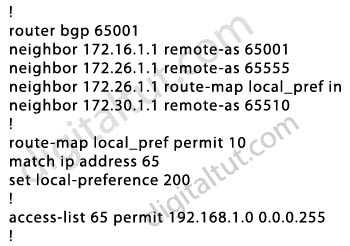
Refer to the exhibit. Routing updates for the 192.168.1.0 network are being received from all three neighbors. Which statement is correct regarding the result of the configuration shown?
A. The router will prefer the next hop of 172.16.1.1 for packets destined for the 192.168.1.0 network.
B. The router will prefer the next hop of 172.26.1.1 for packets destined for the 192.168.1.0 network.
C. The router will advertise the 192.168.1.0 network only to 172.30.1.1.
D. The router will advertise the 192.168.1.0 network only to 172.26.1.1.
E. The router will prefer the next hop of 172.26.1.1 for packets except those destined for the
Answer: B
Explanation
The local-preference of the next hop 172.26.1.1 is set to 200, which is higher than the default value (100) so this path is preferred for packets destined to the 192.168.1.0 network.
Question 3
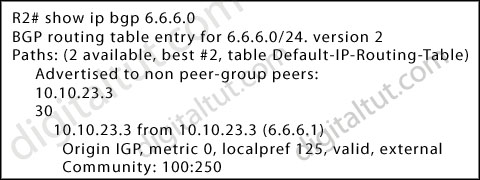
Refer to the exhibit. Which statement is true about the 6.6.6.0/24 prefix?
A. If another path advertises the 6.6.6.0/24 path and has the default local preference, that path is more preferred.
B. The command neighbor send-community is configured on BGP neighbor 10.10.23.3.
C. The route 10.10.23.3 is not being advertised to other BGP neighbors.
D. Route 6.6.6.0/24 is learned by an IBGP peer.
Answer: B
Explanation
By default, the community attributes are not advertised to BGP neighbors. But in the output we see the “Community: 100:250″ which means the command “neighbor … send-community” was used to send community attributes of the local router to the neighbor. For more information about this command please read my BGP next-hop-self, community no-export & send-community – GNS3 Lab.
Question 4
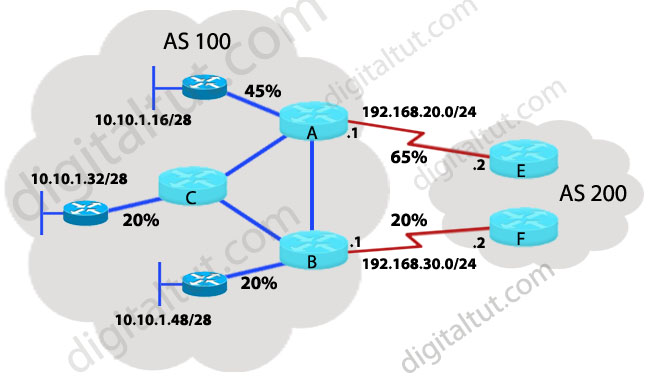
Refer to the exhibit. Currently the two eBGP links between AS100 and AS200 have an average inbound load of 65% and 20% respectively. After further investigation, traffic to 10.10.1.16/28 accounts for 45%, and traffic to 10.10.1.32/28 and to 10.10.1.48/28 each account for 20% of the inbound load. The BGP attributes are currently set at their default values in both autonomous systems.
If you want to influence how AS200 sends traffic to AS100, which eBGP configurations would you configure in AS100 to influence AS200 to use the eBGP links more evenly? (Choose two.)
A. neighbor 192.168.30.2 route-map as_50 out
B. neighbor 192.168.20.2 route-map as_50 out
C. route-map as_50 permit 10
match ip address 50
set metric 150
access-list 50 permit 10.10.1.16 0.0.0.240
D. route-map as_50 permit 10
match ip address 50
set metric 150
access-list 50 permit 10.10.1.32 0.0.0.240
Answer: B C
Explanation
Note: The wildcard masks in the access-list are not correct, they should be 0.0.0.15 instead of 0.0.0.240.
First let’s recall about MED. If you want to influence external neighbors about the path it sends traffic then MED, also called the metric, should be used. A lower MED value is preferred over a higher value. The default MED value is 0.
Also, an important point I wish to notice in this question is: there is a “deny all” statement at the end of each access-list. In other words, all the routes that do not match the access-list used by the route-map will be filtered out. For example in answer C, only network 10.10.1.16/28 is matched by the access-list and all other networks will be dropped (not advertised to EBGP).
Therefore in answer C, only traffic to 10.10.1.16/28 will be go through routerA (45%). All other traffic must go through routerB (40%) -> links are used more evenly -> C is correct.
There are some debates saying D is correct but in fact it is not. If answer D is applied for router A, the MED for 10.10.1.32 set to 150 would make traffic for this route go through router B (because the MED default value is 0, which is lower than 150). The access-list will also filter out network 10.10.1.16 -> router E can not send traffic for network 10.10.1.16 to router A. Now all traffic must go through router B (85%).
(For detailed information about how to use route map with MED, please read my BGP Route map and MED – GNS3 Lab)
Question 5
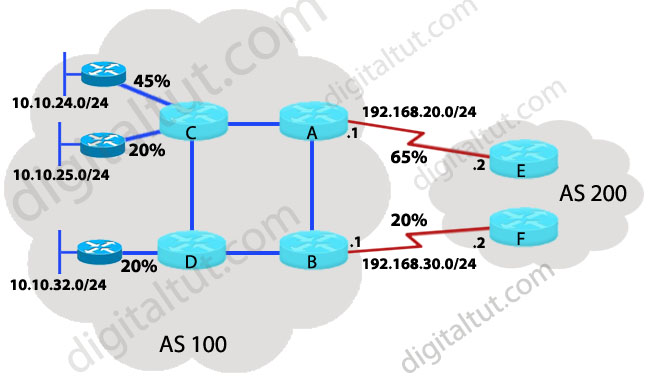
Refer to the exhibit. A client has asked you to consult on an eBGP loading question. Currently the AS 100 eBGP links have an average outbound load of 65% and 20% respectively. On further investigation, traffic from 10.10.24.0 accounts for 45%, and 10.10.25.0 and 10.10.32.0 accounts for 20% each of the outbound load. The customer wants to spread the load between the two eBGP links more evenly. The BGP attributes are currently set at their default values.
If you are located at AS 100 and want to influence how AS 100 sends traffic to AS 200, what BGP attribute could you configure to cause AS 100 outbound traffic to load the eBGP links more evenly?
A. On router A, set the default local-preference to 50.
B. On router B, set the default metric to 150.
C. On router B, configure a route map for 10.10.25.0/24 with a local preference of 150 linked to neighbor 192.168.30.2.
D. On router B, set the default local-preference to 150.
Answer: C
Explanation
To make the eBGP links more evenly we should use the link B-F for network 10.10.25.0/24 so that the total traffic going through B-F link is about 40%. In this case we should apply a route map on B to set the local preference of 10.10.25.0/24 to a higher value than 100. But notice that we must use a second clause to permit other traffic if not they will be filtered out.
Note: The default value for local preference is 100. A path with higher local preference is preferred.
Question 6
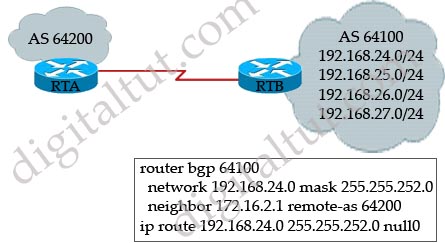
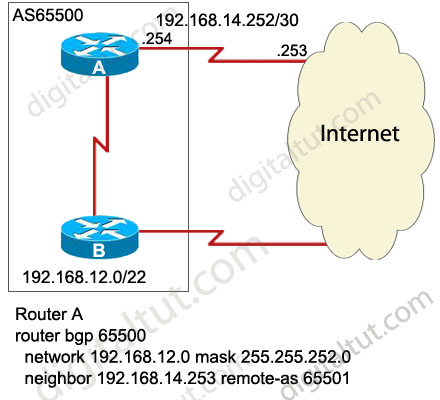
Refer to the exhibit. AS 65500 is not advertising the prefix 192.168.12.0/22 to its provider. AS 65500 is running OSPF as its IGP.
Which of the following additions to the configuration is most likely to solve the problem?
A. RouterA(config)#ip cef
B. RouterA(config)#ip route 192.168.12.0 255.255.255.252 null 0
C. RouterA(config-router)#ebgp multihop 1
D. RouterA(config-router)#redistribute ospf 1
E. RouterA(config-router)#neighbor 192.168.14.253 next-hop-self
F. RouterA(config-router)#neighbor 192.168.14.253 local-as 65500
Answer: B
Explanation
The synchronization rule states “A BGP router should not use, or advertise to an external neighbor, a route learned by IBGP, unless that route is local or is learned from the IGP”. Notice that IGP here can be a static route.
In this case, unless there is an entry about network 192.168.12.0 in the routing table of RouterA, RouterA will not advertise this network to its EBGP -> B is correct (even if this static route points to Null0).
Note: Although this question states that OSPF is being used as IGP but for some reasons, network 192.168.12.0/22 is not advertised to RouterA -> RouterA does not have this route in its routing table.

correction required in question 4 answers must be B n D …… ACL in option D will cover both of the networks .16 and .48 and seding Metric 150 out from router A will force routes to be accessed from Router B with O metric …..
Q4 is stupid as its not a possible scenario anyway if default attribute values are used as all traffic should go down one link and not be split. I dont actually think either option would solve the problem.
Q4 it is not the implicit deny at the end of ACL meaning only 1 route gets advertised, its the route-map missing a permit 20 line.
Joe check this discussion….. https://learningnetwork.cisco.com/message/78533 regarding question 4
some correction in my 23rd March Comment its .32 and .48 … not .16
“correction required in question 4 answers must be B n D …… ACL in option D will cover both of the networks .32 and .48 and sending Metric 150 out from router A will force routes to be accessed from Router B with 0 metric …..
Good link Router thanks.
It states 2 errors in the question, that the route-maps should have permit lines at the end and wildcard mask should be 0.0.0.15
I can see how B and D could be right now
Guys, can someone explian to me how Local Pref would change the traffic for question 5?
10.10.25.0 belonges to AS100. Thus AS 100 is announcing it. LocalPref with an ebgp neighbor AS200 is to change how the routes announced by AS200 are preferred in AS100. Normally AS200 would announce it’s partial routes or a default (If ISP). So why if I change the pref for one of my routes with a ebgp neighbor would influnce outgoing traffc ?
Thanks
mihai it doesnt say the direction of the route-map and we can assume a full mesh of as100.
so if the route-map is inbound it would be advertised the local preference within AS100
i think, but its very late i’m tired. so i could be wrong
but you’re right, you dont advertise your own networks inbound hey
Did anyone know what the answer of question 6 is “ip route 192.168.12.0 255.255.255.252 null 0″ but not “ip route 192.168.12.0 255.255.252.0 null 0″ ?
Q2 has errors in your exhibit tut – access list # does not match # specified in route map and answers A and B are identical so one should be removed (or changed)
Q5 – I thought local preference could not exit an AS? That would mean none of these answers are correct.
my bad – setting it in its own view is ok – still an obvious set of answers?
If this is true for answer D (Q4) “If answer D is applied for router A, the MED for 10.10.1.32 set to 150 would make traffic for this route go through router B (because the MED default value is 0, which is lower than 150).” Why is the same not true for answer C applied to router A ?
In Q6 they should not have mention that is is running OSPF as IGP.
Q4 is totally wrong, as the metric is high all the traffic will prefer through router B, and no router will go through Router A as there is an implicit deny at the end.
Q6 the mask given in answer B is a /30 on the static route remedy, which doesnt match the missing network mask of /22, so that wouldnt work either would it?
Q4 is wrong. l look its explains, if his say was right, the answer should A,C because the answer A set 150, traffic to net 10.10.1.16 would go upper link(low MED). So its explain is wrong far away.
Q4. B and D are the correct answers.
Q4.
1. Between A C B routers must be run IBGP
2. Between E and F – must be run IBGP
IF not – no matter MED or something else – one way – no decision.
next … who are think that 45% from network 10.10.1.16/28 an 20% from 10.10.1.32/28 = 65% on AE?
Hey guys – that`s not right. If IBGP run on ACB – and they are neighbors – all networks advertice.
And for example we can see: 40% to 10.10.1.16 + 15% to 10.10.1.32 + 10% to 10.10.1.48 = 65% on router A
and 5% to 10.10.1.16 + 5% to 10.10.1.32 + 10% to 10.10.1.48 = 20% on router B
right? :)
next… route-map as on exhibit… Answer B and C. (Don`t think about A – that`s not right at all, just decide C or D)
OK. on router E you will see route to 10.10.1.16 from router A with MED 150 and nothing else (deny at end in route-map).
on router F you will see route to ALL network with default MED 0. F use their own routes.
Router E use all routes which advertise from router F with IBGP…
ALL traffic go on B – BF 85%…
next… B and D
on router E you will see route to 10.10.1.32 from router A with MED 150 and nothing else (deny at end in route-map).
on router F you will see route to ALL network with default MED 0. F use their own routes.
E use routes from F same as in previous example – again 85% on BF…
WTF? no correct answers?
OK.. Who say what config in exhibit is complete? Maybe this is a mistake – maybe they show not all for us?
But at the end of route-map MUST BE
route-map as_50 permit 20
Huh… as_50 where is you see AS 50? Cisco get it from another example :)
And now…
on router E you will see route to 10.10.1.32 from router A with MED 150 and another nets with med=0.
on router F you will see route to ALL network with default MED 0. F use their own routes.
And don`t forgot that External BGP route better then internal IBGP route..
sh ip bgp on E
10.10.1.32 next-hop A MED 150 ext – bad route bad MED
10.10.1.32 next-hop F MED 0 int — fraffic for this network go to F router
10.10.1.16 next-hop A MED 0 ext
10.10.1.48 next-hop A MED 0 ext
sh ip bgp on F
10.10.1.32 next-hop B MED 0 ext
10.10.1.16 next-hop B MED 0 ext
10.10.1.48 next-hop B MED 0 ext
and now:
40% to 10.10.1.16 + disable with MED + 10% to 10.10.1.48 = 50% on router A
5% to 10.10.1.16 + 15% from router F+ 5% to 10.10.1.32(old traffic) + 10% to 10.10.1.48 = 35% on router B
right? :)
CORRECT ANSWERS B and D…
Question on Q2 where did you get the match ip address 20? the access-list is 65 or is this a typographical mistake only…
In q.2 access-list 0.0.0.240 is configured right ,u need to understand the syntax
i mean q.4
Q6 mask of the IP route is wrong… /30… however I cannot see any good answer. ip cef, local-as and next-hop-self are off topic of advertising a route.
redistribute ospf 1 is useless: an ospf route within the network command value should already be advertised with the current configuration. Thus the ospf route is absent, we need a static route, but the suggested static route is wrong. wtf…
Well actually I just found that:
http://www.cisco.com/en/US/tech/tk365/technologies_tech_note09186a00800943c5.shtml
“The default behavior is not to redistribute any routes from OSPF into BGP. Redistribution must be configured. You can use the route-map command to filter routes during OSPF to BGP redistribution. When redistributing, specific keywords like internal, external and nssa-external are required to redistribute respective routes.”
Q6:
WHO IS AS#65501 MENTIONED IN CONFIGURATION ?!
IT IS 65500 IN THE TOPOLOGY ..
+
I think the problem is
that there is no connectivity between the routerB and the ISP
as routerB doesn’t have it in its routing table it only knows about routerA so i think next-hop-self would be more helpful than configuring a static route to NULL0
what do you think?
has any one encountered Q7 on the actual exam and verify what the answer was? I’m going for B and D on my exam 2 days from now.
AMIRA: next-hop self will say to router B how to reach routes announced by the ISP (routes learned by eBGP). It should indeed be configured to make routerB, assuming it is iBGP, correctly routes the traffic if router B has no connectivity to the ISP. but it seems it has on the exhibit. In any case it will never influence the route ADVERTISED by router A and this is our problem.
To make the route being advertised, it must appear in the routing table. Thus the idea of the static route, even with null0, is OK. But the route is wrong (wrong mask), so it may not be the correct answer.
I don’t know if anyone could lab it, but according to some docs I have posted above, OSPF routes may need redistribution to be injected in bgp table and be advertised. (on contrary to eigrp and static routes where network command is enough if the route is in the routing table)
Q4 – A simpler explanation.
The percentages are important. The link AE accounts for 65% of the inbound traffic, and the BF link 20%. We are told that 10.10.1.16/28 accounts for 45% of the traffic, and the other two account for 20% of the inbound traffic load each. We are not privileged as to why AS200 has a routing policy that favors the AE link for the 10.10.1.16/28 and one of the two routes that account for 20% of the inbound traffic.
We are being asked to influence AS200 to more evenly load balance the traffic more evenly.
Deducing this, we need to figure out how to route one of the two 20% inbound loads to the BF link which would cause the AE link to have a 45% inbound load and the BF link a 40% inbound load.
We are given two possibilities of where to apply a route-map and two route-maps to choose from. The two route-maps change the metric and thus, with all other values set to their default, make one route less favorable to the EBGP neighbor. Knowing this, we need to make one of the 20% inbound loads less favorable for the AE link making traffic more load balanced.
With B & D selected the load changes to AE 45% and BF 40%
q6 answer is wrong nigger
@digitaltut,
in Q2,
“route-map local_pref” matches only to “access-list 20″ but “access-list 20″ doesnt exist.
shouldn’t it be “match ip address 65″ command under route-map instead?
or shouldn’t the access-list number be 20 instead?
Please advise.
for question 4
==========
i guess MED Multi Exit Disc. is appliled with in direction and is treated in perspective of the neighbour that is taking the traffic in NOT out. Can someone who has good knowledge comment on the direction of the traffic. Many thanks
regards
The VPN client was full IPSec, so woekrd with the MS VPN and Cisco client. We even used to have our own client that was the router software wrapped in a kernel driver. Quite clever dude that did that.I always liked the old AT config verse the Cisco modal method, but the newer AlliedWare software went the Cisco path, to increase admin simplicity.The big markets for AT gear was Europe and Asia/Pacific. US was too into Cisco etc. Espically in post 2001, when the market was flooded with cheap second hand gear. Bad times for AT.
Q6
I think static route is the solution for this matter, but here answer is not correct due to reasons:
1st: wrong subnet => correct one is 255.255.252.0
2nd: should not be routed to null 0 , since when the traffic comes from the outside to Router-A, Router-A will send it to carbage. but in this case it’s still advertising it to its ISP which is required in this question !!!
I passed my exam today. I had Q4.
Q4: correct answer: B and D. I got 100% for BGP.
Attention !!!
Q4 correct answer is B & D ,
I just did the exam and i answered as B & C and I got 86%
so guys becareful
Deny statements in the ACLs that are called for route maps do not mean the router filters the traffic, it simply means the traffic doesn’t match that particular statement in the route map. The only time the traffic is actually filtered is when the route map itself has a deny statement in it.
Oh, in other words, B & D are your answers.
I believe Q4 B & D is correct because on which ever router you apply the match statements you are making the router less favourable to that traffic. As in this case you are trying to reduce traffic passing through A it is only logical to apply the route map setting higher metric for that route to router A ..
as the rule state MED lower is better… default is 0
I will be doing my test on Friday 22/06 can anyone please let me know if the SIMS are still Valid and any tips and suggestions are more than welcome….
Q4 Explanation:
I am currently looking at Pg495-496 of “CCNP Route 640-902 Official Cert Guide”.
Table 15-2 States that Multi Exit Discriminator (MED) and Local_Pref are set only outbound.
Table 15-3 States Weight and Local_Pref are bigger the better (steps 1 and 2)
Table 15-3 States AS_Path and MED are smaller the better (steps 4 and 6)
So to set outbound they must be set on the router connected to the link.
So for Q4 you need to specify the traffic (10.10.1.32/28 network) and setting a higher MED of 150 would mean you DON’T want it to take that path. The path you don’t want it to take would be the higher one or 192.168.20.1.
For Q5 setting the Local_Pref to 150 mean you want it to take that route, so you want to put it on the 192.168.30.2 route.
Note that the two questions above are not interchangeable as the second has a lower AS_Path , and AS_Path comes before MED, so you can only set MED when the AS_Path is equal, otherwise you need to set Weight or Local_Pref (remembering weight does not get passed to other routers, so it would need to be set on every router – weight is also not considered a BGP Path attribute, but rather a Cisco proprietary feature that acts somewhat like a path attribute – Referenced from bottom of Table 15-2).
To clarify my comment above “take would be the higher one or 192.168.20.1″ I mean higher as in height not numbers, it is the high route, as it is drawn above the other route.
dear ccnp tut please please help me with this :
in order to advertise a network in BGP should i put just the ip address or the ip address followed by mask coz i found conflicting intsruction about this and i am totally confused
Q6
I think the answer is B, but you have to correct the mask:
ip route 192.168.12.0 255.255.252.0 null 0 (instead 255.255.255.252)
@juantron I think so as well. The mask needs to be changed to the proper one though.
I don’t understand very well send-communite command what attributes the router send ??
Q4 Is (B AND D )By Using Route Map On Router A When You Increasing The Metric (Med) Value For The 10.10.1.32 The Router B Will Be Chose For The Import Traffic
Q4 is B & D for sure, access list only exclude all other addresses from being applied the selected MED value, not from being advertised, author’s explanation is wrong because this is a route map to set an attribute not a distribute list to filter traffic.
Thus, B&D for sure.
Josh, Q4 is B & C, router E will have metric 150 for the network .16 and metric 0 for the rest of routes, so E will chose E-A path to sent traffic for .32 and .48, these ones have low load 20% that can go trough this link. Router F will use F-B link to go to route .16 which has load of 60%
Q4
—-
If you look at the setup of the drawing and the given configurations it seems clear to me that this is an exercise about BGP MED.
BGP is used to tell an external AS which link it should prefer. There are many BGP attributes that should normally be also considered, I believe we shouldn’t over think their influence on this fictive scenario.
—-
>
Setting the metric higher would force that subnet to be used via the other link than where the metric is announced. (it seems that is all they want you to do)
>
—
So don’t think about the implicit deny any, maybe there is a second permit statement that just isn’t show ….
If you try to think about everything suchs as the other BGP attributes, the implicit deny any any; then you will end up seeing that none of the solutions is OK !!!!!
When you would apply one of the filters you would always state the following:
=> Send all traffic for this subnet via the other interface, it has a lower MED. Also send all the rest of the traffic also via that interface because here we are dropping it…
So you end up sending all traffic through the same interface.
If you look just at the current percentages 20 – 65
If you look at the filter options .16 (45%) or .32 (20%).
—
Now if you would force all traffic for the .32 subnet via router F you can assure an increase of 20% on the link between routers B and F which has already a load of 20% = 20 + 20 = 40% load
-
The link between routers A and E would decrease with this 20% that now goes to router F = 65 – 20 = 45%
—
Doesn’t this look great? two links one 40% load the other 45% load.
Instead of sending the biggest load (45%) of the .16 subnet through all of the AS 100 which would results in 65% load on the link between B and F and 20% load on the link between A and E.
Q4 => answers B and D forcing a nice load of 40% (routers BF) and 45% (routers AE).
Q6
There a type error is the subnet mask of the static route, should be 255.255.252.0
It is the correct answer to the question. The person who made the drawing for this explanation just made a little error don’t get confused by it! @Digitaltut, can you update the drawing please?
The fact that it is pointing to null would blackhole all the traffic but that is not the purpose of the question !
i think that the answer of the question 5 is wrong if not can any one give me the command that we ll use
I think answer for question is wrong too. From what I know about BGP, local preference only matches route prefixes, which is the destination of the routed traffic but not source
repost – I think answer for question 5 is wrong too. From what I know about BGP, local preference only matches route prefixes, which is the destination of the routed traffic but not source
Passed with 988 today. Many EIGRP questions but very few BGP questions.
Q4 what is the correct answers with explanation ?
thanks
Q4
B and C won’t work even if implicit deny is considered. If you apply B and C to router A for example all traffic would go through B due to lower metric (0<150).
The only sensible answers are B and D like others have stated. Just ignore the implicit deny in route map, it's safe to assume it simply isn't showed here. Besides this is clearly a question about influencing preferred routes through MED.
Question # 4 answer should be a B D because the Route Map works differently than an access list. For a Route Map if there is no match the packet is routed normally.
Ahmed, “For a Route Map if there is no match the packet is routed normally.”
you’re wrong, in routing protocols route-map filters routes
that would work like you stated in PBR
A comment on BGP Question 5..
Is Cisco really suggesting to advertise only one network to Router E, and the other two networks to router F to distribute load?
This is a CCNP Route test??
All networks should be advertised to both BGP peers and the MED/Local Preference should be used to distribute load !
What if one goes down Cisco !!!
)*@(&#@#
you can read it………..Practice……….Practice………Practice
Comparison of Routing Protocols EIGRP OSPF BGP with diagram[+] http://cisconetworkingcenter.blogspot.com/2013/01/comparison-of-routing-protocols-eigrp.html
Q5.
I do not answer why answer C should be correct. To me the whole question is wrong.
You don’t advertise local-preference on an EBGP link. If your goal is to influence the other side to send over a specific link then you can use MED.
And anyway this would not influence the outbound traffic but only the inbound traffic.
If we really want IP packets sourced from 10.10.25/24 to leave AS100 on router B, then we would need to configure on router A a PBR matching this source prefix and forwarding them to router B.
This has nothing to do with BGP :)
Eventually if the network 10.10.25/24 speaks mostly to a specific prefix, let’s call it prefix P, then we might also influence the outbound load on the link B-F doing the following:
On router B, configure a route map for with a local preference of 150 linked to neighbor 192.168.30.2.
This is almost answer C except for the matched prefix.
Q5.
I do not understand why answer C should be correct. To me the whole question is wrong.
You don’t advertise local-preference on an EBGP link. If your goal is to influence the other side to send over a specific link then you can use MED.
And anyway this would not influence the outbound traffic but only the inbound traffic.
If we really want IP packets sourced from 10.10.25/24 to leave AS100 on router B, then we would need to configure on router A a PBR matching this source prefix and forwarding them to router B.
This has nothing to do with BGP :)
Eventually if the network 10.10.25/24 speaks mostly to a specific prefix, let’s call it prefix P, then we might also influence the outbound load on the link B-F doing the following:
On router B, configure a route map for _prefix P_ with a local preference of 150 linked to neighbor 192.168.30.2.
This is almost answer C except for the matched prefix.
Q5.
I do not understand why answer C should be correct. To me the whole question is wrong.
You don’t advertise local-preference on an EBGP link. If your goal is to influence the other side to send over a specific link then you can use MED.
And anyway this would not influence the outbound traffic but only the inbound traffic.
If we really want IP packets sourced from 10.10.25/24 to leave AS100 on router B, then we would need to configure on router A a PBR matching this source prefix and forwarding them to router B.
This has nothing to do with BGP :)
Eventually if the network 10.10.25/24 speaks mostly to a specific prefix, let’s call it prefix P, then we might also influence the outbound load on the link B-F doing the following:
On router B, configure a route map for _prefix P_ with a local preference of 150 linked to neighbor 192.168.30.2 (direction = in)
This is almost answer C except for the matched prefix. (and the direction of the applied filter)
What is the correct answer for question 5? B,C or B,D
BGP question 5 what is the correct answer B,C or B,D ?
I mean question 4.
Dear digitaltut author.
Could you please clarify Q4
Especially variants of answers C.
First you kindly notice that wildcard mask should be changed to 0.0.0.15 – I am totally
agree with that
but expressions
<>> and
<<>>
will couse the same result as i believe:
‘set metric 150′ command makes link where the route-map was used less preferable for reaching the network described in access list than another link where no route-map were applyed and MED remains default (0).
explicit deny in the end of route-ap will block all other traffic which is not satisfy access-list
So part of traffic we block another part – make not preferable
as a result “C” and “D” forces the traffic two flow over link without applyed route-map
## oops i meant to put <> and <> innstead of > and <>
The answers could be B and C under 2 conditions
1st condition ) statement C should similar to
route-map as_50 permit 10
match ip address 50
route-map as_50 permit 20
set metric 150
access-list 50 permit 10.10.1.16 0.0.0.1
2nd condition)
proportion of traffic which create appriorate load in AS and link between AS’s should be solid
I mean that load of 65% on AE is exactly 45% (from 10.10.1.16) + 20% (from 10.10.1.32 or 10.10.1.48) without any load redistribution,
because if we face load redistribution, case when 65% load of AE is 35% from 10.10.1.16 +15% from 10.10.32 +15 % from 10.10.1.48 and 20 % load of BF is 10% from 10.10.1.16 + 5% from 10.10.1.32 + 5% from 10.10.1.48
if we face traffic redistribution it is becoming to impossible to solve this task by configuring route-maps on 1 router only
And unfortunately cisco does not specify the way of propagation of traffic over AS 200 and do not even specify that traffic goes without redistribution
All this things make the formulation of question unsufficent for giving thorough answer
Q4 :
iam trying to understanding but i cant : (
what is he need ?? plz help
why / b+D
i think the bgp Choose low metric from path B>F
so what is the best path ? AE Or BF
and why
thanks
Q4 :
iam trying to understanding but i cant : (
what is he need ?? plz help
why / b+D
i think the bgp Choose low metric from path B>F
so what is the best path ? AE Or BF
and why
thanks
in Q2 both A and B are similiar Answer.
@ Q6
Is there a misprint in option (B) or am I missing something because, as far as I know, (B) will add a RT entry for 192.168.12.0/30 (255.255.255.252 mask) whereas BGP would need an exact match (prefix as well as “prefix-length”) for 192.168.12.0/22 in RT for the route to be added to the BGP table. Though, since all other options are clearly not right, (B) is the option to go for.
Correct me please.
TIA
Q4: Answer is not correct, all traffic will go through B router, because B announce 10.1.1.1/16 with MED=0.
In Q6, they should have mentioned Synchronization is ON in IBGP routers
In Q4, I think B+D are more common sense than the non-sense B+C
Q6:::looks a little wacky to me…if the network is already running ospf, why is the static route needed? Should that route not be covered by ospf, even though it is connected….or why was the fact that the igp is running ospf added??? Just to through us off???
I’m having a hard time understanding why there are 2 of the same answers, yet one is wrong.
What is the difference between A & B and why is one wrong and the other right?
A. The router will prefer the next hop of 172.16.1.1 for packets destined for the 192.168.1.0 network.
B. The router will prefer the next hop of 172.26.1.1 for packets destined for the 192.168.1.0 network.
C. The router will advertise the 192.168.1.0 network only to 172.30.1.1.
D. The router will advertise the 192.168.1.0 network only to 172.26.1.1.
E. The router will prefer the next hop of 172.26.1.1 for packets except those destined for the
I have emulated the network and all the routers in GNS3. Neither C nor D is correct. in both answers all traffic will enter AS 100 trough Router B. try it!
Q4: I have emulated the network and all the routers in GNS3. Neither C nor D is correct. in both answers all traffic will enter AS 100 trough Router B. try it!