
EIGRP Questions 3
Here you will find answers to EIGRP Questions – Part 3
Note: If you are not sure about EIGRP, please read my EIGRP tutorial.
Question 1
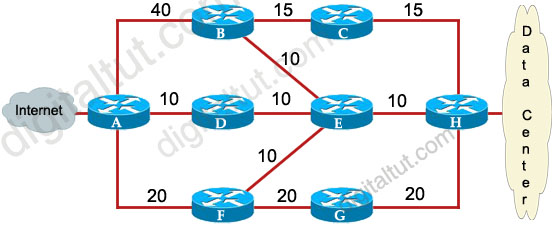
Refer to the exhibit. ROUTE.com has just implemented this EIGRP network. A network administrator came to you for advice while trying to implement load balancing across part of their EIGRP network.
If the variance value is configured as 2 on all routers and all other metric and K values are configured to their default values, traffic from the Internet to the data center will be load balanced across how many paths?
A. 1
B. 2
C. 3
D. 4
Answer: C
Explanation
First we should list all the paths from the Internet to the data center:
+ A-B-C-H with a metric of 70 (40 + 15 + 15)
+ A-B-E-H with a metric of 60 (40+10+10)
+ A-D-E-H with a metric of 30 (10+10+10)
+ A-D-E-B-C-H with a metric of 60 (10+10+10+15+15)
+ A-D-E-F-G-H with a metric of 70 (10+10+10+20+20)
+ A-F-G-H with a metric of 60 (20+20+20)
+ A-F-E-H with a metric of 40 (20+10+10)
So the path A-D-E-H will be chosen because it has the best metric. But EIGRP can support unequal cost path load balancing. By configuring the variance value of 2, the minimum metric is increased to 60 (30 * 2) and all the routes that have a metric of less than or equal to 60 and satisfy the feasibility condition will be used to send traffic.
Besides the main path A-D-E-H we have 4 more paths that have the metric of less than or equal to 60 (we also include the Advertised Distances of these routes for later comparison):
+ A-B-E-H with an AD of 20
+ A-D-E-B-C-H with an AD of 50
+ A-F-G-H with an AD of 40
+ A-F-E-H with an AD of 20
Now the last thing we need to consider is the feasible condition. The feasible condition states:
“To qualify as a feasible successor, a router must have an AD less than the FD of the current successor route”
The FD of the current successor route here is 30 (notice that the variance number is not calculated here). Therefore there are only 2 paths that can satisfy this conditions: the path A-B-E-H & A-F-E-H.
In conclusion, traffic from the Internet to the data center will be load balanced across 3 paths, including the main path (successor path) -> C is correct.
Question 2
Which condition must be satisfied before an EIGRP neighbor can be considered a feasible successor?
A. The neighbor’s advertised distance must be less than or equal to the feasible distance of the current successor.
B. The neighbor’s advertised distance must be less than the feasible distance of the current successor.
C. The neighbor’s advertised distance must be greater than the feasible distance of the current successor.
D. The neighbor’s advertised distance must be equal to the feasible distance of the current successor.
E. The neighbor’s advertised distance must be greater than or equal to the feasible distance of the current successor.
Answer: B
Explanation
As explained in question 1, this is called the feasible condition.
Question 3
Which statement about a non-zero value for the load metric (k2) for EIGRP is true?
A. A change in the load on an interface will cause EIGRP to recalculate the routing metrics and send a corresponding update out to each of its neighbors.
B. EIGRP calculates interface load as a 5-minute exponentially weighted average that is updated every 5 minutes.
C. EIGRP considers the load of an interface only when sending an update for some other reason.
D. A change in the load on an interface will cause EIGRP to recalculate and update the administrative distance for all routes learned on that interface.
Answer: C
Explanation
The load metric (k2) represents the worst load on a link between source and destination.
EIGRP routing updates are triggered only by a change in network topology (like links, interfaces go up/down, router added/removed), and not by change in interface load or reliability -> A & D are not correct.
The load is a five minute exponentially weighted average that is updated every five seconds (not five minutes) -> B is not correct.
EIGRP considers the load of an interface only when sending an update for some other reason (like a link failure, topology change). Updates are not sent out each time the load changes -> C is correct.
Note: To learn how to calculate EIGRP metric, please read my EIGRP tutorial – Part 3.
Question 4
Your network consists of a large hub-and-spoke Frame Relay network with a CIR of 56 kb/s for each spoke.
Which statement about the selection of a dynamic protocol is true?
A. EIGRP would be appropriate if LMI type ANSI is NOT used.
B. EIGRP would be appropriate, because the Frame Relay spokes could be segmented into their own areas.
C. EIGRP would be appropriate, because by default, queries are not propagated across the slow speed Frame Relay links.
D. EIGRP would be appropriate, because you can manage how much bandwidth is consumed over the Frame Relay interface.
Answer: D
Explanation
By default, EIGRP will limit itself to using no more than 50% of the interface bandwidth. The primary benefit of controlling EIGRP’s bandwidth usage is to avoid losing EIGRP packets, which could occur when EIGRP generates data faster than the interface line can absorb it. This is of particular benefit on Frame Relay networks, where the access interface bandwidth and the PVC capacity may be very different.
For example, in our Frame Relay topology a Hub is connected with 4 Spoke routers. The main Frame Relay interface on Hub router is 512Kpbs which is not enough to use for 6 links of 128 Kbps ( = 768 Kbps).
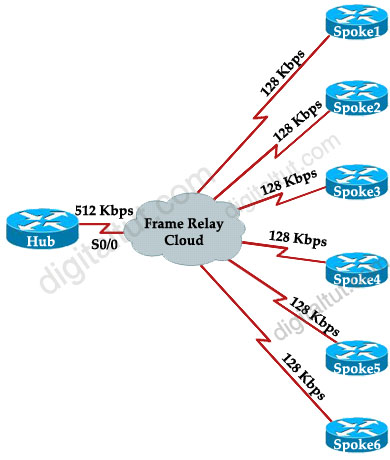
The solution here is we can use 512 / 6 = 85 Kbps on each subinterface of Hub by using “bandwidth 85” command. For example:
Hub(config)#interface Serial0/0.1 point-to-point
Hub(config-subif)#bandwidth 85
Also on Spoke routers we need to set this value. For example on Spoke1:
Spoke1(config)#interface Serial0/1.0 point-to-point
Spoke1(config-subif)#bandwidth 85
Notice that by default, EIGRP limits itself to use no more than 50% of the configured interface bandwidth. In this case EIGRP will not use more than 42.5 Kbps (50% of 85 Kbps).
(For more information about implementing EIGRP over Frame Relay, please read http://www.cisco.com/en/US/tech/tk365/technologies_tech_note09186a0080094063.shtml)
Question 5
When an EIGRP topology change is detected, what is the correct order of events when there is a FS?
A.
The neighbor adjacency is deleted.
The feasible route is used.
DUAL is notified.
Remove all topology entries learned from that neighbor.
B.
DUAL is notified.
Remove all topology entries learned from that neighbor.
The neighbor adjacency is deleted.
Routes enter the Active state and the feasible route is used.
C.
The neighbor adjacency is deleted.
Routes enter the Active state and the feasible route is used.
DUAL is notified.
Remove all topology entries learned from that neighbor.
D.
DUAL is notified.
The neighbor adjacency is deleted.
Remove all topology entries learned from that neighbor.
The feasible route is used.
Answer: D
Question 6
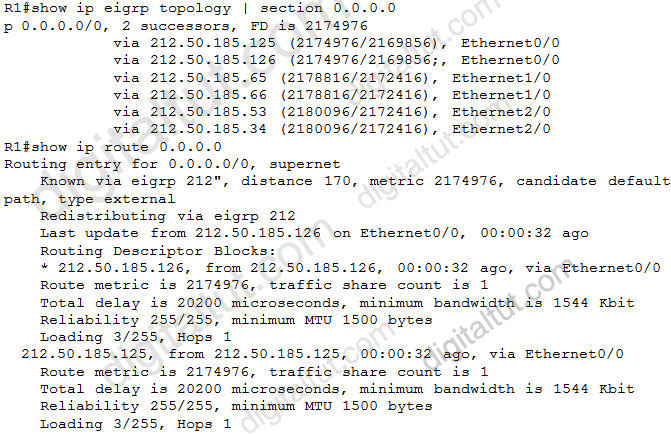
Refer to the exhibit. You want to use all the routes in the EIGRP topology for IP load balancing.
Which two EIGRP subcommands would you use to accomplish this goal? (Choose two)
A. traffic-share balanced
B. distance
C. maximum-paths
D. default-network
E. variance
Answer: C E
Explanation
Notice that the “maximum-paths” command is used to share traffic to equal cost path while the “variance” command can share traffic to unequal cost path.
In the output above we learn that EIGRP is using 2 successors to send traffic. By using the “variance 2” command we can share traffic to other feasible successor routes. But by default, EIGRP only shares traffic to 4 paths. So we need to use the “maximum-paths 6” to make sure all of these routes are used.
Question 7
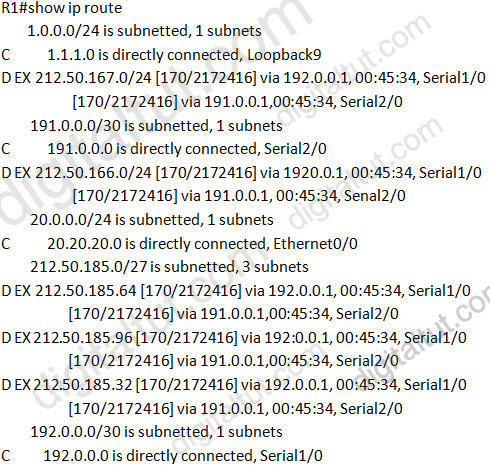
Refer to the exhibit. R1 accesses the Internet using E0/0. You have been asked to configure R1 so that a default route is generated to its downstream devices (191.0.0.1 and 192.0.0.1). Which commands would create this configuration?
A.
router eigrp 190
redistribute static
!
ip route 0.0.0.0 0.0.0.0 Null0
B. ip default-network 20.0.0.0
C.
router eigrp 190
redistribute static
!
ip route 0.0.0.0 255.255.255.255 Null0
D. ip default-network 20.20.20.0
Answer: A
Question 8
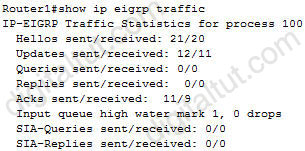
Which command will display EIGRP packets sent and received, as well as statistics on hello packets, updates, queries, replies, and acknowledgments?
A. debug eigrp packets
B. show ip eigrp traffic
C. debug ip eigrp
D. show ip eigrp interfaces
Answer: B
Explanation
Below is the output of the “show ip eigrp traffic” command:
Question 9
Which three statements are true about EIGRP operation? (Choose three)
A. When summarization is configured, the router will also create a route to null 0.
B. The summary route remains in the route table, even if there are no more specific routes to the network.
C. Summarization is configured on a per-interface level.
D. The maximum metric for the specific routes is used as the metric for the summary route.
E. Automatic summarization across major network boundaries is enabled by default.
Answer: A C E
Question 10
Which two statements about the EIGRP DUAL process are correct? (Choose two)
A. An EIGRP route will go active if there are no successors or feasible successors in the EIGRP topology table.
B. An EIGRP route will go passive if there are no successors in the EIGRP topology table.
C. DUAL will trigger an EIGRP query process while placing the flapping routes in the holddown state.
D. A feasible successor in the EIGRP topology table can become the successor only after all the query requests have been replied to.
E. The stuck in active state is caused when the wait for the query replies have timed out.
F. EIGRP queries are sent during the loading state in the EIGRP neighbor establishment process.
Answer: A E
Question 11
What are three key concepts that apply when configuring the EIGRP stub routing feature in a hub and spoke network? (Choose three)
A. A hub router prevents routes from being advertised to the remote router.
B. Only remote routers are configured as stubs.
C. Stub routers are not queried for routes.
D. Spoke routers connected to hub routers answer the route queries for the stub router.
E. A stub router should have only EIGRP hub routers as neighbors.
F. EIGRP stub routing should be used on hub routers only.
Answer: B C E


jeeva tamil mp3 – myfreemp3.review/search/jeeva-tamil-mp3/
download free music
Здесь вы можете заказать копию любого сайта под ключ, недорого и качественно, при этом не тратя свое время на различные программы и фриланс-сервисы.
Клонированию подлежат сайты как на конструкторах, так и на движках:
– Tilda (Тильда)
– Wix (Викс)
– Joomla (Джумла)
– WordPress (Вордпресс)
– Bitrix (Битрикс)
и т.д.
телефон 8-996-725-20-75 звоните пишите viber watsapp
Копируются не только одностраничные сайты на подобии Landing Page, но и многостраничные. Создается полная копия сайта и настраиваются формы для отправки заявок и сообщений. Кроме того, подключается админка (админ панель), позволяющая редактировать код сайта, изменять текст, загружать изображения и документы.
Здесь вы получите весь комплекс услуг по копированию, разработке и продвижению сайта в Яндексе и Google.
Хотите узнать сколько стоит сделать копию сайта?
напишите нам
8-996-725-20-75 звоните пишите viber watsapp