
Drag and Drop 2
Here you will find answers to Drag and Drop Questions – Part 2
Question 1
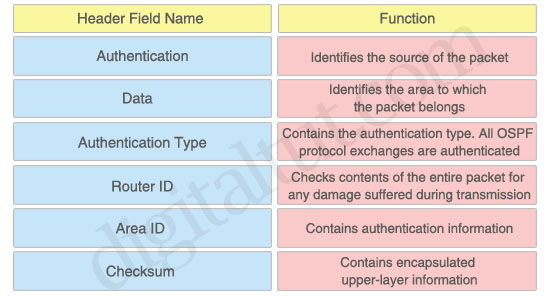
Answer:
Identifies the source of the packet: Router ID
Identifies the area to which the packet belongs: Area ID
Contains the authentication type. All OSPF protocol exchanges are authenticated: Authentication Type
Checks contents of the entire packet for any damage suffered during transmission: Checksum
Contains authentication information: Authentication
Contains encapsulated upper-layer information: Data
Question 2
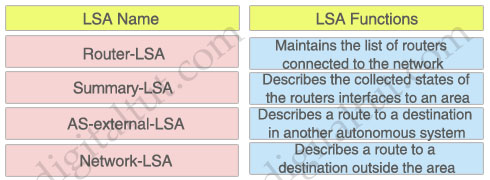
Answer:
Maintains the list of routers connected to the network: Network-LSA
Describes the collected states of the routers interfaces to an area: Router-LSA
Describes a route to a destination in another autonomous system: AS-external-LSA
Describes a route to a destination outside the area: Summary-LSA
Question 3
A virtual private network (VPN) is a computer network that is layered on the top of an underlying computer network. VPNs are of different technologies, such as Trusted VPNs, Secure VPNs, and Hybrid VPNs, each having distinct requirements. Drag the various VPN names to their appropriate places.
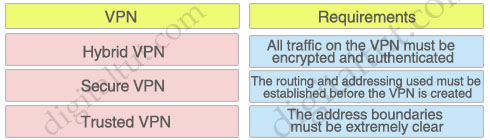
Answer:
All traffic on the VPN must be encrypted and authenticated: Secure VPN
The routing and addressing used must be established before the VPN is created: Trusted VPN
The address boundaries must be extremely clear: Hybrid VPN
Question 4
IPv6 to IPv4 transition methods
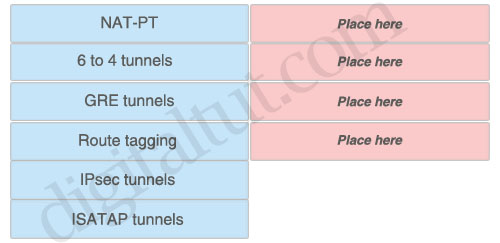
Answer:
NAT-PT
6 to 4 tunnels
GRE tunnels
ISATAP tunnels
Question 5
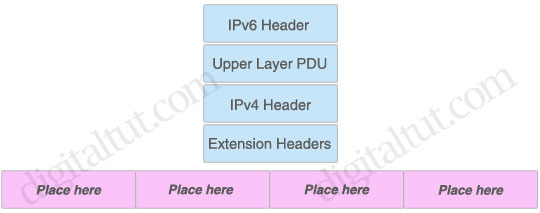
IP tunneling is a method to encapsulate IP datagram within IP datagrams, which allows datagrams intended for one IP address to be wrapped and redirected to another IP address. IPv6 packets are encapsulated directly behind the IPv4 header. Drag the header fields to the appropriate places:
Answer:
The correct order is:
| IPv4 Header | IPv6 Header | Extension Headers | Upper Layer PDU |
Explanation
The structure of a normal IPv6 packet is:
| IPv6 Header | Extension Headers | Upper Layer PDU |
The IPv6 header is always present and is a fixed size of 40 bytes. Zero or more extension headers can be present and are of varying lengths. The upper layer protocol data unit (PDU) usually consists of an upper layer protocol header and its payload (for example, an ICMPv6 message, a UDP message, or a TCP segment).
Because “IPv6 packets are encapsulated directly behind the IPv4 header” so we can deduce an IPv4 Header must be placed before an IPv6 header.
Question 6
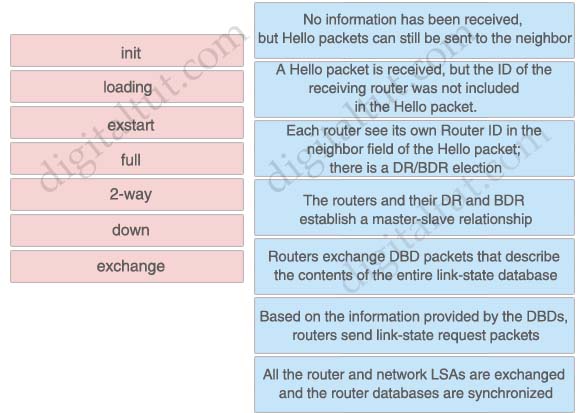
Drag each OSPF states into correct definition.
Answer and Explanation
The OSPF states below are described in the correct order when OSPF adjacency is formed:
Down: No information has been received, but Hello packets can still be sent to the neighbor
Init: A Hello packet is received, but the ID of the receiving router was not included in the Hello packet.
2-way: Each router see its own Router ID in the neighbor field of the Hello packet; there is a DR/BDR election.
Exstart: The routers and their DR and BDR establish a master-slave relationship.
Exchange: Routers exchange DBD packets that describe the contents of the entire link-state database.
Loading: Based on the information provided by the DBDs, routers send link-state request packets
Full: All the router and network LSAs are exchanged and the router databases are synchronized
A detailed explanation of OSPF states can be found here: http://www.cisco.com/c/en/us/support/docs/ip/open-shortest-path-first-ospf/13685-13.html.