
Redistribute Questions
Here you will find answers to Redistribute Questions
Question 1
Refer to the exhibit. Which statement is true?
| hostname RAR1 ! |
A. Router RAR1 will accept only route 10.10.0.0/19 from its BGP neighbor.
B. Router RAR1 will send only route 10.10.0.0/19 to its BGP neighbor.
C. Only traffic with a destination from 10.10.0.0/19 will be permitted.
D. Only traffic going to 10.10.0.0/19 will be permitted.
Answer: A
Question 2
Refer to the exhibit. Which three statements accurately describe the result of applying the exhibited route map? (Choose three)
| router eigrp 1 redistribute ospf 1 route-map ospf-to-eigrp default-metric 20000 2000 255 1 1500 ! ! route-map ospf-to-eigrp deny 10 match tag 6 match route-type external type-2 ! route-map ospf-to-eigrp permit 20 match ip address prefix-list pfx set metric 40000 1000 255 1 1500 ! route-map ospf-to-eigrp permit 30 set tag 8 |
A. The map prohibits the redistribution of all type 2 external OSPF routes with tag 6 set.
B. The map prohibits the redistribution of all type 2 external OSPF routes.
C. The map redistributes into EIGRP all routes that match the pfx prefix list and the five metric values 40000, 1000, 255, 1, and 1500.
D. The map prohibits the redistribution of all external OSPF routes with tag 6 set.
E. All routes that do no match clauses 10 and 20 of the route map are redistributed with their tags set to 8.
F. The map permits the redistribution of all type 1 external OSPF routes.
Answer: A E F
Explanation
In the route-map:
route-map ospf-to-eigrp deny 10
match tag 6
match route-type external type-2
The deny clause rejects route matches from redistribution. If several match commands are present in a clause, all must succeed for a given route in order for that route to match the clause (in other words, the logical AND algorithm is applied for multiple match commands). In this question, both the “match tag 6″ and “match route-type external type-2″ must be matched for this route to be denied -> A is correct.
If a match command is not present, all routes match the clause. In this question, all routes that reach clause 30 match and their tags are set to 8 -> E is correct.
If a route is not matched with clause 10 or 20 then it will be matched with clause 30 for sure -> F is correct.
Note: Route-maps that are applied to redistribution behave the same way as ACLs: if the route does not match any clause in a route-map then the route redistribution is denied, as if the route-map contained deny statement at the end.
(Reference: http://www.cisco.com/en/US/tech/tk365/technologies_tech_note09186a008047915d.shtml)
Question 3
Refer to the exhibit. On the basis of the information in the exhibit, which two statements are true? (Choose two)
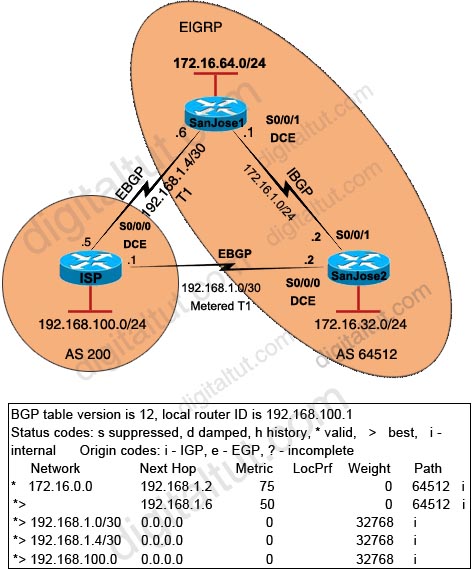
A. The output was generated by entering the show ip bgp command on the ISP router.
B. The output was generated by entering the show ip bgp command on the SanJose1 router.
C. The serial0/0/1 interface on the ISP router has been configured with the set metric 50 command.
D. The serial 0/0/1 Interface on the ISP router has been configured with the set metric 75 command.
E. When traffic is sent from the ISP to autonomous system 64512, the traffic will be forwarded to SanJose1 because of the lower MED value of SanJose1.
F. When traffic is sent from the ISP to autonomous system 64512, the traffic will be forwarded to SanJose2 because of the higher MED value of SanJose2.
Answer: A E
Explanation
From the output, we notice that the “local router ID” is 192.168.100.1 which is an interface on ISP router -> A is correct.
The show ip bgp command is used to display entries in the Border Gateway Protocol (BGP) routing table
Multi-Exit Discriminator (MED) is used when we have multiple entry points (connections) to another AS. A lower MED value is preferred over a higher value. Notice that the comparison between the MED only occurs if the first AS is the same in two (or more) paths. In this question, the first AS is 64512 which is the same -> the comparison can occur.
From the output, we learn that ISP router is receiving the 172.16.0.0 network from SanJose1 (192.168.1.6) with a metric of 50 and from SanJose2 (192.168.1.2) with a metric of 75. Also note that BGP has chosen the best path 192.168.1.6 to the 172.16.0.0 network (the “>” indicates it is the best path). The Weight, Local Preference (LocPrf) and AS-Path values between two next hops (192.168.1.2 & 192.168.1.6) are the same so we can deduce the traffic from ISP is sent from the ISP to SanJose1 because of the lower MED value.
Note: An entry of 0.0.0.0 in the “Next Hop” indicates that the router has some non-BGP routes to this network.
Question 4
Refer to the exhibit. Routers R1 and R2 have been configured to operate with OSPF. Routers R1 and R3 have been configured to operate with RIP. After configuring the redistribution between OSPF and RIP on R1, no OSPF routes are distributed into RIP. What should be done to correct this problem?
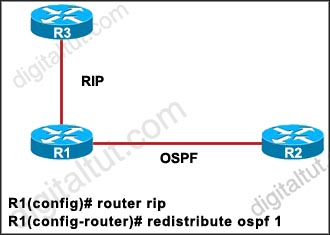
A. The redistribution command should be reentered with the match route-type parameter included.
B. The redistribution command should be reentered with the route-map map-tag parameter included.
C. The redistribution command should be reentered with the metric metric-value parameter included.
D. Routes will first need to be distributed into another protocol, and then into RIP.
Answer: C
Explanation
Notice that RIP metric is based on hop count only, and the maximum valid metric is 15. Anything above 15 is considered infinite. By default, when no metric is assigned when redistributing from EIGRP, OSPF, IS-IS, BGP into RIP, the default metric will be infinite. Therefore we must define a metric that is understandable to the receiving protocol. Usually, we should use a small value (like 1, 2, 3) so that after redistributing, that route can be advertised through many routers (because the limit is 15).
Question 5
| router eigrp 123 redistribute ospf 123 network 116.16.35.0 0.0.0.255 network 130.130.0.0 auto-summary ! router ospf 123 log-adjacency-changes network 116.16.34.0 0.0.0.255 area 0 neighbor 116.16.34.4 |
Refer to the exhibit. Why are the EIGRP neighbors for this router not learning the routes redistributed from OSPF?
A. Redistribution must be enabled mutually (in both directions) to work correctly.
B. Auto-summary causes the OSPF routes redistributed into EIGRP to be summarized; thus the OSPF network 116.16.34 is summarized to 116.34.0.0, which is already covered by the EIGRP protocol.
C. Default metrics are not configured under EIGRP.
D. Both routing protocols must have unique autonomous system numbers for redistribution to function correctly.
Answer: C
Explanation
Same as RIP, when redistribute into EIGRP from OSPF, the default metric is infinite -> We must set a seed metric when redistributing into EIGRP. Below lists the default seed metrics when redistributing from a routing protocol into another:
| Redistributed Protocol | Default Seed Metric |
| RIP | Infinity |
| IGRP/EIGRP | Infinity |
| OSPF | 20 for all (except for BGP, which is 1) |
| BGP | is set to IGP metric value |
Question 6
If a metric is not specified for routes that are redistributed into OSPF, the default metric that is assigned to the routes is 20, except for redistributed BGP routes. What is the metric that is assigned to redistributed BGP routes?
A. 0
B. 1
C. 10
D. 200
Answer: B
Explanation
Same explanation of Question 5
Question 7
During a redistribution of routes from OSPF into EIGRP, an administrator notices that none of the OSPF routes are showing in EIGRP. What are two possible causes? (Choose two)
A. incorrect distribute lists have been configured
B. missing ip classless command
C. CEF not enabled
D. no default metric configured for EIGRP
Answer: A D
Explanation
An incorrect distribute list can filter out updates therefore none of the OSPF routes are showing in EIGRP -> A is correct.
The default metric when redistributing into EIGRP is infinite so we must specify a seed metric for EIGRP to work with -> D is correct.
Question 8
During the redistribution process configured on RTA, some of the EIGRP routes, such as 10.1.1.0/24 and 10.2.2.0/24, are not being redistributed into the OSPF routing domain. Which two items could be a solution to this problem? (Choose two)
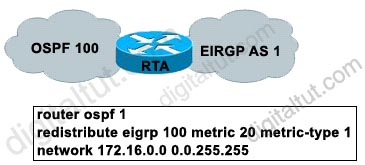
A. Change the metric-type to 2 in the redistribute command.
B. Configure the redistribute command under router eigrp 1 instead.
C. Change the EIGRP AS number from 100 to 1 in the redistribute command.
D. Add the subnets option to the redistribute command.
E. Change the metric to ah EIGRP compatible metric value (bandwidth, delay, reliability, load, MTUs) in the redistribute command.
Answer: C D
Explanation
The AS of EIGRP in the output above is not correct and we need to fix it into “eigrp 1″. Also, some of EIGRP routes, such as 10.1.1.0/24 and 10.2.2.0/24 are subnets so we must use the keyword “subnets” so that OSPF can see these routes. The full commands should be:
router ospf 1
redistribute eigrp 1 metric 20 metric-type 1 subnets
Question 9
You want the redistributed EIGRP AS 10 routes to have an administrative distance of 121 when they appear as RIP routes in the routing table of A1. Which command should you use on a router to accomplish this goal?
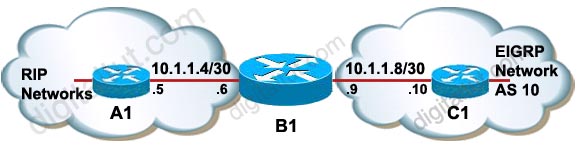
A. redistribute eigrp 10 metric 121
B. redistribute rip metric 121
C. default-metric 121
D. distance 121 10.1.1.6 0.0.0.0
Answer: D
Question 10
Refer to the exhibit. Which three commands should be used on router B1 to redistribute the EIGRP AS 10 routes into RIP? (Choose three)

A. router rip
B. router eigrp 10
C. redistribute eigrp 10
D. redistribute rip
E. default-metric 10000 100 255 1 1500
F. default-metric 5
Answer: A C F

Hello Friends,
I just started to study the ROUTE test after taking almost two years off from passing the CCNA. I am planning to take the ROUTE test in two months. Are the Sims, Drag and Drop, Questions, and everything else on this site still valid for the ROUTE test?
Thank you all!
The table after Q5, ‘redistributed protocol’ not clear. It is the protocol taking in the other protocol, or ‘receiving protocol’.
Can anyone explain Q1 please!
Thanks!!
I also don’t understand an ACL in Q1.
A gess the acl is:
access-list 101 permit ip 10.10.0.0 255.255.224.0 0.0.0.0 0.0.0.0
@from Tokyo
The “distribute-list” command filter(permit or deny) routes, and it uses an “acl” which in this case is alc 101. So routes that matches in acl 101 gets filtered in this case permitted into the routing table. “A” is correct
neighbor 172.16.1.2 distribute-list 101 in
access-list 101 permit ip 10.10.0.0 0.0.0.0 255.255.224.0 0.0.0.0
Can someone explain the answer to Question 9?
Why “D. distance 121 10.1.1.6 0.0.0.0″ is the answer?
More importantly why the ip 10.1.1.6 0.0.0.0?
Why is the ip interface 10.1.16 chosen?
for Q9 Ex
router rip
distance 121 10.1.1.6 0.0.0.0 10
Under the RIP process, an administrative distance of 121 is applied to updates from routers on the 10.1.1.6 0.0.0.0 network, for the specific networks matching access-list 10.
Q3
Answer could be D?
dear admin please comment in Q3 answer can be D except E ???please help me asap
@asif
metric is NOT configured on ISP…it’s learned from SanJose 1 & 2 routers. So D is incorrect.
CCNP Route 642-902 P.520 “Influencing an Enterprise’s Inbound Routes with MED”
explanation for Q1.
a network with all zeros as the subnet mask means that it it that particular network permitted, in this case
I just copied the exact acl from Q1 into one of my 7206 and this is the result
I don’t really under stand why the 0.0.0.0 are in there
show access-lists
Extended IP access list 101
10 permit ip host 10.10.0.0 host 255.255.224.0
Q 9 why not A?
hi I am going to give CCNP route apart from wheelman dumps is any other dump valid.Also does anyone have labs for ccnp route .if yes please send it at divyamarichi@gmail.com
for question 1 the acl is exactly for 10.10.0.0/19 (means it exactly filters the 10.10.0.0 255.255.224.0 destination)
@sup
Q9.
be careful – question about DISTANCE not about metric.
hi
can anyone comment on Q2 option C
regards
Guys correct the answer , the right one is option C not F ….
here is the reference:
http://www.cisco.com/en/US/tech/tk365/technologies_tech_note09186a008047915d.shtml
Prohibits the redistribution of all Type-2 external OSPF routes with tag 6 set.
Redistributes into EIGRP all routes which match the pfx prefix list, with five metric values—40000, 1000, 255, 1, and 1500.
Redistributes all other routes and sets their tags to 8 (the default).
@imran shahid
i think there’s a difference between the grammar of the one in the choices & the one in the article. In the article it says “with” while on the choices is says “and”.
I just noticed this also, i think this is the reason why C is not the right answer. Cheers! :)
in the question 10 u goinng to redistribute eigrp into rip
so the metric is 5 ok?????
and rip is not a hybrid protocol so ans is true
i still think its C bc the question’s theme is same to same as given in the qrticle ..what you think comment
regards
IN Q2 as Kenneth said is a grammar problem:
The map redistributes into EIGRP all routes THAT MATCH the pfx prefix list AND THE five metric values 40000, 1000, 255, 1, and 1500.
Metric is not matched but set…..
In the reference links it is said that: Redistributes routes that match with the defined metric!
REDISTRIBUTES into EIGRP all routes WICH MATCH the pfx prefix list, WITH five metric values—40000, 1000, 255, 1, and 1500.
I am going for route 2morrow, has anyone got any last minute suggestions…
done a bit of wheelman and also digitut… any suggestions are welcome…
Hi guys! I hope from you to visit my blog and I offer a free Cisco Learning Videos in CCNA and CCNP level. I cover many topics and Ideas to explain every thing about EIGRP,OSPF,RIP, Redistribution, Path control, and many topics it would be valuable for every one who wants to understand Cisco topics very well. Because passing the Exam is not every thing in Cisco, you need to understand what you are study!
So I will be happy to visit my Blog to watch my videos and here is the Link:
http://cisco-learning-video.blogspot.com/
Every week I upload a new video with new Idea !
Thank you :)
I’m with Imran on Q2. I don’t believe “with” or “and” make a grammatical difference in the meaning of the answer. If a route matches a prefix list, “AND” has the 5 metric values indicated, it is the same as a route which matches a prefix list and is redistributed “WITH” the 5 metric values indicated. One cannot be exclusive of the other if both are present, and whether or not “WITH” is used, or “AND” is used, they imply a lack of exclusivity. For sure, Cisco is categorically qualifying A, C, and E as the correct answers, and I highly doubt they are playing with conjuctives in the exam simply to redirect somebody to an answer/objective they never mention in their own article.
That said, can somebody please confirm the answers for Q2 as depicted above will be awarded full points on the exam if answered as indicated above? In other words, will somebody who’s had Q2 on their exam AND scored a 1000, please confirm the correct answers.
Thank you.
For clarification in the 3rd sentence of my previous post…I meant “…if both CONDITIONS are present…” Thanks.
Ok…I stand corrected on Q2. The difference is the fact the metric is set, not matched. My response is ultimately wasted time and space. Disregard my dialogue. A, E, F it is. :-)
Do you want to pass your CCNA or CCNP exams in first attempt?
Well we have 100% latest and proven fresh dumps for you.
We gurantee your passing score and we can prove that we have the most current dumps with us
Special Offer:-We will provide you with dumps updates for 3 months.
Price :- 10$
For more details, Please email us at dumpsmania@hotmail.com
Doesn’t the answer for #10 confirm that the answer for #9 is C? #9 wants all EIGRP routes, not just the interface….
ED I think you maybe confused between “metric” and “Distance” Q9 asks for the AD to be 121 and Q10 is if you don’t use “metric” the route will be marked as over 15 hops away, which RIP thinks is infinite. I hope this helps or please correct me.
@ DigitalTut:
Hey there, thanks for all the info. I believe your explanation for Q3 is wrong, as MED is supposed to influence inbound traffic rather than outbound traffic, but you’re saying ISP will prefer route through San Jose1 because of lower MED to reach the other AS (meaning outbound). Besides, there’s another right answer: “D. The serial 0/0/1 Interface on the ISP router has been configured with the set metric 75 command.”, it has since that’s the MED value it’s advertising.
Please let me know your thoughts on this.
@Josh:
‘D’ cannot be right.
@Josh:
The metric is one of those bgp attribute’s that gets tagged along with route advertisements. Both Sanjose’s advertised the network to the ISP, however, sanjose1 tells the ISP that it will cost you less, about 50 bucks, to get to the 172.16.0.0 network if you go through me, while sanjose2 tells the ISP, embedded in the route’s advertisement, it’ll cost you 75 bucks to get to me. The ISP, who prefers the lowest metric(why walk 75km when you can walk 50km to get to the same network), chooses the path through sanjose1 to get there.
NOTE: I think the point of confusion here is who advertises the route, which i believe, you mistake it’s the ISP.
Check out for MED’s use for best path selection:
http://www.cisco.com/en/US/tech/tk365/technologies_tech_note09186a0080094934.shtml
Question 3
Answer should be A and D
D: is correct cause The serial 0/0/1 Interface on the ISP router has been configured with the set metric 75 command.
ALiMATRIX:—-
NOTE:- Metric is not locally assigned.
in this case Metric’s are assigned on Sanjose1 and Sanjose2.
so the correct answer is “E”
When traffic is sent from the ISP to autonomous system 64512, the traffic will be forwarded to SanJose1 because of the lower MED value of SanJose1.
because ISP router is getting the metric of 50 from Sanjose 1 and in case of metric LOWER IS BETTER.
Comments on Q3 –
MED is used to set the inbound routing policy for a given AS. Since the policy is inbound, it cannot be set on the ISP router; it must be configured within the AS setting the policy (i.e., SanJose1 and SanJose2). If it were local preference, it would be set on a per-neighbor basis on the ISP router, but metric = MED, not local preference. At any rate, BGP path attributes are never configured on an interface, so C and D can be ruled out immediately.
Also, the 0.0.0.0 next-hop explanation is misleading, or at least confusing:
“Note: An entry of 0.0.0.0 in the “Next Hop” indicates that the router has some non-BGP routes to this network.”
Having a next-hop of 0.0.0.0 in the BGP table indicates that the route was locally originated, either through redistribution or the use of the network or aggregate commands in the BGP process. This will include connected routes.
Pls I need ccnp route course outline anyone should pls help me out with it
man those questions are so tedious in a way that it’s really hard to find the answer
i mean look at Q1 , access list doesn’t make sense at all ,,,,,
access-list 101 permit (source address – wild card) (destination address – wild card )
access-list 101 permit 10.10.0.0 0.0.0.0 255.255.224.0 0.0.0.0
how come !!!!!!!!!!!!!
and the answer is really like UFO
I echo everyone else above who believes D is a good answer to question 3. If anyone disagrees, please share some lights, here. Thx
I could not stop laughing at memoozzy last post! LOL! we need a little laughter every now and then. Keep the answers, comments, and laughter coming.
In Q 10. Why answer F is correct what about E. could you any one explain it clearly for understanding me…
@Dinesh Kumar, because in Q10 redistribution is happening from EIGRP to RIP therefore hop count must be used cause its RIP hope that clarifies it for you :)
Can anyone explain the Acl in Q1 please ?
question 2
F is wrong plz help me
Yes, pls. Can anyone help to explain the weird looking access list in question 1?
Google is your friend:
… the ACL is correct. This form is used not for filtering traffic but rather for filtering routes in a routing protocol where the destination part defines the prefix length of the routes….
@Abdallah ayman….
F is correct .. If you see Type 1 Routes are not filtered any where .
outer eigrp 1
redistribute ospf 1 route-map ospf-to-eigrp
default-metric 20000 2000 255 1 1500
!
!
route-map ospf-to-eigrp deny 10
match tag 6
match route-type external type-2
!
route-map ospf-to-eigrp permit 20
match ip address prefix-list pfx
set metric 40000 1000 255 1 1500
!
route-map ospf-to-eigrp permit 30
set tag 8
Above configuration only filters type 2 routes in its route-map deny statement which have a tag 6 set.
@ Tut
Please review Q1 exhibit. I think the ACL is incorrect.
In order for answer “A” to be correct, the ACL for a 10.10.0.0 /19 address would have to be shown as;
access-list 101 permit ip 10.10.0.0 0.0.31.255 0.0.0.0 0.0.0.0
This would allow access from only 10.10.0.0 /19 addresses to any other address.
You guys rock! You helped me get my CCNA and know, with your help I will get my CCNP!
Please update Q1.
Thanks,
Your loyal student.
We could realy use a good Explanation of Q1 from Tut… Hint, hint!
@all: The acl in the ehibit of Question 1 is not correct. We updated it, thank you for your detection!