
Redistribute Questions 3
Here you will find answers to Redistribute Questions – Part 3
Question 1
Given the accompanying output, which additional command is needed to redistribute IGRP into EIGRP?
| Router eigrp 123 Network 10.10.10.0 No auto-summary ! Router igrp 123 Network 172.16.0.0 Network 172.17.0.0 |
A. Under the router igrp mode add redistribute eigrp 123
B. Under the router eigrp mode add redistribute igrp 123
C. Under the router eigrp mode add redistribute igrp 123 subnets
D. None, EIGRP and IGRP are automatically redistributed in this instance.
Answer: D
Explanation
If IGRP and EIGRP use the same Autonomous System (AS) then redistribution occurs automatically. In this case both IGRP & EIGRP use the same AS 123 so they are automatically redistributed.
If IGRP and EIGRP use different AS numbers then redistribution must be done manually.
Question 2
Study the exhibit carefully. Router R1 is connected to networks 172.16.1.0/26 and 172.16.1.64/27. Based on the partial output in the exhibit, which description is correct?
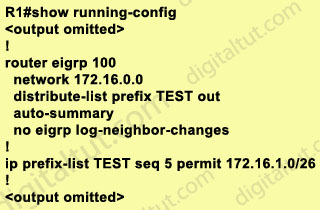
A. Router R1 should be reconfigured with an ACL instead of an ip prefix-list command.
B. Router R1 will advertise both routes.
C. Router R1 will deny the 172.16.1.0/27 route while permitting the 172.16.1.0/26 route to be advertised.
D. Router R1 will deny the 172.16.1.0/26 route while permitting the 172.16.1.64/27 route to be advertised.
Answer: C
Explanation
Prefix lists are configured with permit or deny keywords to either permit or deny the prefix based on the matching condition. A prefix list consists of an IP address and a bit mask. The IP address can be a classful network, a subnet, or a single host route. The bit mask is entered as a number from 1 to 32.
Prefix lists are configured to match an exact prefix length or a prefix range. The ge and le keywords are used to specify a range of the prefix lengths to match, providing more flexible configuration than can be configured with just the network/length argument. The prefix list is processed using an exact match when neither ge nor le keyword is entered.
Therefore in this case the exact 172.16.1.0/26 network is permitted while other networks are denied.
(Reference: http://www.cisco.com/en/US/docs/ios/12_3t/ip_route/command/reference/ip2_i2gt.html)
Question 3
Refer to the exhibit. The partial configuration for an OSPF ASBR and an Area 0 ABR is shown. Assume the OSPF configurations throughout the network are operable. Which statement about these configurations is true?
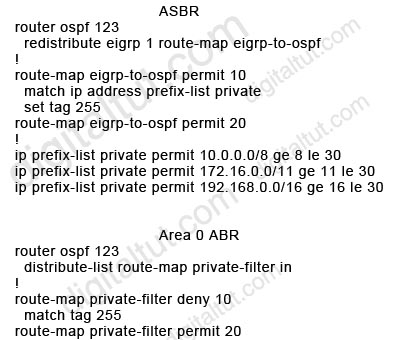
A. The ASBR route-maps are basically useless, because there are no deny prefix-lists.
B. LSA Type 5s will not be received by the ABR from the ASBR.
C. The OSPF backbone will not learn any RFC 1918 addresses.
D. The matched prefix-list addresses will be given a metric of 255, which is essentially unreachable.
Answer: C
Explanation
The ASBR accepts RFC 1918 addresses and set these networks to “tag 255″ but when advertising into Area 0, the ABR Area 0 filters out these networks because they match “tag 255″ so the OSPF backbone will not learn any RFC 1918 addresses.
Note that if you use an ACL in a route-map deny clause, routes that are permitted by the ACL are not redistributed.
All the networks with “tag 255″ are blocked by the clause 10 while all other networks are permitted by the clause 20 of the route-map (if a match command is not present, all routes match the clause).
Note:
RFC 1918 addresses include:
+ Class A: 10.0.0.0 – 10.255.255.255 (10/8 prefix)
+ Class B: 172.16.0.0 – 172.31.255.255 (172.16/12 prefix)
+ Class C: 192.168.0.0 – 192.168.255.255 (192.168/16 prefix)
Question 4
A network administrator is troubleshooting a redistribution of RIP routes into OSPF. Given the exhibited configuration commands, which statement is true?
| rooter rip network 10.0.0.0 ! router ospf 5 network 172.10.0.0 0.0.255.255 area 0 redistribute rip |
A. Redistributed routes will be tagged as external type 1 (E1) with a metric of 30.
B. Redistributed routes will be tagged as external type 2 (E2) with a metric of 20.
C. Redistributed routes will maintain their original RIP routing metric.
D. Redistributed routes will have a default metric of 0 and will be treated as unreachable and not advertised.
E. Redistributed routes will have a default metric of 0 but will not be treated as reachable and will be advertised.
Answer: B
Explanation
By default, all routes redistributed into OSPF will be tagged as external type 2 (E2) with a metric of 20, except for BGP routes (with a metric of 1).
Note: The cost of a type 2 route is always the external cost, irrespective of the interior cost to reach that route. A type 1 cost is the addition of the external cost and the internal cost used to reach that route.
Question 5
Refer to the exhibit. On the basis of the partial configuration, which two statements are correct? (Choose two)
A. Only routes matching 10.0.1.0/24 will be advertised out Ethernet 0.
B. Only routes 10.0.1.0/24 will be sent out all interfaces.
C. Only routes 10.0.1.0/24 will be allowed in the routing table.
D. Only routes matching 10.0.0.0/8 will be advertised out Ethernet 0.
E. Only routes matching 10.0.0.0/8 will be advertised out interfaces other than Ethernet 0.
F. All routes will be advertised out interfaces other than Ethernet 0.
Answer: A E
Explanation
In this case, the following algorithm is used when multiple distribute-lists are used:
1. First check which interface is being sent out. If it is Ethernet 0, distribute-list 2 is applied first. If the network is denied then no further checking is done for this network. But if distribute-list 2 permits that network then distribute-list 1 is also checked. If both distribute-lists allow that network then it will be sent out.
2. If the interface is not Ethernet 0 then only distribute-list 1 is applied.
Now let’s take some examples.
+ If the advertised network is 10.0.1.0/24, it will be sent out all interfaces, including Ethernet 0.
+ If the advertised network is 10.0.2.0/24, it will be sent out all interfaces, excepting Ethernet 0.
+ If the advertised network is 11.0.0.0/8, it will be dropped.
Note: It is possible to define one interface-specific distribute-list per interface and one protocol-specific distribute-list for each process/autonomous-system.
(For more information, please read: http://www.cisco.com/en/US/tech/tk365/technologies_tech_note09186a0080208748.shtml)
Question 6
Refer to the exhibit. Examine the partial configuration and the routing table excerpt. Which routes would be redistributed into OSPF area 1?
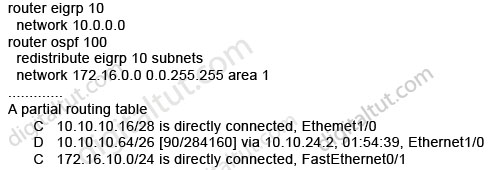
A. 10.10.10.16/28 only
B. 10.10.10.16/28 and 10.10.10.64/26
C. 10.10.10.16/28, 10.10.10.64/26, and 172.16.10.0/24
D. 10.10.10.64/26 only
Answer: B (but in the exam you should choose D)
Explanation
The network 172.16.10.0/24 belongs to OSPF (we know from the “network 172.16.0.0 0.0.255.255 area 1″ command) so it will not be redistributed.
When using the “subnets” keyword, all the connected networks will be redistributed so 10.10.10.16/28 & 10.10.10.64/26 will be redistributed, too. You can read my GNS3 lab about this topic here: http://www.digitaltut.com/redistribute-eigrp-and-ospf-gns3-lab.
Therefore the correct answer should be B but in the exam you should choose D. Maybe it is a mistake of Cisco.
Question 7
Refer to the exhibit. A partial routing configuration is shown. Complete the configuration so that only the default-network is redistributed from EIGRP 190 into EIGRP 212. Which ACL statement completes the configuration correctly?
| router eigrp 190 redistribute eigrp 212 network 192.0.0.0 0.0.0.3 ! router eigrp 212 redistribute eigrp 190 route-map default_route network 212.50.185.96 0.0.0.31 ! route-map defau1t_route permit 10 match ip address 100 |
A. access-list 100 permit ip 0.0.0.0 0.0.0.0 0.0.0.0 0.0.0.0
B. access-list 100 permit ip host 0.0.0.0 any
C. access-list 100 permit ip any host 0.0.0.0
D. A default-network cannot be redistributed between routing processes.
Answer: C
Explanation
The command “access-list 100 permit ip any host 0.0.0.0″ means permit any source address with the destination of 0.0.0.0/0, which is the default route
Note:
any equals 0.0.0.0 255.255.255.255
host 0.0.0.0 equals 0.0.0.0 0.0.0.0
Question 8
Refer to the exhibit. Router B and router C are performing mutual redistribution between OSPF and EIGRP, and their default metrics are configured the same. Router D has equal cost paths to networks where both paths are not really equal cost. For example, network 172.16.54.0 shows equal cost through both router B and router C, though in reality the cost is greater using router C. Other routers, though not shown, are connected to the 172.16.54.0 and 172.16.55.0 networks, and the same issues exist to those routers and the networks connected to them.
What can be done so that data will be routed along the most optimal path in the network?
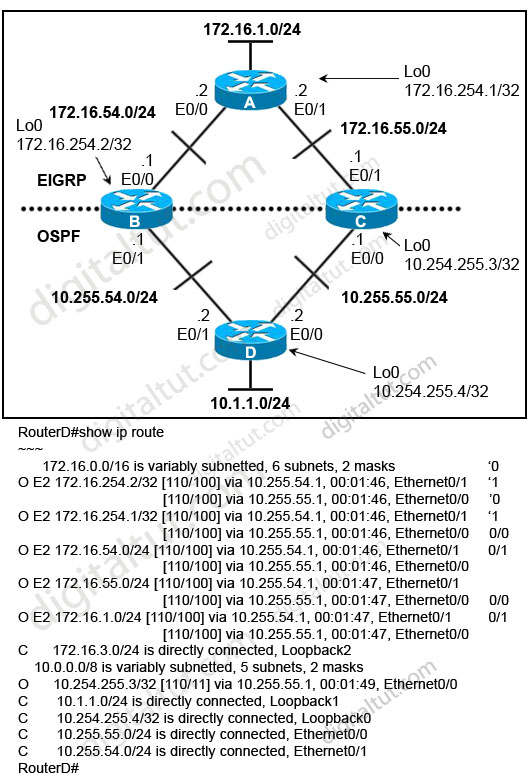
A. Redistribute connected interfaces on router B and router C.
B. Set the maximum number of equal cost paths to 1 in all routers.
C. When redistributing EIGRP into OSPF, set the external metric type to type E1.
D. Adjust the default metrics in router B and router C so that the values are different in each router.
E. None of these solutions will fix the problem. Migrate to a single dynamic routing protocol.
Answer: E
Explanation
Let’s discuss about answers C & D first.
From the output, we learn that all the External OSPF routes have metrics of 100 (the second parameters in [110/100]). This is not the default metric of OSPF Type 2 External route (the default value is 20) so the metrics of redistributed routes have been modified. Maybe when redistributing into OSPF, the “metric” in the “redistribute” command or the “default-metric” command was used on router B & C to assign the metric of these routes. Something like this:
| router ospf 1 redistribute eigrp 1 metric 100 subnets |
or
| router ospf 1 ….. default-metric 100 |
Therefore even if we use the metric type E1 the problem still exists because the link B-D & C-D seems to have the same metric -> the total metrics remains the same -> C is not correct.
We can use route-map and set different metrics for each networks but some unshown networks will have the same issues -> D is not a good choice
So the best answer should be E.
Question 9
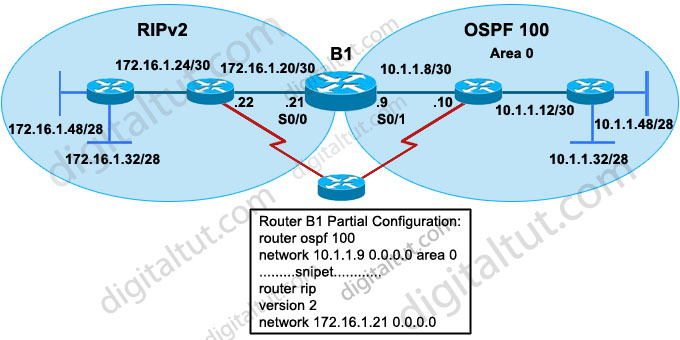
Refer to the exhibit. A new TAC engineer comes to you for advice. The engineer wants to configure RIPv2-OSPF two-way redistribution while avoiding routing loops. Which two additions to the router B1 configuration should the engineer make? (Choose two)
A. access-list 40 deny 172.16.1.0 0.0.0.255
access-list 40 permit any
router rip
redistribute ospf 100 metric 5
distribute-list 40 out ospf 100
B. ip prefix-list rip_routes permit 172.16.1.16/25 ge 26 le 28
route-map redis-ospf deny 10
match ip address prefix-list rip_routes
router rip
redistribute ospf 10 route-map redis-ospf subnets
C. ip prefix-list rip-to-ospf permit 10.1.1.8/25 ge 26 le 28
route-map redis-rip deny 20
match ip address prefix-list rip-to-ospf
router ospf 100
redistribute rip route-map redis-rip subnets
D. access-list 15 deny 10.1.1.0 0.0.0.63
access-list 15 permit any
route-map redis-rip deny 10
match ip address 15
route-map redis-rip permit 20
router ospf 100
redistribute rip route-map redis-rip subnets
Answer: A D
Explanation
B1 is not the only router that redistributes between RIP & OSPF. The “small” router below B1 can be configured for this task too so B1 can try to redistribute networks advertised by that “small” router again. Therefore it is necessary to filter out networks that have been advertised by the “small” router. For example, we need to prevent network 172.16.1.0/24 from advertised back into RIPv2 or network 10.1.1.0/26 from advertised back into OSPF. Notice that all networks in OSPF domain (including 10.1.1.8/30, 10.1.1.12/30, 10.1.1.48/28, 10.1.1.32/28) can be summarized as 10.1.1.0/26 and all networks in RIP domain (including 172.16.1.24/30, 172.16.1.20/30, 172.16.1.32/28, 172.16.1.48/28) can be summarized as 172.16.1.0/24 -> answers A & D are correct.
In answer B, the command “ip prefix-list rip_routes permit 172.16.1.16/25 ge 26 le 28″ means:
+ First check the first 25 bits of the address -> this will allow addresses from 172.16.1.0 to 172.16.1.127

+ If those match then check the subnet mask, which in this case can be GREATER THAN or EQUAL to 26 bits & LESS THAN or EQUAL to 28 bits -> meaning that /26, /27, /28 subnet masks would match.
For example, networks 172.16.1.0/26; 172.16.1.16/28 would match (but notice networks 172.16.1.0/25; 172.16.1.128/26 wouldn’t).
In the “ip prefix-list rip_routes permit 172.16.1.16/25 ge 26 le 28″, the prefix-list “rip_routes” only covers networks 172.16.1.32/28 & 172.16.1.48/28 but can’t cover networks 172.16.1.24/30 & 172.16.1.20/30. Also, the OSPF process in the “redistribute” command should be 100, not 10 -> B is not correct.
Same problem as answer B, the prefix-list in answer C can’t cover networks 10.1.1.8/30 & 10.1.1.12/30 -> C is not correct.
Question 10
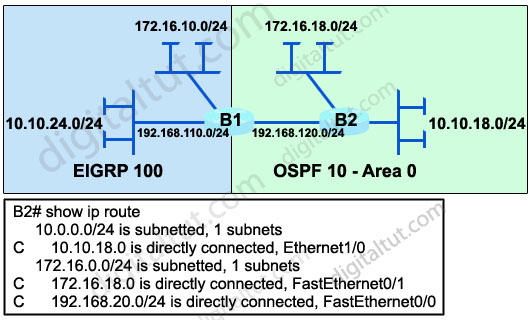
Refer to the exhibit. The network administrator is trying to configure mutual redistribution between EIGRP and OSPF. Autosummarization in EIGRP 100 AS is disabled. After adding OSPF configuration to router E31, the network administrator checked the routing table of router B2, but none of the EIGRP routes appeared there.
To redistribute the EIGRP AS 100 routes into OSPF, which command should be added, or edited, on router B1 under router ospf 10?
A. redistribute eigrp 100 metric-type 1
B. redistribute eigrp 100 subnets
C. no auto-summary 10.0.0.0 255.0.0.0
D. area 0 range 10.10.0.0 255.255.0.0
Answer: B
Explanation
When redistributing into OSPF without keyword “subnets”, only classful networks will be redistributed. Classful networks here mean networks with the default major subnet masks (for example 10.0.0.0/8; 180.1.0.0/16; 200.200.200.0/24…).
In fact, the routing table on the exhibit above is not totally correct. The network 192.168.110.0/24 will be redistributed and shown in the routing table of B2 even if the keyword “subnets” is not used because it belongs to class C with the default subnet mask of class C.
To make all the networks, including subnets appear in the routing table of B2 we must use keyword “subnets” when redistributing into OSPF. This is also an important thing to remember when redistributing into OSPF.
Please read my Redistribute EIGRP and OSPF – GNS3 Lab if you are still not sure about this.
Question 11
Refer to the exhibit. Routers R1 and R2 are running EIGRP and have converged. On the basis of the information that is presented, which statement is true?
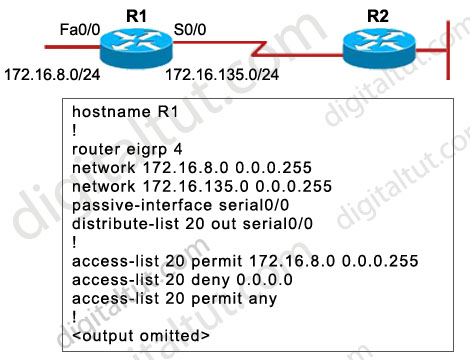
A. All outgoing routing updates from router R1 to router R2 will be suppressed, but the inbound updates will continue to be received.
B. All incoming routing updates from R2 will be suppressed, but the outgoing updates will continue to be sent.
C. Both outgoing and incoming routing updates on R1 will be stopped because of the passive-interface Serial0/0 configuration statement.
D. Both outgoing and incoming routing updates on R1 will be permitted because the distribute-list 20 out Serial0/0 command cannot be used with association with the outgoing interface.
Answer: C
Explanation
In EIGRP (and OSPF) the passive-interface command stops sending outgoing hello packets, hence the router can not form any neighbor relationship via the passive interface. This behavior stops both outgoing and incoming routing updates -> the distribute-list has no use here.

Q9 is not correct you have a deny ACL going into a Deny Route-map that will not work. May want to up date that.
I agree with Viper.
Viper it will work. I disagree with you.
If you have deny in one statement which denies another thing the result of that is PERMIT.
Same with Permit a permit will result in PERMIT.
Deny a permit = Deny
Permit a deny = Deny
Look at that as if Deny is – and permit is plus. Do the math … + and – always results with – while – and – always results with +. Simples :)
can be the answer of Q6 is D ??
@ bolo i believe u r wrong in the sense because in question 9
when option D is selected
ACL has a deny statment and the router map is also denying
and DENY+ DENY = PERMIT
thats confusing but i dont understand how is going to stop it
once it has allowed by route map 15 it is not going to be stopped by route map 20
@ digitaltut please help us out in this regards
In question 7, the answer is correct however the explanation logic is slightly flawed.
When used in a route-map, extended ACL’s act like prefix-lists. The source portion defines the prefix and prefix range, and the destination defines the mask or acceptable mask range.
For example
to allow any 192.168.x.x with prefixes from /23 to /32
permit ip 192.168.0.0 0.0.255.255 255.255.255.255 0.0.1.255
Hence, the permit ip any host 0.0.0.0 is using exactly 0.0.0.0/0 as the prefix with exactly 0.0.0.0 as the subnet mask.
Allow 192.168.0.X through 192.168.127.X configured with masks of /21 through /24
permit ip 192.168.0.0 0.0.127.255 255.255.255.0 0.0.7.0
Q9 is completely right cus Acl use deny+deny and the result ll be permitted.it the same way if v give the access-list 15 permit 10.1.1.0 0.0.0.63 and route-map redis-rip deny 10 and match ip add 15.
Q9 is right simply because the two wrong route map options, the prefix-list doesn’t match all the subnets you want to block. The explanation is clearly there for you all if you understand the concept correctly, which you really should do before taking the exam.
Regards route maps and deny deny then this discussion should answer the intricacies of them.
https://supportforums.cisco.com/message/3568749#3568749
Q6 I would go with B as the answer also, however I’m thinking perhaps the wording of the question or the IP addresses will be different in the Cisco exam and make more sense.
After all the 10.10.10.64/26 network is learnt from another router on 10.10.24.2/? via eth1/0,…which is directly connected to 10.10.10.16/28
Wish it wasn’t a partial routing table and a full table so I could lab it up in GNS3
Q1: None IGRP no longer exists.
Q6: correct is D, because there is a command to redistribute EIGRP only and you can see in partial routing table only 10.10.10.64/26 from EIGRP. If you want to redistribute also 10.10.10.16/28, you need command “redistribute connected”.
Please correct me, if I´m wrong
Q9 is not correct. When looking into route-maps just remeber first about looking into MATCH in route-map, not if it is permitted or denied. So in our case our ACL permits everything except 10.1.1.0 0.0.0.63, this everything will be denied because of route-map 10 deny. Everything which was not matched (so in our case 10.1.1.0 0.0.0.63) goes into next route-map statemant which is route-map 20 permit. So this will allow only 10.1.1.0 0.0.0.63 to be redistributed which is not exactly our goal as we wanted to redistribute everything except 10.1.1.0 0.0.0.63. Correct route-map for this goal should be:
D. access-list 15 permit 10.1.1.0 0.0.0.63
access-list 15 deny any
route-map redis-rip deny 10
match ip address 15
route-map redis-rip permit 20
router ospf 100
redistribute rip route-map redis-rip subnets
(switched permit and deny in ACL 15)
U r right smajko… :)
Q.7. Could anyone please explain in details why the Answer of Q.7 will not be a?
I am also agree with Munky about Q.6. No route will be redistributed from EIGRP to OSPF without you mention that route/network in eigrp process. how connected route will be redistributed into ospf from eigrp if we dont declare them in eigrp process??
Sayem, Q 7 is not “a” since the acl permits a default route out itself. Send default route out the default route.
11. is incorrect, a passive interface doesn’t stop both directions…it will stop sending updates but will continue to listen for incoming updates
Hello. In Q8 i think tha the correct answer is C because IF you do the redistribution with E1 metric type routers B and C will add to the default cost (100) and the cost to reach the specific subnet.For example Router’s C cost must be 100 plus the cost to reach router A and router A to reach the subnet BUT Router B has this subnet directly connected.
And A to
Hi. In Q8 answer C is not correct, because with E1 metric type routers add internal OSPF costs, and not external. For example, router C will not add the costs through routers C-A-B, because this path is in the EIGRP domain and not in the OSPF domain.
Yes indeed you are right and A is TOTALY wrong
Munky you are wrong about Q6. The correct answer is B. What you say is true, but it happens in OSPFv3 for IPv6 and not in OSPFv2. OSPFv2 also redistributes connected routes by default.
Julián, in my lab routers don’t redistribute connected. it happens only after “redistribute connected ” command.
Q9. Smajko is right. So this is the truth about route-maps:
Deny on ACL———-No match regardless of deny or permit on route-map(So long as the route map has a match statement). Example acl 10 deny 1.1.1.1, route-map ROUTE deny 5, MATCH ip add 10——-No match coz of the match statement.
Deny on ACL———-Matches deny or permit on route-map (So long as no match statement on route-map) Example acl 10 deny 1.1.1.1, route-map ROUTE deny 5—–Will match due to no MATCH statement.
| Route-map
|
| Permit | Deny
————-|——————————————————-
| Permit | Deny
ACL | |
|——————————————————-
Permit | Permit | Permit
| |
Munky and vel, according to Odom’s CCNP Route book “The IPv6 version of the redistribute command takes only routes learned from an IGP but by default does not take connected routes on interfaces enabled for that IGP. To also redistribute those connected routes, the redistribute command must include the include-connected parameter. When an IPv4 routing protocol redistributes from an IGP, it always attempts to take both the IGP-learned routes and the connected routes for interfaces enabled for that IGP.”
Q2. Totally wrong
NO CORRECT answers.
with config in exibit:
1. auto-summary enabled – router advertised net 172.16.0.0/16 – classfull
2. prefix-list TEST – allow EXACTLY network 172.16.1.0/26 because no LE no GE…
But 172.16.0.0/16 not equal 172.16.1.0/26 :) right?
and router advertice NOTHING…
All this was checked in GNS3…
Q6. Correct answer D. GNS3 labs help you: R1 and R2 – ospf neighbors – R1 also eigrp…
R1#sh ip ro
Gateway of last resort is not set
172.16.0.0/26 is subnetted, 1 subnets
C 172.16.1.0 is directly connected, Loopback1
C 192.168.1.0/24 is directly connected, FastEthernet0/0
15.0.0.0/24 is subnetted, 1 subnets
C 15.0.0.0 is directly connected, FastEthernet0/1
R1#sh run | sec router
router eigrp 100
network 172.16.0.0
auto-summary
router ospf 1
log-adjacency-changes
redistribute eigrp 100 subnets
network 192.168.1.0 0.0.0.255 area 0
Ok now on R2:
R2#sh ip ro
Gateway of last resort is not set
172.16.0.0/26 is subnetted, 1 subnets
O E2 172.16.1.0 [110/20] via 192.168.1.1, 00:01:27, FastEthernet0/0
C 192.168.1.0/24 is directly connected, FastEthernet0/0
AND where is connected routes from R1???
DIV:
isn’t it just there in your show commands?
R1
C 172.16.1.0 is directly connected, Loopback1
(C as connected network, included in the router eigrp command)
R2
O E2 172.16.1.0 [110/20] via 192.168.1.1, 00:01:27, FastEthernet0/0
(redistributed here in OSPF…)
in the exam question you have network 10.0.0.0 under EIGRP. In this network you have one subnet that is directly connected to the router, C 10.10.10.16/28, and D 10.10.10.64/26 that is learned by an EIGRP neighbor. In my mind both are part of the EIGRP topology (10.10.10.16/28 will be advertised to EIGRP neighbors), so both are redistributed in OSPF. And your example, again, confirms it.
Of course connected networks that are not in EIGRP or OSPF will not appear on any OSPF neighbor (15.0.0.0 in your example).
Q6 B is confirmed there:
http://www.cisco.com/en/US/tech/tk365/technologies_tech_note09186a008009487e.shtml#connectRoute
You have the exact same example, and see that connected C routes that are part of the EIGRP process (according the network command) are redistributed into OSPF. In addition to any D (EIGRP learned) routes.
just took the exam 1000/1000pts. i can confirm that Q6 correct answer is D
thanks jana, actually I can also see in the course that only EIGRP learbed (D) routes that are installed in the routing table may be redistributed. Thus connected routes should not.
But the documentation above shows exactly the contrary.
Q9:
- B does not work basically because it redistributes ospf 10 and not ospf 100, nothing to add.
- B and C are wrong because they only include a deny statement in the routemap, no permit:
“If a router reaches the bottom of the route map without finding a match, it denies the route from being redistributed” (ROUTE course)
==> either it matches and you get a deny, or it does not match and reaches the bottom, and you get a deny ==> no redistribution.
However:
- D is also wrong
ask yourself:
access-list 15 deny 10.1.1.0 0.0.0.63
access-list 15 permit any
route-map redis-rip deny 10
match ip address 15
route-map redis-rip permit 20
1.
Does OSPF networks 10.1.1.* matches this ACL 15? the answer is no (access list deny is ACL)
Thus it does not match route-map redis-rip deny 10. this it goes to redis-rip permit 20, thus it is redistributed, this is not what we want.
2.
does rip network 172.16.1.* matches this ACL 15 ? the answer is yes: access-list 15 permit any
Thus it matches route-map redis-rip deny 10, thus it is not redistributed, and this is exactly what we do not want.
Julián, I hope that the creator of the question has read this book too.
Q9.
I checked in GNS3.
access-list 15 deny 10.1.1.0 0.0.0.63
access-list 15 permit any
route-map redis-rip deny 10 (in this stage denied all second clause of access-list 15)
match ip address 15
route-map redis-rip permit 20 (in this stage permitted 10.1.1.0 0.0.0.63)
router ospf 100
redistribute rip route-map redis-rip subnets
So, we should deny 10.1.1.0/26 network to OSPF process, but it is permitted, so it is wrong answer!
(answer C also wrong)
Q6
as the question saying: Which routes would be redistributed into OSPF area 1?
see “redistributed” NOT Advertised so only routes which are being learned by EIGRP.
so answer is D. 10.10.10.64/26 only
free iphone 5 pohotsHey there this is kind of of off topic but I was wondering if blogs use WYSIWYG editors or if you have to manually code with HTML. I’m starting a blog soon but have no coding knowledge so I wanted to get guidance from someone with experience. Any help would be greatly appreciated!
Thanks Jana, about question 6 maybe we should choose answer D (before the explanation says “Answer: B (but in the exam you should choose D. Maybe it is a mistake of Cisco.”) but Cisco has had a big mistake here. This is confirm at http://www.cisco.com/en/US/tech/tk365/technologies_tech_note09186a008009487e.shtml#connectRoute as Mart said. Also according to Odom’s CCNP Route book “When an IPv4 routing protocol redistributes from an IGP, it always attempts to take both the IGP-learned routes and the connected routes for interfaces enabled for that IGP.” as I said previously.
Regards
Question 7
In my opinion
A. access-list 100 permit ip 0.0.0.0 0.0.0.0 0.0.0.0 0.0.0.0
means right the defautl and nothing else
C. access-list 100 permit ip any host 0.0.0.0
means all the routes with /32 mask, meaning not only 0.0.0.0/32 byt also, for instance, 18.89.156.89/32
Based my opinion on what Anonymous says, the src specified as network & network range, if specified as “any” that means a prefix that contains the whole Internet address, i.e. from 0.0.0.0 to 255.255.255.255 within which only networks whose mask goes from /32 to /32 will be taken.
Instead if in place of any we put 0.0.0.0 0.0.0.0 then we already restrict the prefix to one /32 and then the mask range is almost superfluous.
My 2 cents
Q8 which one is it: Good dumps say it’s D you guys say it’s E?
so which one is it?
Hi guys! I hope from you to visit my blog and I offer a free Cisco Learning Videos in CCNA and CCNP level. I cover many topics and Ideas to explain every thing about EIGRP,OSPF,RIP, Redistribution, Path control, and many topics it would be valuable for every one who wants to understand Cisco topics very well. Because passing the Exam is not every thing in Cisco, you need to understand what you are study!
So I will be happy to visit my Blog to watch my videos and here is the Link:
http://cisco-learning-video.blogspot.com/
Every week I upload a new video with new Idea !
Thank you :)
@Dude I think Q8 Has to be D, adjust the default Metric to give preference to the C route.
Hi,
I have just passed my exam with 976/1000. I think I failed Q6, I chose B, therefore must be D, although it is a Cisco’s mistake. Anyways, I am not sure if I failed Q6 or it was another one.
Regards
Please anyone confirm Q8 ans would be E or D.Giving Exam next Week.Moreover WheelMan is still valid or not???Pls help.
Q8 i agree with Wholehawg because in the sentense of D says about DIFFERENT values to each router and in the explanation of the correct answer talk for the SAME values to each router
Q7 is strange. As I see it the network and wildcard is matching on source address in a standard access-list and source and destination address in an extended access-list where 0 is bitwise exact match and 1 is don’t care. A match on 0.0.0.0 0.0.0.0 (host 0.0.0.0) could therefore never match though that destination address do not exist.
As I see it is a match on ip address in ip header, not on entries in routing table. I’m going to set up a lab and test it.
/Jonny in sweden
Q6. correct answer is D.
Morally ans. B is right but directly connected route dont redistributed.
http://www.cisco.com/en/US/tech/tk365/technologies_tech_note09186a008009487e.shtml
Question #4, the answer should be E. there is no “subnet” in the “redistribute rip” command.
Hey,
Question 6 is a bit confusing. Thing is, they say:
1) 10.10.10.64/28 via 10.10.24.2. So…. 10.10.24.2 is the next hop connected to Ethernet 1/0.
2) 10.10.10.16/26 is the directly connected subnet on Ethernet 1/0… don’t get why this is not 10.10.24.0/26 or something, that is what I would have expected.
Or am I overlooking something? 2 Directly connected subnets on Ethernet 1/0???
Hey,
Another question, this time about Q8.
Setting different seed metrics , would I’d say make them router to one of either routers? Instead of e.g. showing both links having cost 100 (since both sides used the same seed metric), if you choose 100 and 200 instead, they wouldn’t have these load balanced routers as they have them now.
On the other hand, they’re asking for optimal paths to the routes. So if e.g. all traffic went via Router B, then that would also mean 172.16.55.0/26, and that should have a more optimal path via Router C.
So I guess the answer is indeed E, but D is also hanging in my head. Maybe if they’d chosen using route-maps instead or something.
On the other hand, I don’t like the 2nd part of the answer. Yes, A – D are not solving the issue, but that doesn’t mean there is no solution. “Migrate to single dynamic routing protocol”, sure for this network maybe, what if it’s a live network where it’s not possible? Weird answer, they should have sticked with “None of these solutions will solve the problem”.
@Jonny M
Did you try to set up Q7 in the lab? What is the result of redistributing eigrp 190 to eigrp 212 using that access-list and route-map? I tried to set it up in SPARC, but I didn’t get what I expected. Nothing has been redistributed to eigrp as 212.
About Q5, the answer is correct, but the explanation not 100%:
“+ If the advertised network is 10.0.1.0/24, it will be sent out all interfaces, including Ethernet 0.”
I believe that should be:
“+ If the advertised network is 10.0.1.0/24, it will be sent out Ethernet 0.”
Correct me if I’m wrong, but if that explanation given is correct, it doesn’t match the outcome of the question :D.
update about Q8? I think the answer should be D… is it really E on the exam??
Question 3: I don’t think C is the right answer (to my mind there’s no right answer in this question). “distribute-list … in” command in OSPF just prevents the routes from appearing in routing table, it does not flush the LSAs type 5 out of ospf database. So, ABR still has LSAs type 5 of RFC 1918 addresses in its database, and it will advertise them to routers in OSPF backbone, therefore those routers still learns RFC 1918 addresses. You can check this with GNS3
Q2
Div you are not right
1) Auto-summary will force router to summarize advertisements only on classful boundaries
2) Based on this output we can draw a conclusion that router may use 172.16.1.0/xx subnet to his neighbor (only 172.16.0.0 network statement under eigrp).
3) That means that it will not auto-sumarize, but will try to advertise both networks.
4) Distribute list will permit to advertise only 172.16.1.0/26 network.
http://blog.ioshints.info/2009/06/quick-tip-matching-default-route-in.html
This answers Q7 and the correct one is A like Alex1 wrote.
Q6 is really D.
A. 10.10.10.16/28 only -> Directly connected
B. 10.10.10.16/28 and 10.10.10.64/26
C. 10.10.10.16/28, 10.10.10.64/26, and 172.16.10.0/24
D. 10.10.10.64/26 only -> Known from EIGRP
As such A cannot be redistributed to OSPF as it is not an EIGRP originated route in the routing table. Although, it is in the EIGRP topology table, in the routing table it is shown directly connected not EIGRP Internal/External. So this is tricky but D is indeed the correct answer.
Has somebody encountered Q7 on the exam? If so what was the correct answer? It’s shown as C everywhere but that’s incorrent for sure (A is correct IMO). Thanks
Question 6: Because in the partial routing table we can see only 10.10.10.64/26 are learned from EIGRP. -> D is the best answer.
I’ve labbed out Q6 and the answer is D.
Only routes that are in the routing table should be redistributed.
Q6
All you guys are Right, EIGRP redistribute the Conected Networks BUT with 2 conditions:
- The interface should be running EIGRP
- Just the PRIMARY ADDRESS will be in EIGRP
in this case 10.10.10.16/28 is a secundary address, because the primary address is 10.10.24.x
in the PARTIAL routing table said:
C 10.10.10.16/28 E1/0
D 10.10.10.64/26 via 10.10.24.2 Eth1/0 (same interface than 10.10.10.16, but one is running EIGRP becasue is the primary and the other not)
the missing part of the routing table is :
C 10.10.24.X/XX E1/0
that is why i think D is correct.
Q7
the default route is 0.0.0.0 / 0
the first part is declared by host 0.0.0.0 and the second is declared by host 0.0.0.0
host 0.0.0.0 host 0.0.0.0 equals 0.0.0.0 0.0.0.0 0.0.0.0 0.0.0.0
i think A is correct
Q8
Router B and C
router opsf 1
redistribute eigrp 1 subnets (already)
* redistribute connected subnets metric 90 (less than 100)
i think A is correct.
Q6 is very confusing. I believe the answer is B.
Connected routes WILL get redistributed into OSPF from EIGRP if that interface is enabled for EIGRP.
Since the EIGRP learned route is from interface Ethernet1/0, we know that interface is enabled for EIGRP. That means the connected interface IP will also get redistributed.
C 10.10.10.16/28 is directly connected, Ethernet1/0
D 10.10.10.64/26 via 10.10.24.2 Ethernet1/0
I lab’d it up, and get same results. Both networks get resdistributed. If I add a non-EIGRP enabled interface, that one does not get resdistributed.
kindly confirm the answer for question 4:
router rip
network10.0.0.0
!
router ospf 5
network 172.10.0.0 0.0.255.255 area 0
redistribute rip
A. redistributed routes wil hav external type of 1 and metric of 1
B. redistributed routes wil hav external type of 2 and metric of 20
C. redistributed routes wil hav default metric of 0 but will b treated as unreachable and not advertised
in Boyi file ..it is repeated twice..at one place answer is B. and in the othe answer is C
Kindly clarify
In Q8 is not the answer D is definitly the answer E because answer D says:
D. Adjust the default metrics in router B and router C so that the values are different in each router.
So if we change the default metric with the command:
default-metric 100
Maybe it will remain another command like:
redistribute eigrp 1 metric 100 subnets
So we dont know what kind of config has the router for that reason D is not valid and the correct answer is
E
Hu Umar,
i have the same problem..
in lead2pass they use answer E.
Redistributed routes will have a default metric of 0 and will be treated as unreachable and not advertised.
In my opinion B should be the right answer…
Could anybody please confirm ?
Hello DT,
In question 9, I think that the same commands should also be there on small router if it is doing the full redistribution as it can also advertise the routes wrongly. Correct me if I am wrong
Thanks
@Shivam: Yes, we need both answers A & D to do full redistribution.
Q9: there’s another story to prevents routing loops by set tag easier than that solution
Q7. in my opinion all 3 Answers are correct A, B and C. I tried to set it up on GNS3.
all Answers work. but no matches by show route-map, just by show access-lists.
i don’t understand this why there is no matchs. can you help me
Hi,
i just took the exam with 1000/1000 , Q6 D is the correct answer,for Q7 is C. those are the rihgt answers 100% in the exam, even if wehn i labed Q6 in gns3, i had the answer B (i don’t know why ?) but my brother told me the Connected network should not be redistributed , in order to do so you must do 3way redistribution wich include connected networks too, he took the CCIE exam 5 yaers ago and works in Cisco Environement since 2003.
so good luck every body.
@Amit
Q6
Amit, you are right.The correct is D.You made a gret research job.
In the documentation referenced by him (‘Redistributing Connected Networks into OSPF’, Cisco Document ID: 18722), explains that exist:
“different behavior of redistributing connected routes into OSPF. The change in behavior began in Cisco IOS version 12.1(3).”
– Before IOS 12.1(3) -> Connected routes were redistributed.
– Starting with IOS 12.1(3) -> Connected routes are not redistributed.
So, present IOS releases doesn’t redistribute connected routes into OSPF.This is the most general scope answer, so is the correct one.
Question 7
Here’s a known authority on Cisco IOS about selecting just the default route
“http://blog.ioshints.info/2009/06/quick-tip-matching-default-route-in.html
Read also the comments.
So it should be
access-list 100 permit ip 0.0.0.0 0.0.0.0 0.0.0.0 0.0.0.0
As for logic in this one:
first set of eight zeros means: select EXACTLY 0.0.0.0 for a prefix
the following set of eight zero means: select just the 0 mask and it can be of exactly 0 length
So, access-list 100 permit ip any host 0.0.0.0 or permit ip 0.0.0.0 255.255.255.255 0.0.0.0 0.0.0.0
means this:
permit ANY ip prefix with 0 lenght. It will also work as there’s only one route with /0 prefix. The default.
So both will work and both are correct in this question.
@Amit @ NMPAMPEN1
The one NMAMPEN1 mentioned is from this link
http://www.cisco.com/en/US/tech/tk365/technologies_tech_note09186a0080094707.shtml
So it does seem like according to cisco documentation, redistributed routes into OSPF only applies to non directly connected routes. However, from my lab using Cisco IOS release 12.4(23) it shows that it does get redistributed. Type 5 LSAs are being created.
So who should I trust? Cisco documentation , or lab results?
http://i.imgur.com/WwaNaQl.jpg
Question 7
funny thing but it seems that all ACLs are correct
I did it in GNS3 lab (redistribution from ospf to eigrp) with these ACLs
access-list 101 permit ip host 0.0.0.0 host 0.0.0.0
access-list 102 permit ip host 0.0.0.0 any
access-list 103 permit ip any host 0.0.0.0
and every one of them filters all D EX but default
R1#
R1#sh ip route
Codes: C – connected, S – static, R – RIP, M – mobile, B – BGP
…
Gateway of last resort is 192.168.12.2 to network 0.0.0.0
C 192.168.12.0/24 is directly connected, FastEthernet0/1
172.16.0.0/24 is subnetted, 1 subnets
D EX 172.16.23.0 [170/284160] via 192.168.12.2, 00:00:02, FastEthernet0/1
10.0.0.0/8 is variably subnetted, 7 subnets, 2 masks
C 10.1.3.0/24 is directly connected, Loopback3
C 10.1.2.0/24 is directly connected, Loopback2
C 10.1.1.0/24 is directly connected, Loopback1
D EX 10.1.7.0/30 [170/284160] via 192.168.12.2, 00:00:02, FastEthernet0/1
D EX 10.1.6.0/24 [170/284160] via 192.168.12.2, 00:00:03, FastEthernet0/1
D EX 10.1.5.0/24 [170/284160] via 192.168.12.2, 00:00:03, FastEthernet0/1
C 10.1.4.0/30 is directly connected, Loopback4
D*EX 0.0.0.0/0 [170/284160] via 192.168.12.2, 00:26:43, FastEthernet0/1
R1#
R1#
R1#sh ip route
Codes: C – connected, S – static, R – RIP, M – mobile, B – BGP
D – EIGRP, EX – EIGRP external, O – OSPF, IA – OSPF inter area
…
Gateway of last resort is 192.168.12.2 to network 0.0.0.0
C 192.168.12.0/24 is directly connected, FastEthernet0/1
10.0.0.0/8 is variably subnetted, 4 subnets, 2 masks
C 10.1.3.0/24 is directly connected, Loopback3
C 10.1.2.0/24 is directly connected, Loopback2
C 10.1.1.0/24 is directly connected, Loopback1
C 10.1.4.0/30 is directly connected, Loopback4
D*EX 0.0.0.0/0 [170/284160] via 192.168.12.2, 00:26:56, FastEthernet0/1
R1#
@Snajdan October 5th, 2012
Q3
I totally agree with your comment. For me there is no correct answer.
In the scenario described in the question, the ABR will not install the prefix in its routing table but it doesn’t prevent him from flooding LSAs to other routers in the backbone area.
Q6: i checked this one with GNS3 and IOS 12.4.5D.
Result: EIGRP enabled Interfaces will definitely be redistrubited to OSPF.
My Subnets are different and the routing processes are:
router eigrp 100
redistribute ospf 1 metric 1544 2000 100 255 1500
network 10.0.0.0
!
router ospf 1
log-adjacency-changes
redistribute eigrp 100 subnets
network 10.1.23.0 0.0.0.255 area 0
On the Router doing the redistribution (EIGRP to OSPF) , i got the route:
C 10.1.12.0/24 is directly connected, Serial0/0
On the Router in the OSPF Domain it appears as E2 Route.
O E2 10.1.12.0/24 [110/20] via 10.1.23.2, 00:22:29, Serial0/0
@Digitaltut,
Many comments on Q6 regarding D being the correct answer. Do you agree or disagree? The very first time I look at the question, I could not make sense of B being the correct answer. If you agree, please correct the answer. Thank you.
Q5)
Why answer cannot be B?? Please some kind heart explain.
Q7, there is no acess list command like permit or deny for 100, Match ip address 100. But no access list created for 100 as per output then we can discuss the answer. Plz could any one explain clearly since i am beginer…
@digitaltut,
on my exam, i got similiar Similiar Question for Number 4 Question at Digitut. But what the Configuration is a little Different, which is :
rooter Ospf 5
network 10.0.0.0
!
router rip
network 172.10.0.0 0.0.255.255 area 0
redistribute ospf 5.
The Answer Question is : A network administrator is troubleshooting a redistribution of OSPF routes into RIP. Given the exhibited configuration commands, which statement is true?
They swap the Command and the Question, So Carefully to read the Question before directly Answer it. Several of the question are ask different things but the Multiple Choice are same.
Correction for the Quote Above :
What I mean is “The Question is” Not “The Answer Question is”
Hi,
I”m preparing my CCNP route exam. Thanks a lot for your explanation and comments. I will pass my exam in the next two weelks.
Q4
redistribute rip SUBNETS
Without that keyword, nothing will be redistributed..
Q5)
Wht the answer cannot be B? Please explain
Q7
I agree with “conip” I also created a lab with a static default GW on a router and redistributed that using
ip default-network
and the third router got the default router no matter what of the 3 different access-list options I provided (of course I first removed the previous one before entering the next access-list)