
Home > EIGRP Simlet

EIGRP Simlet

July 31st, 2011 in ROUTE 642-902 Go to comments

EIGRP – SHOW IP EIGRP TOPOLOGY ALL-LINKS


Here you will find answers to EIGRP Simlet question

Question

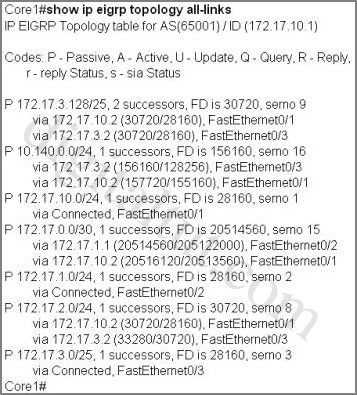
Refer to the exhibit. BigBids Incorporated is a worldwide auction provider. The network uses EIGRP as its routing protocol throughout the corporation. The network administrator does not understand the convergence of EIGRP. Using the output of the show ip eigrp topology all-links command, answer the administrator’s questions.
simlet_show_ip_eigrp_topology_all_links

Question 1

Which two networks does the Core1 device have feasible successors for? (Choose two)

A – 172.17.0.0/30
B – 172.17.1.0/24
C – 172.17.2.0/24
D – 172.17.3.0/25
E – 172.17.3.128/25
F – 10.140.0.0/24


Answer: A F

Explanation

To understand the output of the “show ip eigrp topology all-links command” command, let’s analyze an entry (we choose the second entry because it is better for demonstration than the first one)

FeasibleDistance_and_AdvertisedDistance

The first line tells us there is only 1 successor for the path to 10.140.0.0/24 network but there are 2 lines below. So we can deduce that one line is used for successor and the other is used for another route to that network. Each of these two lines has 2 parameters: the first one (“156160″ or “157720″) is the Feasible Distance (FD) and the second (“128256″ or “155160″) is the Advertised Distance (AD) of that route.

The next thing we want to know is: if the route via 172.17.10.2 (the last line) would become the feasible successor for the 10.140.0.0/24 network. To figure out, we have to compare the Advertised Distance of that route with the Feasible Distance of the successor’s route, if AD < FD then it will become the feasible successor. In this case, because AD (155160) < FD (156160) so it will become the feasible successor. Therefore we can conclude the network 10.140.0.0/24 has 1 feasible successor.

After understanding the output, let’s have a look at the entire output:
simlet_show_ip_eigrp_topology_all_links_2

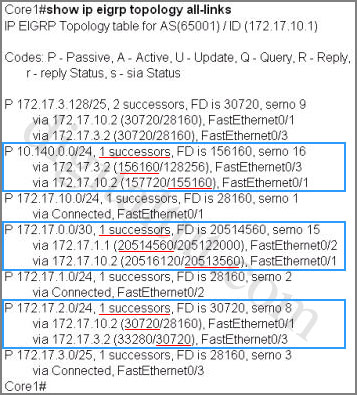
Because the question asks about feasible successor so we just need to focus on entries which have more paths than the number of successor. In this case, we find 3 entries that are in blue boxes because they have only 1 successor but has 2 paths, so the last path can be the feasible successor.

By comparing the value of AD (of that route) with the FD (of successor’s route) we figure out there are 2 entries will have the feasible successor: the first and the second entry. The third entry has AD = FD (30720) so we eliminate it.

Question 2

Which three EIGRP routes will be installed for the 172.17.3.128/25 and 172.17.2.0/24 networks? (Choose three)

A – 172.17.3.128.25 [90/28160] via 172.17.1 2, 01:26:35, FastEthernet0/2
B – 172.17.3.128/25 [90/30720] via 172.17.3.2, 01:26:35. FastEthemet0/3
C – 172.17.3.128/25 [90/30720] via 172.17.10.2, 01:26:35. FastEthernet0/1
D – 172.17.2.0/24 [90/30720] via 172.17.10.2, 02:10:11, FastEthernet0/1
E – 172.17.2.0/24 [90/28160] via 172.17.10.2, 02:10:11. FastEthernet0/1
F – 172.17.2.0/24 [90/33280] via 172.17.3.2, 02:10:11. FastEthernet0/3


Answer: B C D

Explanation

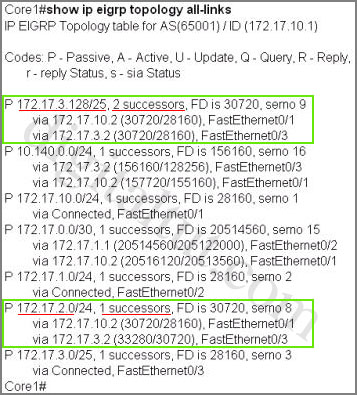
First indicate the positions of these networks:
simlet_show_ip_eigrp_topology_all_links_3

Network 172.17.3.128/25 has 2 successors, therefore the two paths below are both successors.

Network 172.17.2.0/24 has only 1 successor, therefore the path lies right under it is the successor.

Question 3

Which three networks is the router at 172.17.10.2 directly connected to? (Choose three)

A – 172.17.0.0/30
B – 172.17.1.0/24
C – 172.17.2.0/24
D – 172.17.3.0/25
E – 172.17.3.128/25
F – 172.17.10.0/24


Answer: C E F

Explanation
simlet_show_ip_eigrp_topology_all_links_4

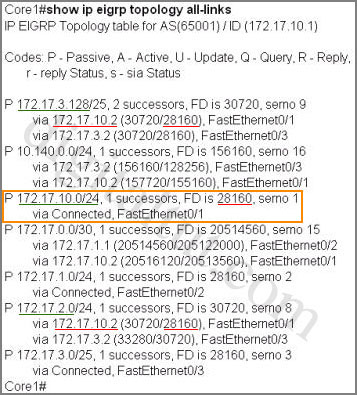
First, we should notice about the entry in the orange box, it shows that the network 172.17.10.0/24 is directly connected with this router and has a FD of 28160. So we can guess the networks that directly connected with router at 172.17.10.2 will be shown with an AD of 28160. From that, we find out 3 networks which are directly connected to the router at 172.17.10.2 (they are green underlined). The network 172.17.10.0/24 is surely directly connected to the router at 172.17.10.2 (in fact it is the network that links the router at 172.17.10.2 with Core1 router).


Other lab-sims on this site:

EIGRP Stub Sim

OSPF Sim

EIGRP OSPF Redistribution Sim

IPv6 OSPF Virtual Link Sim

Policy Based Routing Sim

Comments
  1. mongolio
    August 18th, 2010

    >>First, we should notice about the entry in the orange box, it shows that the network 172.17.10.0/24 is directly connected with this router and has a FD of 28160. So we can guess the networks that directly connected with router at 172.17.10.2 will be shown with an AD of 28160.
    o_O
    28160 is the local router FD for connected network, how can we assert that neigboring router have identical links to local? Maybe it has serial link with bandwidth 64 kb connected, then AD will be mutch worse then 28160.
    This answer seems to be more intuitive than reasonable…

  2. digitaltut
    August 18th, 2010

    Yes, it is the most reasonable answer. It is not always correct.

  3. HG
    August 26th, 2010

    thank you mongolio explain the answer angin .so I understand well

  4. firstcause
    September 7th, 2010

    Wait, three networks ACTUALLY show “via connected” – how is it not those three?
    172.17.10.0/24 via Fa0/1
    172.17.1.0/24 via Fa0/2
    172.17.3.0/25 via Fa0/3
    Three networks directly connected to three interfaces…what am I missing here?

  5. Muhammad
    September 9th, 2010

    @firstcause :

    agree with you

  6. David
    September 19th, 2010

    @Muhammad , @firstcause :

    It says which networks are connected to 172.17.10.2, if the router that this command was run on was 172.17.10.2 then we would not be seeing routes advertised as ‘via 172.17.10.2′ such as the one to 172.17.2.0

  7. Ben Hayak
    October 7th, 2010

    mongolio & firstcause

    you can see that 172.17.10.2 directly connects to This Router (Core1)
    through fa0/1 network 172.17.10.0/24 is obvious.

    172.17.1.0/24 via Fa0/2
    172.17.3.0/25 via Fa0/3
    both directly connect from core1 to other routers but we don’t know to which routers. agree?

    FD = would be the same on shared link routers(default metrics) unless you manually change only one side(router) with a different BW or Delay.

    so you are right that it’s not 100% correct but it’s more likely answer.

  8. Miljan
    October 12th, 2010

    I check the table for entries witch have a “via 172.17.10.2″ entry. if the entry isn’t first in the list (has higher AD) that means it’s not directly connected. it is highly unusual that the directly connected interface has higher AD than not directly connected.

  9. Guy
    October 19th, 2010

    Question 3 why not the answer B. 172.17.1.0/24 is not correct. pls explain

  10. Lara
    November 10th, 2010

    Good explanation Miljan!

  11. athai
    November 15th, 2010

    @ GUY,

    notice: via Fa0/2 # Fa0/1

  12. bonesaw
    December 2nd, 2010

    I didn’t get why F was an answer until I thought about the question “Which three networks is the router at 172.17.10.2 directly connected to?”

    So if the IP of the routers interface is 172.17.10.2 AND the subnet is 172.17.10.0/24 well the router MUST be directly connected.

  13. Bobby G
    December 23rd, 2010

    Question 3 asks which networks router at 172.17.10.2 is directly connected to. First, consider the output shown. The top line of the output says “IP EIGRP Topology table for AS(65001)/ID (172.17.10.1)” which indicates that we’re issuing the show command from a different router. Had the question asked which networks router 172.17.10.1 was directly connected to, the answer would be B, D, F but that’s not what is being asked. We’re asked to determine what links are connected directly to our ‘neighboring’ router 172.17.10.2. Therefor, I agree the correct answers are as listed (C,E,F).

  14. diaaa
    January 1st, 2011

    i think the answer will be A,E,F because it was mentioned that those three networks can be reached through 172.17.10.2

  15. Anonymous
    February 15th, 2011

    Question 1
    Even for the 1st entry 172.17.3.128/25 the FD(30720) > AD (28160) but still ignored, am I missing something here?

  16. dong
    February 17th, 2011

    Hi guys.
    Assuming all router have default k value.

    ***
    First, we can sure that : router 10.1 connected directly with router 10.2 via fastEthernet, metric = 28160. From formula of metric: 28160 = 256x(10.000.000/100.000 + delay) –>delay(between 10.1 and 10.2) = 10.

    ***
    Refer to “3.128 via 10.2 (30720/28160.)”,
    AD = 28160, (same at above). It could be a fastEthernet, delay =10, between 10.2 and 3.128.
    Lets check it with FD :FD = 256x(10.000.000/minimum BW + delay + delay ) = 256x(100+10+10) = 30720 !!! (Bravo!!!)

    ***
    172.17.2.0 is same as 172.17.3.128.

    I think my explain could make the answer more reasonable.

  17. san
    February 28th, 2011

    The neighbor’s advertised distance must be less than the feasible distance of the current successor so 172.17.3.2 is not right ans. In 2nd Q.

  18. sam
    March 13th, 2011

    currently any1 give the exam………

    wat type of question are asked in exam

  19. w1zard
    April 4th, 2011

    Question 3 asks:
    Which three networks is the router at 172.17.10.2 directly connected to?

    The question might as well have been:
    Which three networks is Core2 directly connected to?

    The question is not about Core1, but about the router with a router-id of 172.17.10.2 .
    The output we have here is for device Core1, so we have to deduce what networks are connected to the other router (the router with a router-id of 172.17.10.2).
    We do this by reasonably ( like dong pointed out ) assuming that when Core2 reports a RD of 28160 for a given network (networks 172.17.3.128/25 and 172.17.2.0/24 in this particular case), then these networks are directly connected to Core2.
    Now, a very bad network administrator could have easily changed the delay and bandwidth settings on interfaces connecting to networks, but that would change nothing in the answers of this question. The K values could not have been changed on just that one router, or anyway they would have to be changed everywhere, thus making no difference.

    The main reason that we know that Core2 is directly connected to those networks is because no-one, (no other router) has a feasible distance that is better than the reported distance that Core2 (the router with a router-id of 172.17.10.2) reports for those networks. Since Core2 has the lowest metric (feasible Distance) to get to those networks, then this must mean that all other routers (including the routers with router-IDs of 172.17.10.1, 172.17.3.2) use the path through Core2.

    @digitaltut

    Please fix the following:

    “So we can guess the networks that directly connected with router at 172.17.10.2 will be shown with an AD of 28160.”
    to:
    “So we can guess the networks that directly connected with router at 172.17.10.2 will be shown with a Feasible Distance (EIGRP metric) of 28160. The Administrative Distance of such connected networks will be the default of 0.”

  20. Leo from China
    April 28th, 2011

    i failed my TSHOOT exam. this OSPF questions all of them wrong and old. no questions from this one. pls change and update that questions!!!! 9tut!!!

  21. CJS
    April 30th, 2011

    HI

    Q2:
    Did I get it right that question 2 means “Which three EIGRP routes will be installed for the 172.17.3.128/25 and 172.17.2.0/24 networks INTO THE EIGRP TOPOLOGY TABLE? ” ???

    I 1rst thought it means “Which three EIGRP routes will be installed for the 172.17.3.128/25 and 172.17.2.0/24 networks INTO THE ROUTING TABLE?” !!

    If yes, the answer is clear. If no, I’ve a problem :-)

    Cheers and congrats to that great page!!
    CJS

  22. w1zard
    May 1st, 2011

    This is a simlet question. This means that the the output of the show ip eigrp topology all-links command that appears at the beginning of the page is valid and used as reference for answering all the next questions. The output of the show ip eigrp topology all-links command gives you the networks, their next hop, the next hop’s Reported Distance, and the Feasible Distance to reach that network as learned by the EIGRP process. Question number two (Q2) apparently asks which routes will be installed into the ROUTING table. This we can tell by listening to four hints:
    1. The EIGRP topology table is already given to us at the beginning of the Simlet question.
    2. The format of the possible answers is the format of routes in the ROUTING table.
    3. The EIGRP topology table is built using discovered networks, and all networks learned via EIGRP are present in the EIGRP topology table. (there are no criteria regarding Distances etc.)
    4. The EIGRP topology table (and EIGRP as a protocol for that matter) has no concept of Administrative distances, which are present in the possible answers that we are presented with.

  23. pokey
    May 5th, 2011

    hi, pls can any one send me the link to download the lab sims for 642 902{routing} so that i can practice them or send it to my email …tunde4real055@yahoo.com

  24. Mike
    May 8th, 2011

    @W1zard
    Very good! I might add a comment about using the FD (28160) of the neighboring router. To make a determination as to whether a route is directly connected or not. From the perspective of the neighboring router (172.17.10.2) a directly connected network will have an FD of 0 so the total distance to the Core1 router will be 0+28160. So, any network with a path that has an AD equal to the FD of 172.17.10.2 is directly connected to it. That applies in all equal cases. Further, looking at the topology table again. If there is 1 successor and 2 paths then the first path is the successor path and the other is not a Feasible Successor. If there are 2 successors and 2 or more paths the two paths will be first the Successor, then the Feasible Successor and both will be put in the routing table.
    If there are more paths, for example, 2 successors and 4 paths, the first will be the successor (always), the second will be the Feasible Successor(always if there is one), then followed by non-feasible successor paths in that order.

  25. CJS
    May 11th, 2011

    @w1zard:

    Thanks for that great answer. Of course u r absolutely right!
    To tell the truth I do not know why this was not clear to me that day!?!?! Right now I don’t understand why I aksed that silly question!

    thx again and best regard

  26. DaEngineer
    May 24th, 2011

    Does anyone know where I can get premade topology for GNS3 for labs for this exam ? I figure someone must have created and uploaded these, can’t find them on didgitaltut

  27. YESUAH
    May 28th, 2011

    preparing 2 right 642-902 any help mail to yesuah1@gmail.com thks

  28. Azim
    June 5th, 2011

    Can anyone give me the answer of P4S v4.11 question number 14 of EIGRP, from my understanding it could be 5 but answer shows 3,

    confused

  29. JHUN
    June 9th, 2011

    DO U HAVE THE LATEST CCNP PASS4 SURE? CAN I HAVE IT? NEED TO TAKE THE EXAM IN A WEEK

  30. Anonymous
    June 16th, 2011

    @9tut

    Question 1 is totally wrong…

    the correct answers are C and E

    the FD metric parameter for the network line of the routes is all you need to go by to answer this question… of all the routes 2 of them have a FD of 30720 (which is the lowest).

    on 172.17.3.128 both routes meet the feasibility parameter so it has 2 successors.

    on 172.17.2.0 the route with the lowest FD 172.17.10.2 also meets the feasibility criteria as its AD is lower then 30720.

    i had to really study wendell odoms icnd 2 book to understand this and i think i finally get it. this is a tough concept but the thing to remember is the FD metric for the network line is what you look at first. this question is worded so that all you need is the FD metric on the very first line to answer it.

  31. Anonymous
    June 16th, 2011

    each network has 1 successor with the first network having 2. a successor simply means that a route has a AD lower then the FD of the network. this does not qualify it as a feasible successor.

    feasible successors are determined firstly by which network has the lowest FD. in this example there are 2 networks that match for lowest (30720). of those networks there are three routes that meet the feasible successor criteria.

  32. Anonymous
    June 16th, 2011

    i am going to re-read wendell odom to make sure i am right but if i am then that totally changes the answer for Q3 too.

    i dont understand that question… how do you know it is directly connected to those networks… if it is via anything then it isnt directly connected right?

    wouldnt the three directly connected networks be the ones without routes?? B, D, F

  33. Anonymous
    June 16th, 2011

    I think i got it… the feasible successors are only used if the connected routes go down. if you look at it this way it all makes sense.

    the directly connected routes are the ones with the lowest metric (28160) and no routes.

    the feasible successors are the routes that have an AD lower then the next lowest metric which is 30720

  34. Anonymous
    June 16th, 2011

    geez this is complicated… i think i am wrong on Q3.. i get that one now. i am still not sure about Q1 though. that one doesnt seem to jive with what i have seen. i will study more tonight the ICND 2 book to make sure

  35. blah, blah and more blah
    June 17th, 2011

    @9tut

    Ok i know what the problem is now. U are right here on this page. All the questions here are correct it’s the question 4 on the other page (EIGRP questions) that is screwed up. That question is totally messed up and has been screwing me up bad. There are no feasible successor routes in the output for that question.

    There are two rules for this from what i have seen. According to Wendell Odom.

    1 The feasible successor must not be a successor route. (ref 386 ICND 2)

    2 The Reported Distance (or AD as you have been calling it) must be less then the feasible distance. Period. (ref. 395 ICND 2)

    It doesn’t say less then or equal too… it must be less or it’s not a feasible successor. If a route fails and there is no feasible successor then EIGRP uses DUAL to query for a loop free route to replace the failed route. All the Feasible Successors on Question 4 from the other page have RD’s that are equal to the FD of the successor. That question has typos or something… i would not expect to see that on a Cisco exam.

    Something else that was very confusing for me was highlighting the FD of the successor route without explaining how it relates to the FD of the network. They are one in the same. The FD of the successor route is what generates the FD for the Network.

  36. shah
    July 2nd, 2011

    Hello guys..

    does anyone have ccnp route 642-902 cbt, pass4sure or any dumps. kindly send me links on shariq2009@live.com or u can send here as well.

    Thanksss

  37. Newbie4@Digitaltut
    July 3rd, 2011

    Hi, in Q1. why the answer E is not correct . E also has its AD lower than its FD so it should be a feasible successor also right ?

  38. shah
    July 3rd, 2011

    Hello guys..

    does anyone has ccnp route 642-902 cbt, pass4sure any dumps or GNS3 LAB?.
    kindly send me links on
    shariq2009@live.com or u can send here as well.

    GNS3 LAB is very important.. kindly send me links.

    Thanksss

  39. digitaltut
    July 23rd, 2011

    @Newbie4: Sorry for my late response, E is not correct because the network 172.17.3.128/25 has 2 successors and it doesn’t have any feasible successor.

  40. Panama foundation
    August 1st, 2011

    .DUAL evaluates the data received from other routers in the topology table and calculates the primary successor and secondary feasible successor routes. Both successors and feasible successors are maintained in the topology table but only the successors are added to the routing table and used to route packets..For a route to become a feasible successor its RD must be smaller than the FD of the successor.

  41. @ Ashish
    August 9th, 2011

    I have confusion in question no. 2, why option D is write and E can also be the right answer, please correct me if i am wrong?

  42. mettl
    August 10th, 2011

    @ Ashish

    D – 172.17.2.0/24 [90/30720] via 172.17.10.2, 02:10:11, FastEthernet0/1
    E – 172.17.2.0/24 [90/28160] via 172.17.10.2, 02:10:11. FastEthernet0/1

    The correct metric is 30720.
    28160 is the AD, it appears in the topology table, never in the routing table

    So, answer E in wrong

  43. anon
    August 19th, 2011

    anybody know if this is current?

  44. Madjheed
    September 3rd, 2011

    Pls, add more questions 4 good practice…..

  45. Paulie
    September 7th, 2011

    Can someone please send me GNS3 labs please send to paulina.tsengiwe@gmail.com

  46. Sugel
    September 16th, 2011

    It chooses the path through One as its best path the successor and the path through Three as a loop-free path a feasible successor . When the path through Router One becomes unavailable Router Two examines its topology table and finding a feasible successor begins using the path through Three immediately..From this brief explanation it is apparent that EIGRP must provide . A feasible successor is a path whose reported distance is less than the feasible distance current best path .

  47. Bruno
    September 26th, 2011

    Do we really need so many areas?????!!!!! 4294967295?????

  48. Asterisk
    October 1st, 2011

    Please find below links to a GNS3 LAB I’ve made to simulate the EIGRP Simlet.
    This can help to a better understanding of the Simlet.

    http://www.4shared.com/photo/alEsWfkq/EIGRP_Simlet.html
    http://www.4shared.com/document/koUhXzxq/R_Fa01.html
    http://www.4shared.com/document/T9Ab90vd/R_Fa02.html
    http://www.4shared.com/document/x81TT_qV/R_Fa03.html
    http://www.4shared.com/document/jwBYdfYe/Core1.html

    Real outputs from the LAB:
    * Please note the Interface References:
    Fa0/1 = Fa0/0
    Fa0/2 = Fa1/0
    Fa0/3 = Fa2/0

    Core1#show ip eigrp topology all-links
    IP-EIGRP Topology Table for AS(65001)/ID(172.17.10.1)
    Codes: P – Passive, A – Active, U – Update, Q – Query, R – Reply,
    r – reply Status, s – sia Status

    P 172.17.3.128/25, 2 successors, FD is 30720, serno 8
    via 172.17.3.2 (30720/28160), FastEthernet2/0
    via 172.17.10.2 (30720/28160), FastEthernet0/0
    P 10.140.0.0/24, 1 successors, FD is 156160, serno 6
    via 172.17.3.2 (156160/128256), FastEthernet2/0
    via 172.17.10.2 (158720/156160), FastEthernet0/0
    P 172.17.10.0/24, 1 successors, FD is 28160, serno 1
    via Connected, FastEthernet0/0
    P 172.17.1.0/24, 1 successors, FD is 28160, serno 2
    via Connected, FastEthernet1/0
    P 172.17.0.0/30, 1 successors, FD is 20514560, serno 7
    via 172.17.1.1 (20514560/20512000), FastEthernet1/0
    via 172.17.10.2 (20516096/20513536), FastEthernet0/0
    P 172.17.3.0/25, 1 successors, FD is 28160, serno 3
    via Connected, FastEthernet2/0
    P 172.17.2.0/24, 1 successors, FD is 30720, serno 17
    via 172.17.10.2 (30720/28160), FastEthernet0/0
    via 172.17.3.2 (33280/30720), FastEthernet2/0

    Core1#show ip eigrp topology
    IP-EIGRP Topology Table for AS(65001)/ID(172.17.10.1)
    Codes: P – Passive, A – Active, U – Update, Q – Query, R – Reply,
    r – reply Status, s – sia Status

    P 172.17.3.128/25, 2 successors, FD is 30720
    via 172.17.3.2 (30720/28160), FastEthernet2/0
    via 172.17.10.2 (30720/28160), FastEthernet0/0
    P 10.140.0.0/24, 1 successors, FD is 156160
    via 172.17.3.2 (156160/128256), FastEthernet2/0
    P 172.17.10.0/24, 1 successors, FD is 28160
    via Connected, FastEthernet0/0
    P 172.17.1.0/24, 1 successors, FD is 28160
    via Connected, FastEthernet1/0
    P 172.17.0.0/30, 1 successors, FD is 20514560
    via 172.17.1.1 (20514560/20512000), FastEthernet1/0
    via 172.17.10.2 (20516096/20513536), FastEthernet0/0
    P 172.17.3.0/25, 1 successors, FD is 28160
    via Connected, FastEthernet2/0
    P 172.17.2.0/24, 1 successors, FD is 30720
    via 172.17.10.2 (30720/28160), FastEthernet0/0

    Core1#sh ip eigrp neighbors
    IP-EIGRP neighbors for process 65001
    H Address Interface Hold Uptime SRTT RTO Q Seq
    (sec) (ms) Cnt Num
    2 172.17.10.2 Fa0/0 10 00:43:05 74 666 0 37
    1 172.17.1.1 Fa1/0 14 00:43:06 273 1638 0 20
    0 172.17.3.2 Fa2/0 11 00:43:06 335 2010 0 19

  49. Asterisk
    October 1st, 2011

    Here is the IP Routing Table:

    Core1#show ip route
    Codes: C – connected, S – static, R – RIP, M – mobile, B – BGP
    D – EIGRP, EX – EIGRP external, O – OSPF, IA – OSPF inter area
    N1 – OSPF NSSA external type 1, N2 – OSPF NSSA external type 2
    E1 – OSPF external type 1, E2 – OSPF external type 2
    i – IS-IS, su – IS-IS summary, L1 – IS-IS level-1, L2 – IS-IS level-2
    ia – IS-IS inter area, * – candidate default, U – per-user static route
    o – ODR, P – periodic downloaded static route

    Gateway of last resort is not set

    172.17.0.0/16 is variably subnetted, 6 subnets, 3 masks
    D 172.17.3.128/25 [90/30720] via 172.17.10.2, 00:52:10, FastEthernet0/0
    [90/30720] via 172.17.3.2, 00:52:10, FastEthernet2/0
    C 172.17.10.0/24 is directly connected, FastEthernet0/0
    C 172.17.1.0/24 is directly connected, FastEthernet1/0
    D 172.17.0.0/30 [90/20514560] via 172.17.1.1, 00:52:10, FastEthernet1/0
    C 172.17.3.0/25 is directly connected, FastEthernet2/0
    D 172.17.2.0/24 [90/30720] via 172.17.10.2, 00:44:17, FastEthernet0/0
    10.0.0.0/24 is subnetted, 1 subnets
    D 10.140.0.0 [90/156160] via 172.17.3.2, 00:52:09, FastEthernet2/0

  50. Blackhat
    October 14th, 2011

    I understand the answers in question 3. However, in a real world environment, doesn’t the topology table show only successors and feasable successors? So if there are more than one route to a location in the topology table they are either all successors or one is a successor and the others are feasible successors

  51. prce
    October 16th, 2011

    The issued command on Core1 is

    sh ip eigrp topology all-links

    With the “all-links” keyword the command lists all known paths to a given subnet, not only the successors and feasible successors.

  52. Nitin Mohan
    December 6th, 2011

    Q3:
    if they are connected to the same router their FD should match, therefore the correct answer to Q3 is D,B,F i.e they have same FD 28160

  53. Da
    December 9th, 2011

    Actually their Advertised Distances should match. The Advertised Distance is the distance between the next router to the network. The Feasible Distance is the distance between me and the guy with the AD, and from him to the network. So it’s the entire distance whereas the AD is just from the next guy to the network. So where ever 172.17.10.2 is in the table, if his AD is 28160, that’s the network he is directly connected to. It is very confusing at first, but after looking at it for a while, it starts to make sense.

  54. Asif205
    December 18th, 2011

    can some one share .VCI software.

    tanh123@live.com

  55. Asif205
    December 18th, 2011

    can some one share .VCI software.

    tanh123@hotmail.com

  56. Anonymous
    December 19th, 2011

    Don not understand. In P4S answers given are: B D F
    172.17.10.0/24 via Fa0/1
    172.17.1.0/24 via Fa0/2
    172.17.3.0/25 via Fa0/3

    What is the right answers for the exam ???

  57. Mostafa Hijazi
    December 20th, 2011

    Hello. I understand the concept about choosing Feasible successors. But in Question 1, why the route to 172.17.3.128/25 via 172.17.3.2 is not considered a Feasible successor ? The AD is less than the FD of the successor. it is because the question asked about which 2 networks has only 1 sucessor ?

    Thanks and regards,
    Mostafa Hijazi

  58. Swati
    December 23rd, 2011

    @Anonymous
    Q1
    Because the question asks about feasible successor so we just need to focus on entries which have more paths than the number of successor. In this case, we find 3 entries that are in blue boxes because they have only 1 successor but has 2 paths, so the last path can be the feasible successor.

    By comparing the value of AD (of that route) with the FD (of successor’s route) we figure out there are 2 entries will have the feasible successor: the first and the second entry. The third entry has AD = FD (30720) so we eliminate it.

  59. VED
    December 29th, 2011

    Hi All

    I passed the exam today !!! Many of You know Me Last time When I passed The CCNA exam I remember All the Question and i send to you all also and its very helpfull to U all !!! Dont Worry Friends this time Also I remember All the Question !!! In exam I got 50 question

    Out of that three are Similator
    2 drag and drop

    Friends Any one Want the Question Please Update the Mail Id Or Send the Mail to the mail id : dononearth0@gmail.com ( as u know )

    Better U send the Mail So that I can Quick reply to You All

    Help other God will help You !!!

    Ur Friend Ved Prakash INDIA

  60. B.
    January 2nd, 2012

    Hi Ved Congrats!!! I emailed you, yes pl kindly share your doc with me! :)
    Thanks and congrats again

  61. Ahmed
    January 7th, 2012

    Ved is a spammer;beware

  62. anonymous
    January 14th, 2012

    This was NOT on my test

  63. Sir CCNP
    January 18th, 2012

    Hello Friends,

    I just started to study the ROUTE test after taking almost two years off from passing the CCNA. I am planning to take the ROUTE test in two months. Are the Sims, Drag and Drop, Questions, and everything else on this site still valid for the ROUTE test?

    Thank you all!

  1. No trackbacks yet.
Add a Comment